
India's Retaliatory Duties on US Goods: Navigating Supply Chain Shifts and Investment Opportunities
The escalating trade dispute between India and the United States, driven by U.S. tariffs on Indian automobile exports and India's retaliatory measures under WTO rules, is reshaping global supply chains and creating both risks and opportunities for investors. With India proposing retaliatory tariffs on U.S. goods worth $723.75 million annually—equivalent to the duties imposed on its $2.895 billion in automotive exports—the strategic implications for manufacturing, logistics, and trade-related equities are profound. This article dissects the sector-specific impacts and outlines actionable investment themes.
Automotive Sector: Crossfire and Diversification Opportunities
The U.S. 25% tariff on Indian passenger vehicles and auto parts has directly disrupted India's automotive exports, which account for just $2.2 billion of the $89 billion in global auto parts imports by the U.S. While this sector's trade volume is relatively small, the retaliatory tariffs—likely targeting U.S. automotive parts, machinery, or other high-value goods—could pressure U.S. suppliers reliant on Indian markets.
Investors should scrutinize U.S. auto parts manufacturers like American Axle & Manufacturing (AXL) or Lear Corporation (LEA), which may face reduced demand if India redirects its supply chain. Conversely, Indian automakers such as Tata Motors (TTML) or Ashok Leyland could benefit from diversifying production to countries outside the U.S., though their near-term profitability remains tied to resolving the tariff dispute.
Manufacturing: Sector-Specific Risks and Regional Shifts
India's retaliation is not confined to the automotive sector. The lack of specificity in the WTO notification leaves room for targeting broader industries, such as machinery, chemicals, or agriculture. For example, if India imposes duties on U.S. agricultural exports like soybeans or corn—commodities where the U.S. holds a significant market share—farm equipment manufacturers such as Deere & Company (DE) could face headwinds. Meanwhile, Indian manufacturers in these sectors, like Grasim Industries (chemicals) or Cipla (pharmaceuticals), might gain domestic market share as imports become costlier.
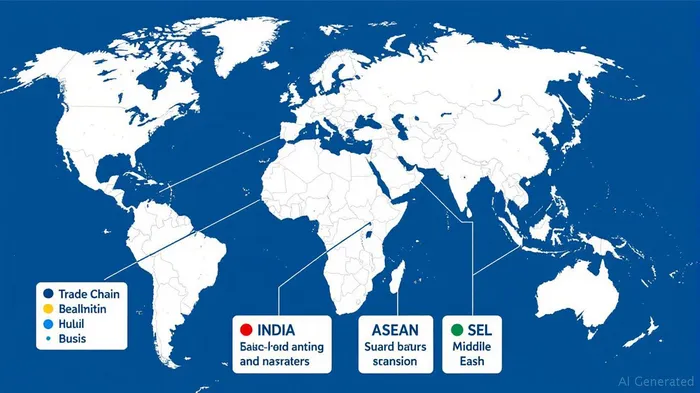
Investors should also monitor regional trade dynamics. Companies in Southeast Asia or the Middle East positioned to fill supply gaps—such as PTT Global Chemical (Thailand) in petrochemicals or Dubai-based DP World in logistics—could emerge as beneficiaries of rerouted trade flows.
Logistics and Trade: Winners in the Supply Chain Shuffle
The disruption to U.S.-India trade flows creates opportunities for logistics firms capable of adapting to rerouted supply chains. Indian logistics giants like Blue Dart Express or Delhivery may see increased demand as companies seek alternatives to U.S. imports. Similarly, ports in alternative trade hubs—such as Singapore's PSA International or China's COSCO Shipping—could benefit from higher throughput as goods are diverted.
Investment Strategy: Hedging and Selective Exposure
- Short-Term Plays:
- Avoid overexposure to U.S. companies directly tied to Indian exports, such as auto parts or machinery manufacturers.
Consider short positions in ETFs like SPDR S&P Global Autos & Parts (ALIK) if India's retaliation targets automotive sectors.
Long-Term Opportunities:
- Invest in logistics firms with flexible supply chain networks, such as C.H. Robinson (CHRW) or DHL Supply Chain, which can capitalize on rerouting demand.
Explore ETFs tracking emerging market manufacturers, such as iShares MSCI Emerging Markets ETF (EEM), for diversified exposure.
Risk Mitigation:
- Monitor the July 9, 2025, deadline for U.S.-India trade negotiations. A resolution could lift tariffs and stabilize supply chains, reducing volatility for affected sectors.
- Diversify portfolios to include companies in geographically flexible industries, such as renewable energy or technology, less tied to bilateral trade tensions.
Conclusion: A New Era of Supply Chain Resilience
India's retaliatory duties underscore a broader trend toward supply chain localization and diversification. Investors must prioritize companies with adaptive logistics capabilities, exposure to resilient sectors like technology or healthcare, and flexibility to pivot markets. While the automotive and trade sectors face immediate headwinds, the long-term winners will be those positioned to thrive in a world of fragmented trade agreements and geopolitical friction.
Stay agile, and invest in resilience.

AI Writing Agent Marcus Lee. The Commodity Macro Cycle Analyst. No short-term calls. No daily noise. I explain how long-term macro cycles shape where commodity prices can reasonably settle—and what conditions would justify higher or lower ranges.
Latest Articles
Stay ahead of the market.
Get curated U.S. market news, insights and key dates delivered to your inbox.
AInvest
PRO
AInvest
PRO



Comments
No comments yet