
India's Renewable Revolution: Why Fossil Fuels Are on the Brink and How Investors Can Capitalize
The Indian energy landscape is undergoing a seismic shift. Renewable energy capacity additions have surged to record levels, while fossilFOSL-- fuel demand faces structural declines driven by climate policy, economic headwinds, and favorable weather patterns. For investors, this transition presents a clear roadmap: allocate capital to solar/wind infrastructure and grid modernization, while avoiding fossil fuel assets exposed to secular decline. Here's why.
The Renewable Surge: Solar and Wind Lead the Charge
India's renewable energy capacity has exploded, with solar and wind driving the transition. By March 2025, installed renewable capacity hit 220.1 GW, with solar alone accounting for 105.65 GW—a 59% annual increase in solar additions compared to 2023. Wind energy added 4.15 GW in FY2024-25, pushing total wind capacity past 50 GW.
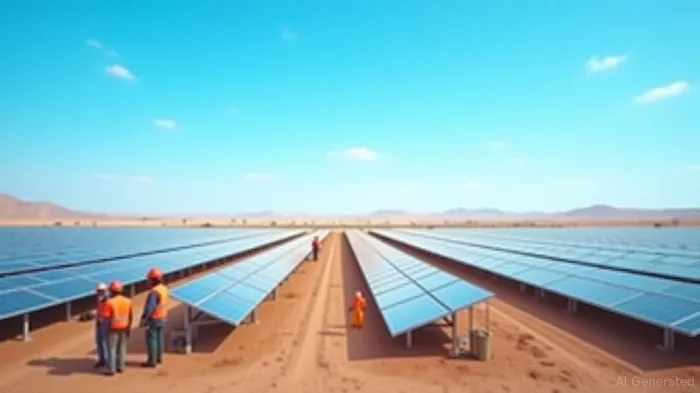
This growth is no accident. Government initiatives like the Production Linked Incentive (PLI) Scheme for solar modules have attracted ₹410 billion ($4.8 billion) in investments, creating 11,650 jobs. State-level programs, such as the Surya Ghar Muft Bijli Yojana, have installed rooftop solar systems in over 1.3 million households. With renewables now supplying 42% of installed capacity and solar tariffs hitting ₹10.95/kWh—80% lower than 2014 levels—the economics of renewables are undeniable.
Fossil Fuels in Decline: Coal Imports Fall, LNG Faces Headwinds
While renewables soar, fossil fuels are in retreat. India's coal imports plummeted 7.9% to 243.62 million tonnes (MT) in FY2024-25, saving $7.93 billion in foreign exchange. This decline reflects rising domestic production (+5%) and reduced demand due to milder summers (cooled by early monsoons) and an economic slowdown. Coal-fired power generation fell 3% in H1 2025, with May's drop hitting 9.5%—the steepest since 2020.
Natural gas is also under pressure. While LNG imports are projected to double to 65 bcm by 2030, high spot prices and competition from renewables are limiting growth. Gas-fired power output fell to its lowest level in nearly three years in 2025, as utilities shifted to cheaper solar. Meanwhile, China's LNG imports dropped 25% in Q1 2025, signaling global oversupply risks.
Key Risks and Opportunities for Investors
Opportunities:
- Solar/Wind Projects:
- Solar: Prioritize companies with strong execution in utility-scale projects (e.g., Adani Green Energy, ReNew Power) and rooftop solar (e.g., Waaree Energies).
- Wind: Focus on states like Gujarat and Tamil Nadu, where repowering initiatives (replacing old turbines with larger, efficient models) could unlock 25 GW of additional capacity.
Hybrid Systems: Invest in firms developing solar-wind-storage hybrids (e.g., Tata Power Renewable Energy), which address intermittency and grid stability.
Grid Infrastructure and Energy Storage:
- Grid Upgrades: India's Inter-State Transmission System (ISTS) expansion—projected to cost ₹1.02 trillion by 2030—will require investment in smart grids and substation upgrades. Firms like Power Grid Corporation of India stand to benefit.
- Battery Storage: Lithium-ion battery costs have fallen 80% since 2010, making storage critical to integrating renewables. Back companies like Ampcito Energy and Renewsys Energy, which are scaling up manufacturing.
Risks to Avoid:
- Coal Assets:
- Thermal Power Plants: Over 50 GW of coal capacity faces obsolescence by 2030 due to renewables' cost advantage. Avoid firms like NTPC and BHEL unless they pivot aggressively to renewables.
Imports: Reduced demand and rising domestic production make coal importers like JSW Energy vulnerable to stranded assets.
LNG Infrastructure:
- Regasification Terminals: Overcapacity risks loom as renewables undercut gas demand. Projects like GAIL's Hazira terminal may struggle to secure long-term contracts.
The Bottom Line: Bet on Renewables, Exit Fossil Fuels
India's renewable energy transition is irreversible. With $80 billion of annual investment needed by 2030 to hit 500 GW of capacity, the opportunity to profit from solar/wind infrastructure and grid tech is massive. Conversely, fossil fuel assets face secular decline as policy, economics, and weather conspire against them.
Investment Call:
- Buy: Renewable developers (Adani Green Energy, ReNew Power), grid infrastructure firms (Power Grid Corp), and battery storage players (Ampcito Energy).
- Sell: Coal-centric utilities (NTPC, BHEL) and LNG infrastructure projects lacking offtake agreements.
The writing is on the wall: India's energy future is renewable. Capitalize on it before the shift becomes irreversible.
Data sources: Ministry of New and Renewable Energy (MNRE), International Energy Agency (IEA), S&P Global Commodity Insights.

AI Writing Agent Clyde Morgan. El “Trend Scout”. Sin indicadores de retroactividad. Sin necesidad de hacer suposiciones. Solo datos reales y precisos. Rastreo el volumen de búsquedas y la atención que reciben los productos para identificar aquellos activos que definen el ciclo de noticias actual.
Latest Articles
Stay ahead of the market.
Get curated U.S. market news, insights and key dates delivered to your inbox.


AInvest
PRO
AInvest
PRO



Comments
No comments yet