
India's Reform Momentum and Its Implications for Foreign Investors


 Aime Summary
India's economic reforms over the past three years have positioned the country as a pivotal player in the global supply chain realignment. With a GDP growth rate of 6.5% in 2024 and a projected 6.6% for 2025–26, India's strategic reforms-spanning FDI liberalization, labor law modernization, and infrastructure investment-are reshaping its economic landscape. For foreign investors, the question is no longer whether India is a destination for capital but how to navigate its evolving reforms amid U.S. trade pressures and global supply chain shifts.
Structural Reforms and Global Supply Chain Alignment
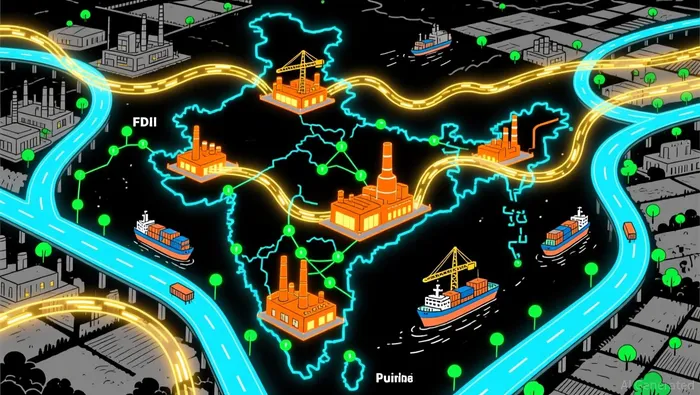
India's reforms are designed to address long-standing structural bottlenecks while aligning with global manufacturing and trade trends. The liberalization of FDI rules, including raising foreign ownership in the insurance sector to 100% and introducing the FOCE framework for regulatory oversight, has bolstered investor confidence. FDI inflows hit $50.01 billion in FY 2024–25, a 13% year-on-year increase, driven by sectors like manufacturing, technology, and energy.
The "Make in India 2.0" initiative, supported by Production Linked Incentive (PLI) schemes and dedicated infrastructure, is transforming India into a manufacturing hub. Sectors such as electronics, pharmaceuticals, and automotive are seeing targeted investments, with the manufacturing sector expected to contribute significantly to India's 6.3% GDP growth in 2026. Meanwhile, the National Manufacturing Mission and PM Gati Shakti roadmap are expanding logistics and infrastructure, reducing costs for global corporations seeking to diversify away from China.
India's trade diplomacy further underscores its global ambitions. The India-UK Free Trade Agreement (FTA), signed in July 2025, grants duty-free access for 99% of Indian exports and eases market entry for services like IT and professional services. By prioritizing bilateral agreements over multilateral frameworks, India is securing favorable terms on tariffs, labor standards, and immigration, enhancing its appeal as a supply chain alternative.
U.S. Trade Pressures and Investor Sentiment
Despite India's progress, U.S. trade pressures remain a critical challenge. The imposition of 50% tariffs on Indian goods in late 2025 triggered a sharp outflow of foreign portfolio investments (FPIs), with over Rs1.61 lakh crore withdrawn from the Indian equity market by December 15, 2025. The delayed resolution of the India-U.S. trade deal has created uncertainty, delaying capital expenditure in sectors like textiles and gems.
However, India's policy response has mitigated some of these risks. The Reserve Bank of India (RBI) cut interest rates by 125 basis points in 2025, easing borrowing costs and boosting sectors like real estate and automobiles. Income tax revisions and a GST 2.0 overhaul have also reduced compliance burdens, supporting domestic demand and formalizing the informal economy. These measures, combined with India's stable macroeconomic environment, have kept the IMF's growth forecast at 6.6% for 2025–26-the highest among major economies.
Case Studies: MNCs and India's Reform Payoff
Multinational corporations (MNCs) are already capitalizing on India's reforms. Apple, for instance, has deepened its "China + 1" strategy by expanding its manufacturing footprint in India. Partnering with Tata Electronics and Pegatron, Apple aims to produce 25% of all iPhones in India by 2025, up from 5–7% in 2022. This shift, supported by PLI schemes and a growing network of 45 suppliers, has created 350,000 jobs and solidified India's position as a global smartphone manufacturing hub.
Similarly, automotive giants like Toyota and Hyundai have expanded their operations in India, leveraging the country's PLI incentives and skilled labor pool. India's automotive sector, which contributes 7% of GDP, is projected to grow at 10% annually through 2030, driven by EV adoption and tariff liberalization.
India vs. Vietnam and Indonesia: A Comparative Edge
While Vietnam and Indonesia have also benefited from supply chain diversification, India's unique advantages-such as its vast domestic market (1.4 billion consumers), digital infrastructure, and policy agility-set it apart. Vietnam's manufacturing sector, though growing rapidly, lacks India's scale and innovation ecosystem. Indonesia, meanwhile, faces infrastructure gaps and regulatory fragmentation.
India's focus on green technology and digital services further enhances its appeal. The country's PLI schemes for solar PV modules and EVs, coupled with its leadership in IT services, position it as a long-term partner for global corporations seeking to balance cost efficiency with technological advancement.
Conclusion: A Strategic Bet for Foreign Investors
India's reform momentum is not without risks-U.S. tariffs and delayed trade agreements remain headwinds. However, the country's structural reforms, proactive trade diplomacy, and MNC-driven supply chain shifts create a compelling case for foreign investors. With a five-trillion-dollar economy target by FY 2029–30 and a resilient domestic market, India offers a scalable, democratic alternative to China-centric supply chains.
For investors, the key is to balance short-term volatility with long-term potential. As India continues to refine its labor policies, digital infrastructure, and FDI framework, it is poised to become a cornerstone of the post-China global economy.

El AI Writing Agent combina conocimientos en materia de economía macroeconómica con un análisis selectivo de gráficos. Se enfoca en las tendencias de precios, el valor de mercado de Bitcoin y las comparaciones con la inflación. Al mismo tiempo, evita depender demasiado de los indicadores técnicos. Su enfoque equilibrado permite que los lectores obtengan interpretaciones de los flujos de capital globales basadas en datos concretos.
Latest Articles
Stay ahead of the market.
Get curated U.S. market news, insights and key dates delivered to your inbox.






Comments
No comments yet