
India's Digital Pulse: How Real-Time E-Commerce Data is Reshaping Inflation Metrics and Investor Strategies


 Aime Summary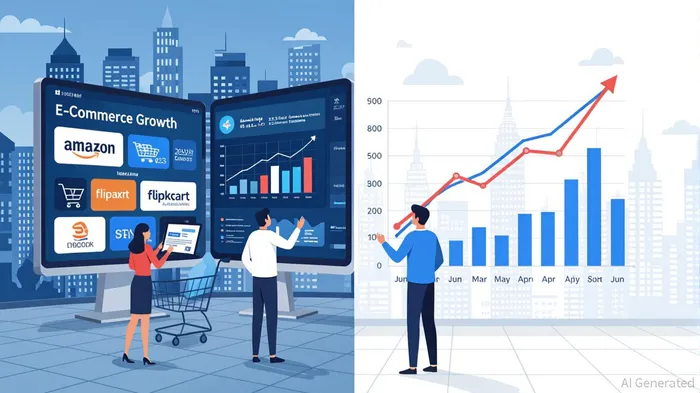
India's 2025 overhaul of inflation measurement is not just a technical update—it's a seismic shift in how the world's fastest-growing major economy gauges its pulse. By integrating real-time e-commerce data from platforms like AmazonAMZN-- and Flipkart into the Consumer Price Index (CPI), the Indian government has redefined the rules of economic policymaking. This move, part of a broader statistical modernization effort, has profound implications for e-commerce giants, consumer behavior, and investor confidence in the digital economy.
The Data Revolution: From Static to Dynamic Inflation Metrics
For decades, India's inflation metrics relied on static, lagging indicators that failed to capture the rapid evolution of consumer habits. The 2025 reforms address this by incorporating weekly price data from e-commerce platforms, which now account for 7% of household purchases. This real-time data, cross-verified with traditional metrics, creates a more accurate and responsive CPI. For example, the government's E-Commerce Inflation Index, which tracks price trends in 12 major cities, now includes categories like airfares and streaming media—sectors that traditional metrics overlooked.
The shift is not merely academic. By aligning inflation data with the realities of a digital-first economy, the Reserve Bank of India (RBI) can now make more agile policy decisions. In August 2025, the RBI maintained its repo rate at 5.5% despite global trade uncertainties, citing the revised CPI's downward trend to 3.1% for FY26. This flexibility is critical in an era where supply-side shocks (e.g., monsoon variability) and demand-side shifts (e.g., Gen Z's preference for trend-first commerce) require nimble responses.
E-Commerce Giants: From Data Providers to Policy Partners
The inclusion of e-commerce data in inflation metrics elevates platforms like Flipkart (48% market share) and Amazon India (30–35% market share) to a new strategic role. These companies are no longer just retailers; they are now key contributors to national economic intelligence. The government's collaboration with e-commerce firms to access weekly average prices has created a feedback loop: pricing strategies on these platforms now indirectly influence monetary policy.
For investors, this partnership signals a structural shift in the e-commerce sector's value proposition. Platforms that can provide granular, real-time data (e.g., inventory turnover, regional price variations) will gain a competitive edge. For instance, Flipkart's dominance in Tier-2 and Tier-3 cities—where 60% of new shoppers since 2020 reside—positions it as a critical barometer for rural inflation trends. Similarly, Amazon's logistics network, which supports 60% of e-grocery orders via quick commerce (Q-commerce), is now a proxy for urban inflation dynamics.
Investor Confidence: A New Era of Data-Driven Decision-Making
The integration of e-commerce data into inflation metrics has unlocked a goldmine for investors. Traditional macroeconomic indicators often lag by weeks or months, but real-time e-commerce data allows for immediate insights into consumer behavior. For example, a spike in online grocery orders for perishables (tracked via Q-commerce platforms) could signal an impending rise in food inflation, prompting investors to adjust portfolios accordingly.
This data-driven approach has already reshaped investment strategies in India's digital economy. Sectors like logistics (Delhivery, DTDC) and digital payments (UPI-based fintechs) are now seen as critical enablers of e-commerce growth. Investors are also rotating into AI-driven analytics firms that parse e-commerce data to predict trends—such as the surge in rural electronics demand or the rise of hyper-value commerce (ultra-low-price platforms).
However, the new metrics also introduce risks. E-commerce data is still a small portion of overall consumption (less than 5%), meaning the E-Commerce Inflation Index is a supplementary, not standalone, indicator. Investors must balance real-time digital metrics with traditional CPI and WPI data to avoid over-optimism.
Strategic Implications for the Digital Economy
The 2025 reforms highlight three key investment themes:
1. Logistics and Infrastructure: As e-commerce penetration grows, companies enabling last-mile delivery and micro-fulfillment centers will benefit.
2. Consumer Behavior Analytics: Firms leveraging AI to decode e-commerce data (e.g., trend forecasting, regional demand patterns) will gain a first-mover advantage.
3. Policy-Driven Opportunities: Regulatory shifts, such as potential tax incentives for e-commerce logistics or data-sharing mandates, could create new market dynamics.
Conclusion: Navigating the Digital Economy's New Frontier
India's inflation measurement overhaul is a masterclass in strategic data integration. By embedding e-commerce data into policy frameworks, the government has not only enhanced the accuracy of economic indicators but also created a more transparent, responsive ecosystem for investors. For e-commerce giants, this means adapting to a new role as both market participants and policy partners. For investors, it offers a powerful tool to navigate the digital economy's complexities.
As India's digital economy accelerates toward $550 billion by 2030, the ability to harness real-time data will separate winners from losers. The key takeaway? In a world where the digital pulse dictates economic health, those who listen closely—and act swiftly—will reap the rewards.

Stay ahead of the market.
Get curated U.S. market news, insights and key dates delivered to your inbox.
AInvest
PRO
AInvest
PRO



Comments
No comments yet