
India's Cosmic Calculus: Strategic Autonomy, U.S. Ties, and the LEO Opportunity
The Indian space sector has emerged as a critical frontier in global technological competition, blending strategic ambition with pragmatic partnerships. As India balances its desire for strategic autonomy with deepening U.S. alignment, the nation's advancements in low-Earth orbit (LEO) satellite technology are unlocking transformative economic and geopolitical opportunities. This article examines the interplay of these forces and evaluates the investment landscape.
The U.S.-India Space Axis: Collaboration or Co-dependence?
India's space strategy has evolved from a Cold War-era reliance on Soviet technology to a 21st-century pivot toward the U.S. The NASA-ISRO Synthetic Aperture Radar (NISAR) mission, set for launch in June 2025, epitomizes this shift.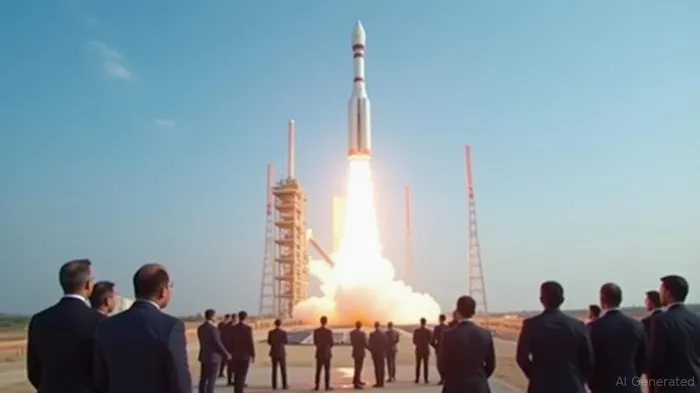
This $1.5 billion mission—combining NASA's L-band radar expertise with ISRO's S-band systems—will monitor ecosystems, ice sheets, and geological activity with unprecedented precision. Beyond scientific value, NISAR underscores a broader pattern: India is leveraging U.S. partnerships to access cutting-edge technology while avoiding overdependence on China.
The U.S.-India TRUST initiative (under the iCET framework) further illustrates this alignment. By collaborating on AI, semiconductors, and space tech, India is securing access to critical U.S. innovations like advanced chip manufacturing, which underpin LEO satellite systems. Yet, India's insistence on multilateral rule-making—such as its abstention from U.S.-led UN space governance resolutions—reveals a nuanced approach. New Delhi seeks influence in U.S.-led frameworks while resisting unilateral norms that could constrain its autonomy.
LEO: The New Economic Frontier
LEO satellite constellations, exemplified by SpaceX's Starlink, are reshaping telecommunications, defense, and climate monitoring. India's commercial space sector, fueled by policy reforms and private-sector dynamism, is capitalizing on this trend.
- Starlink Partnerships: Reliance Jio and Bharti Airtel's agreements with Starlink (pending regulatory approval) aim to extend broadband coverage to rural India.
- Domestic Startups: Firms like Skyroot Aerospace (developing India's first private orbital rocket, Vikram-S) and Astrome (focusing on LEO-based broadband) are attracting global investment.
- Defense Applications: ISRO's GSAT series satellites, dual-use for military and civilian purposes, highlight the convergence of LEO tech with national security.
The economic potential is staggering: India's space economy is projected to grow from $8.4 billion in 2022 to $44 billion by 2033, driven by LEO-driven growth.
This chart illustrates Jio's rise as a digital infrastructure leader—a trajectory that could accelerate with Starlink's integration.
Strategic Autonomy: A Balancing Act
India's pursuit of strategic autonomy involves three pillars:
1. Technological Independence: ISRO's Gaganyaan program (targeting a crewed mission by 2027) and plans for a space station by 2035 aim to reduce reliance on U.S. or Russian capabilities.
2. Geopolitical Leverage: New Delhi uses space diplomacy to counter Chinese influence, as seen in its South Asia Satellite (GSAT-9) and proposed G20 satellite mission.
3. Regulatory Frameworks: The Indian National Space Promotion and Authorization Center (IN-SPACe), established in 2021, is fostering private-sector innovation while ensuring data sovereignty.
However, challenges persist. Bureaucratic inertia and U.S. export controls on sensitive technologies like AI chips could hinder progress. India must also navigate U.S. pressure to align with its space governance agenda without sacrificing its multilateral principles.
Investment Opportunities: Where to Look?
The Indian space sector offers compelling opportunities for investors across public and private markets:
- LEO Telecom and Data Services:
- Public Firms: Bharti Airtel and Reliance Jio are well-positioned to benefit from Starlink's expansion.
Private Startups: Astrome and Earth-i (India's first private Earth observation satellite operator) could go public as demand for LEO data surges.
Semiconductor Partnerships:
U.S.-India collaborations like Bharat Semi and 3rdiTech aim to create a domestic semiconductor ecosystem. Tracking stocks of firms in the India Semiconductor Mission (e.g., companies tied to chip foundries) could yield returns as LEO tech scales up.
Defense and Satellite Manufacturing:
NewSpace India Limited (NSIL), a public-private hybrid, is commercializing ISRO's technologies. NSIL's ventures in LEO satellites and propulsion systems may attract strategic investors.
Geopolitical Plays:
- Space insurance and risk management firms could thrive as LEO constellations grow, given the need for debris mitigation and cyber defense.
Risks and Considerations
- Regulatory Delays: India's labyrinthine bureaucracy often slows commercialization. Investors must assess policy execution risks.
- Geopolitical Volatility: U.S.-China tensions could disrupt supply chains or spark sanctions on dual-use tech.
- Market Saturation: The LEO market is crowded, with players like Starlink, OneWeb, and Amazon's Kuiper. Indian firms must innovate to carve out niches.
Conclusion: Navigating the Stars
India's space sector is at an inflection point. By strategically aligning with the U.S. while nurturing domestic autonomy, New Delhi can transform its space ambitions into a $44 billion economic engine. Investors should focus on firms bridging LEO innovation (e.g., telecom, semiconductors) and geopolitical stability. The stars may be distant, but the rewards for those who navigate this cosmic calculus wisely are vast.
Final Note: Monitor geopolitical developments and regulatory approvals closely. The June 2025 NISAR launch will be a key indicator of U.S.-India collaboration's efficacy—and a harbinger of India's cosmic future.

Delivering real-time insights and analysis on emerging financial trends and market movements.
Latest Articles
Stay ahead of the market.
Get curated U.S. market news, insights and key dates delivered to your inbox.






Comments
No comments yet