
India’s Bond Market Turmoil: A Rebalancing Opportunity Amid Fiscal Uncertainty


 Aime Summary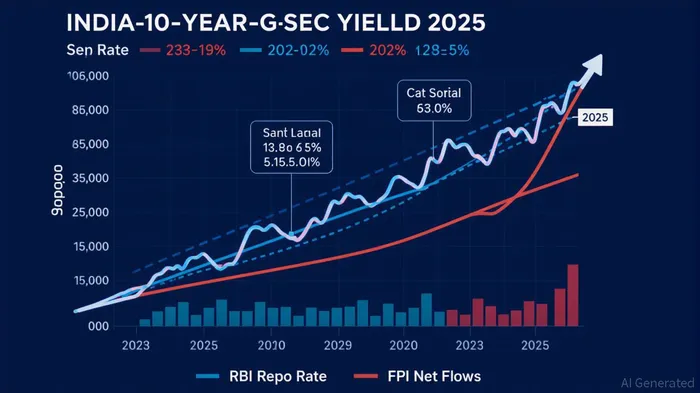
India’s bond market has entered a period of recalibration, driven by a delicate interplay between fiscal consolidation, foreign investor sentiment, and yield volatility. While the government’s commitment to reducing its fiscal deficit to 4.4% of GDP for FY2025–26 signals a disciplined approach to public finances, the market remains sensitive to external shocks and shifting policy expectations. This tension between structural reform and transient uncertainty has created a landscape where investors must navigate both risk and opportunity.
Fiscal Policy and the Path to Stability
The Indian government’s fiscal strategy for 2025–26 is anchored in a reduced deficit target and tighter borrowing plans. By lowering net market borrowings to ₹11.54 lakh crore from dated securities, the government aims to moderate bond yield volatility and improve liquidity [1]. This approach has already yielded results: 10-year government bond yields have fallen to 6.31% as of July 2025, down 150 basis points from their 2023 peak [2]. However, the path is not without bumps. State-level fiscal dynamics, particularly in states like Maharashtra and Tamil Nadu, threaten to offset central government progress. Revised borrowing plans in these states, driven by delayed reforms and infrastructure spending, could compress yields in the 10–20 year segment, prompting caution among investors [3].
The Reserve Bank of India (RBI) has played a pivotal role in this recalibration. A 50-basis-point repo rate cut in June 2025, coupled with a reduction in the Cash Reserve Ratio (CRR) to 3%, injected ₹2.5 lakh crore into the banking system [4]. These measures reflect a neutral policy stance aimed at balancing growth and inflation, with the RBI projecting further rate cuts in the latter half of 2025. Yet, the market’s response has been muted. Short-end yields (5-year bonds) remain more attractive than long-dated paper, suggesting that investors are prioritizing liquidity over duration [4].
Foreign Inflows and the Global Yardstick
Foreign portfolio investors (FPIs) have been a double-edged sword for India’s bond market. While the country’s inclusion in the FTSE WGBI index in September 2025 is expected to attract $15–20 billion in inflows, Q3 2025 has seen outflows of $3.57 billion, driven by a depreciating rupee and global rate differentials [5]. U.S. 10-year yields near 4.5% have made Indian bonds less competitive, particularly as the rupee’s weakness against the dollar raises concerns about currency risk [5].
Investor behavior has adapted to this environment. A barbell strategy—combining long-duration government securities with high-yield corporate bonds—has gained traction, allowing investors to hedge against rate volatility while capturing yield premiums [1]. Meanwhile, institutional investors such as pension funds and insurers have shortened their duration exposure, favoring 2–3 year instruments yielding around 5.50% [1]. This shift underscores a broader trend: defensive positioning in a market where uncertainty remains high.
Yield Volatility and the Repricing of Risk
The bond market’s volatility in 2025 reflects a reevaluation of India’s fiscal and monetary outlook. While the fiscal deficit target of 4.4% GDP has bolstered investor confidence, recent fiscal concerns—such as plans to cut consumption taxes and fears of a widening deficit—have caused 10-year yields to spike by 18 basis points in August 2025 [6]. This volatility has been exacerbated by the RBI’s policy pivot to a neutral stance, which has led to a steepening yield curve and a repricing of rate expectations [3].
Investors are now demanding higher returns for longer-duration bonds, with the 10-year yield trading more than a percentage point above the policy rate [6]. This spread reflects a premium for risk, particularly as external factors—U.S. dollar strength, geopolitical tensions, and potential fiscal slippage—loom large. Yet, the market’s resilience is underpinned by India’s strong macroeconomic fundamentals: falling inflation (2.1% in June 2025), a narrowing fiscal deficit, and robust domestic demand [2]. These factors suggest that the current turmoil may be a temporary recalibration rather than a systemic breakdown.
A Rebalancing Opportunity
The interplay of fiscal discipline, foreign inflows, and yield volatility presents a nuanced opportunity for investors. On one hand, the government’s commitment to fiscal consolidation and the RBI’s accommodative stance provide a structural tailwind for bond markets. On the other, external risks and shifting investor preferences necessitate a defensive approach. For those willing to navigate this complexity, the current environment offers a chance to capitalize on mispriced assets—particularly in the corporate bond segment, where credit spreads have widened, and in short-duration instruments that offer liquidity and yield [6].
India’s bond market is at a crossroads. The path forward will depend on the government’s ability to maintain fiscal discipline, the RBI’s calibration of monetary policy, and the resilience of foreign investor appetite. For now, the market’s turbulence is a reminder that stability is not the absence of volatility but the capacity to adapt to it.
Source:
[1] India's Bond Market at a Crossroads: Navigating Fiscal Uncertainty and Global Rate Cut Bets [https://www.ainvest.com/news/india-bond-market-crossroads-navigating-fiscal-uncertainty-global-rate-cut-bets-2508/]
[2] India economic outlook, August 2025 [https://www.deloitte.com/us/en/insights/topics/economy/asia-pacific/india-economic-outlook.html]
[3] India's Bond Market: Navigating Liquidity Shifts and External Pressures, Q3 2025 [https://www.ainvest.com/news/india-bond-market-navigating-liquidity-shifts-external-pressures-q3-2025-2507]
[4] India's Blazing Bond Rally Collapses as Fiscal Worries Resurface [https://www.bloomberg.com/news/articles/2025-08-25/india-s-blazing-bond-rally-collapses-as-fiscal-worries-resurface]
[5] India's Bond Market: Navigating Policy Uncertainty with Defensive Fixed-Income Strategies [https://www.ainvest.com/news/india-bond-market-navigating-policy-uncertainty-defensive-fixed-income-strategies-2507]
[6] India Bond Yields Rise Despite 1.55% Inflation: RBI Rate Outlook [https://www.jiraaf.com/blogs/bond-insights/bond-yields-rise-despite-low-inflation-india]

Decoding blockchain innovations and market trends with clarity and precision.
Latest Articles
Stay ahead of the market.
Get curated U.S. market news, insights and key dates delivered to your inbox.


AInvest
PRO
AInvest
PRO



Comments
No comments yet