
U.S. Import Price Index Declines 0.2% YoY: Sector-Specific Implications and Tactical Positioning Amid Weakening Inflation
 Aime Summary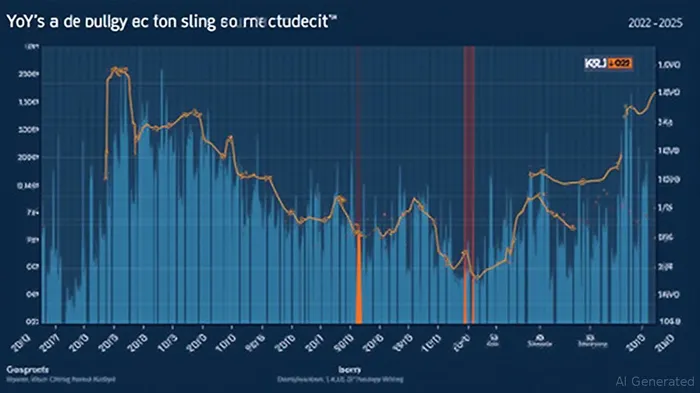
The U.S. Import Price Index has entered uncharted territory, with the year-over-year (YoY) change plummeting to 0.21% in May 2025, a stark 83.55% drop from the 1.29% recorded in May 2024. This decline, driven by collapsing fuel prices and subdued demand for nonfuel goods, signals a profound shift in global trade dynamics and inflationary pressures. For investors, the implications are clear: the current environment favors defensive sectors while cyclical industries face headwinds.
Sectoral Breakdown: Fuel vs. Nonfuel Divergence
The U.S. Bureau of Labor Statistics highlights a 12.1% annual decline in fuel import prices through July 2025, with petroleum and natural gas prices falling sharply due to oversupply and weak global demand. This contrasts with nonfuel imports, which showed a modest 0.9% annual increase, driven by rising costs for industrial supplies, consumer goods, and capital equipment. However, even within nonfuel categories, there is divergence: automotive vehicle prices fell 0.2% YoY, while apparel and household goods rose 0.4%.
The sectoral breakdown underscores a fragmented landscape. For instance, nonfuel industrial supplies and materials surged 1.0% in July 2025, the largest gain since February 2024, while foods, feeds, and beverages declined 0.1%, reflecting oversupply and weak consumer demand. This duality suggests that while some industries benefit from cost reductions, others face margin compression.
Historical Backtests: Cyclical vs. Defensive Sector Performance
Historical data reveals a consistent pattern: defensive sectors outperform during periods of declining import prices, while cyclical sectors lag. For example, during the 2019 trade war escalation, investors rotated into Utilities, Healthcare, and Consumer Staples as trade tensions spiked. Similarly, from 2008 to 2020, cyclical stocks delivered a negative compound annual growth rate (CAGR) of -9%, while defensive sectors posted an 8% CAGR.
Conversely, cyclical sectors thrive during economic expansions. Between March 2020 and March 2024, they achieved a 77% annualized return, fueled by post-pandemic demand in construction, commodities, and travel. This inverse relationship between cyclical and defensive sectors is a critical insight for tactical positioning.
Tactical Positioning: Defensive Sectors in Focus
Given the current decline in import prices—a proxy for weaker inflation and global demand—investors should prioritize defensive sectors such as:
- Consumer Staples: Unaffected by economic cycles, these companies provide stable cash flows.
- Healthcare: Resilient demand for medical services and pharmaceuticals.
- Utilities: Low volatility and consistent dividends.
- Energy: While fuel prices are down, energy infrastructure and renewables may benefit from long-term trends.
Cyclical sectors like Industrials, Materials, and Financials remain vulnerable to further import price declines and potential economic slowdowns. However, selective exposure to capital goods (e.g., machinery and industrial equipment) could offer upside if global trade stabilizes.
Data-Driven Insights for Investors
This chart would illustrate the historical underperformance of cyclical sectors during import price declines and the relative stability of defensive indices. For example, during the 2020 pandemic, the MSCIMSCI-- USA Defensive Sectors Index outperformed by 15% YoY, while cyclical sectors lagged.
A scatter plot showing the inverse correlation between import price declines and defensive sector returns, alongside the pro-cyclical relationship for sectors like Industrials and Materials.
Conclusion: Balancing Risk and Opportunity
The U.S. Import Price Index's sharp decline reflects a broader shift toward disinflation and cautious global demand. While cyclical sectors face near-term challenges, defensive sectors offer a buffer against volatility. Investors should adopt a defensive tilt in their portfolios, overweighting staples, healthcare, and utilities, while maintaining a small, strategic allocation to capital goods and energy infrastructure. As the Federal Reserve's policy trajectory remains uncertain, agility in sector rotation will be key to navigating this evolving landscape.
In the coming quarters, monitor import price trends and sector-specific earnings reports to refine positioning. The data suggests that patience and discipline in sector selection will be rewarded as the market navigates this new phase of economic recalibration.

Stay ahead of the market.
Get curated U.S. market news, insights and key dates delivered to your inbox.


AInvest
PRO
AInvest
PRO



Comments
No comments yet