
The Implications of New York's Proposed 0.2% Crypto Tax on Stablecoins and Digital Asset Liquidity
 Aime Summary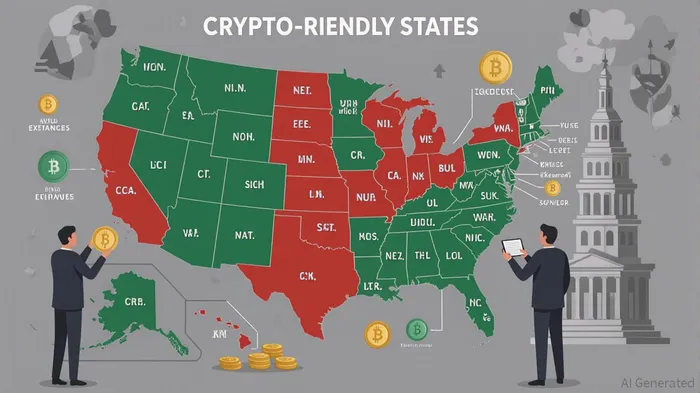
New York's proposed 0.2% excise tax on cryptocurrency transactions, including stablecoins, has ignited a heated debate about the future of digital assetDAAQ-- markets in the U.S. Assembly Bill A0966, introduced by Phil Steck, aims to generate $158 million annually for upstate school substance abuse programs. While the tax is framed as a modest levy, its implications for liquidity, regulatory arbitrage, and the role of stablecoins in mainstream finance are profound. For investors, the tax underscores the growing fragmentation of the U.S. crypto landscape and the urgent need to adapt to a patchwork of state-level policies.
Regulatory Risk and Market Behavior Shifts
The 0.2% tax, if enacted, will directly impact high-frequency traders and institutional players. A $50,000 BitcoinBTC-- trade would incur a $100 tax, a cost that could deter frequent trading and reduce liquidity on New York-based platforms. This aligns with historical trends: when regulatory burdens rise, capital often migrates to jurisdictions with lower compliance costs. For example, New York's 2015 BitLicense framework prompted firms like Bitfinex to relocate operations to Delaware and Singapore. The new tax could accelerate this pattern, pushing crypto-native firms to states like Texas or Wyoming, where regulatory environments are more accommodating.
Stablecoins, which are often used for cross-border transactions and yield generation, face a unique challenge. Despite their dollar pegging, the tax treats them as speculative assets, penalizing routine account management. This could disrupt their role as a bridge between traditional finance and crypto, particularly for users relying on stablecoins for liquidity. For instance, a $1 million stablecoin transfer would incur a $2,000 tax, a cost that may discourage everyday use in favor of fiat alternatives.
The Rise of Regulatory Arbitrage
The U.S. crypto market is increasingly shaped by state-level policies. Texas, Wyoming, and Washington offer stark contrasts to New York's approach:
- Texas has no personal income tax and provides a 10-year tax abatement for crypto mining operations.
- Wyoming treats digital assets as property and offers LLC protections for crypto holdings.
- Washington applies straightforward tax rules to crypto transactions, avoiding the complexity of New York's framework.
These differences create fertile ground for regulatory arbitrage. Investors and businesses are likely to shift operations to states with lower tax burdens and clearer regulations. For example, crypto exchanges may expand their presence in Texas, where the Strategic Bitcoin Reserve initiative signals institutional support for digital assets. Similarly, stablecoin issuers could prioritize jurisdictions like Wyoming, where digital asset laws are more favorable.
Strategic Roadmap for Investors
For investors navigating this fragmented landscape, the key lies in positioning for resilience and adaptability:
- Prioritize Resilient Crypto Assets
- Blue-chip cryptocurrencies like Bitcoin and EthereumETH-- are less sensitive to regulatory shifts than niche tokens. Their established networks and institutional adoption provide a buffer against liquidity risks.
Stablecoins with strong reserves (e.g., USDCUSDC--, USDT) remain critical for hedging against volatility, but investors should monitor their usage in light of New York's tax.
Leverage Regulatory Arbitrage
- Domicile operations in crypto-friendly states: Investors can structure their portfolios through Wyoming LLCs or Texas-based custodians to minimize tax exposure.
Diversify trading platforms: Use exchanges in states with favorable policies (e.g., Gemini in New York vs. CoinbaseCOIN-- in Texas) to hedge against liquidity constraints.
Hedge Against Liquidity Risks
- Adopt long-term holding strategies: The tax's cost per transaction encourages holding assets beyond short-term cycles, reducing exposure to frequent tax liabilities.
Utilize tax-loss harvesting tools: Platforms like CoinLedger can optimize gains and losses, mitigating the impact of New York's tax on taxable events.
Monitor Policy Developments
- Track legislative progress: The fate of A0966 depends on committee reviews and political dynamics. Investors should stay informed about potential amendments or delays.
- Engage with industry advocacy: Supporting groups like the Blockchain Association can influence regulatory outcomes and reduce uncertainty.
Conclusion
New York's 0.2% crypto tax is a microcosm of the broader tension between regulation and innovation in the digital asset space. While the tax may generate revenue for social programs, its unintended consequences—reduced liquidity, regulatory arbitrage, and a reevaluation of stablecoins' utility—pose significant challenges. For investors, the path forward lies in strategic positioning: embracing resilient assets, exploiting regulatory arbitrage, and staying agile in the face of evolving policies. As the U.S. crypto landscape continues to fragment, adaptability will be the hallmark of successful investors in 2025 and beyond.

Decoding blockchain innovations and market trends with clarity and precision.
Latest Articles
Stay ahead of the market.
Get curated U.S. market news, insights and key dates delivered to your inbox.
AInvest
PRO
AInvest
PRO



Comments
No comments yet