
The Implications of a Weaker-than-Expected U.S. GDP Report on Equity Markets and Sector Rotation


 Aime Summary
The U.S. economy's recent performance has painted a mixed picture, with a sharp deceleration in Q4 2025 GDP growth sparking renewed concerns about long-term momentum. While the third quarter of 2025 saw a robust 4.3% expansion, driven by consumer spending and
exports, the fourth quarter's growth slowed to 3.8%, falling short of the 4.8% forecast
according to forecasts. This moderation, coupled with a government shutdown and rising tariffs, has created a volatile backdrop for investors. The Federal Reserve's response-resuming rate cuts in September 2025-and the subsequent equity market rotation toward AI-driven sectors highlight the need for strategic asset reallocation.
GDP Data: A Tale of Two Quarters
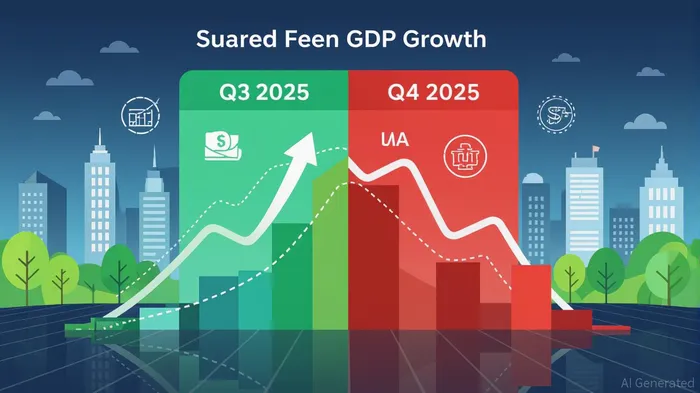 The BEA's Q3 2025 report underscored the economy's resilience, with consumer spending and government outlays offsetting a decline in investment
according to initial estimates. However, Q4's weaker-than-expected growth revealed structural headwinds.
Deloitte's analysis notes that high tariffs, a slowing labor market, and reduced immigration are likely to constrain 2026 GDP growth to 1.9%. Meanwhile, the Atlanta Fed's GDPNow model revised its Q4 2025 estimate downward to 3.5% by December
according to its model, signaling a loss of momentum.
The slowdown was particularly pronounced in manufacturing and technology sectors, where fixed investment fell to 1% in Q3 2025 from 4.4% in Q2
according to data. While AI infrastructure investments contributed significantly to GDP growth in 2025, concerns about overinvestment and depreciation cycles have emerged
according to analysis. Exports, however, rebounded by 8.8% in Q3, offering a glimmer of hope for manufacturing
according to data.
Federal Reserve's Policy Pivot
The Fed's response to the Q4 2025 slowdown has been a key driver of market dynamics. In September 2025, the central bank cut the federal funds rate by 25 basis points to 4.0–4.25%, with further reductions projected to 3.6% by year-end 2025 and 3.4% in 2026
according to policy documents. This easing stance reflects a shift toward labor market stability, as
unemployment rose to 4.3% in August 2025. The Philadelphia Fed's Survey of Professional Forecasters projects 1.9% GDP growth for 2025 and 1.8% for 2026
according to the survey, aligning with Deloitte's caution about long-term headwinds
according to analysis.
Equity Market Reaction and Sector Rotation
The weaker-than-expected GDP report triggered a pronounced sector rotation in equity markets. Technology and Communication Services led the rally, with the S&P 500's Information Technology sector
surging 61.1% since April 2025. This outperformance was fueled by AI-related investments, which reshaped industrial dynamics and
contributed to GDP growth. Growth stocks, particularly in the NASDAQ, outperformed value stocks, with the S&P 500 Growth Index rising 46.1% since April
according to market data.
However, valuations have stretched significantly. The S&P 500 trades at 25.0x 2025 earnings and 22.0x 2026 estimates, well above historical averages
according to market analysis. This raises questions about sustainability, especially as tariffs and inflationary pressures persist. The services sector, meanwhile, saw robust growth in Q3, driven by AI-driven equity gains and a 3.5% rise in personal consumption expenditures
according to economic data.
Strategic Reallocation: Navigating the New Normal
Investors must adapt to the evolving economic landscape by reallocating assets across sectors and asset classes. Here are three key strategies:
Overweight AI-Driven Sectors: Technology and Communication Services remain critical, given their role in GDP growth and equity performance. However, investors should focus on sub-sectors with durable demand, such as cloud infrastructure and AI semiconductors, rather than speculative plays.
Hedge Against Inflationary Pressures: With
tariffs expected to raise core PCE inflation by 3% in 2026, sectors like energy and materials may offer inflation protection. Energy stocks, in particular, could benefit from higher commodity prices linked to trade policies.Defensive Positioning in a Slower Economy: As growth moderates, defensive sectors such as utilities and healthcare may outperform. These sectors historically provide stability during economic transitions and are less sensitive to interest rate fluctuations.
Monitor Rate-Sensitive Sectors: If the Fed continues its easing cycle, financials and real estate could see a rebound. However, investors should remain cautious until the trajectory of rate cuts becomes clearer.
Conclusion
The weaker-than-expected Q4 2025 GDP report underscores the need for a nuanced approach to asset allocation. While the Fed's rate cuts and AI-driven growth have buoyed equity markets, structural challenges like tariffs and labor market weakness persist. By prioritizing sectors aligned with long-term trends and hedging against macroeconomic risks, investors can position portfolios to weather the next phase of the economic cycle.

Stay ahead of the market.
Get curated U.S. market news, insights and key dates delivered to your inbox.






Comments
No comments yet