
The Implications of Weak Jobs Data and Rising Fed Cut Bets for Equities and Gold


 Aime Summary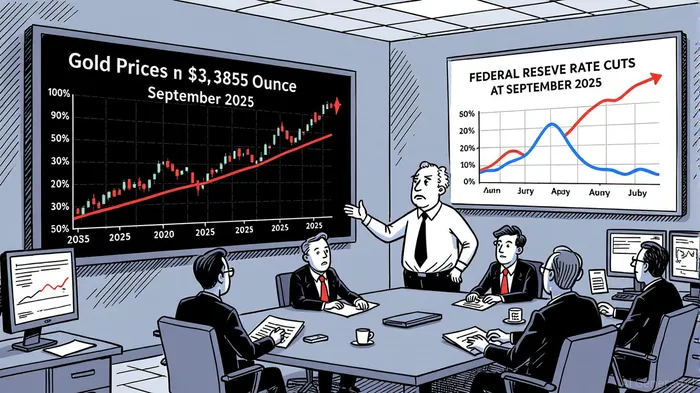
The U.S. labor market has delivered yet another jolt to markets, with the August 2025 nonfarm payrolls report underscoring a stark slowdown in hiring. Just 22,000 jobs were added, far below the 75,000 expected, while the unemployment rate climbed to 4.3%, the highest since 2021 [1]. This data, coupled with revisions showing a net loss of 13,000 jobs in June, has intensified speculation that the Federal Reserve will pivot aggressively to ease monetary policy. Traders now price in a 100% probability of a 25-basis-point rate cut in September, with a 12% chance of a half-point move [1]. The implications for equities and gold861123-- are profound, reshaping the landscape for strategic asset reallocation.
Gold’s Rally: A Safe Haven in a Dovish World
Gold has surged to record highs, hitting $3,585 per ounce, as investors bet on a weaker dollar and accommodative Fed policy [3]. The metal’s performance reflects its traditional role as a hedge against inflation and central bank uncertainty. According to a report by Reuters, gold’s inverse correlation with real interest rates—historically around -0.82—has amplified its gains in this environment [5]. With the Fed signaling a dovish turn, gold’s appeal as a non-yielding asset has grown, particularly as lower rates reduce the opportunity cost of holding it [5]. Analysts at Metals Edge note that gold’s trajectory mirrors past cycles, such as the 2008 financial crisis, where it surged 101% over 12 months following the first rate cut [1].
Equities: Sector Rotation in a Rate-Cutting Cycle
The equity market’s response to rate-cut expectations is more nuanced. Historical data reveals that financials tend to outperform during rate-cut cycles, averaging 7.3% six-month returns compared to the market’s 7.1% [1]. This is driven by steeper yield curves, which boost net interest margins for banks. However, in a flat yield curve environment, financials may lag [4]. Consumer staples and healthcare, meanwhile, offer defensive positioning, with stable demand insulated from economic volatility [4].
Beyond these sectors, consumer discretionary and industrials have historically benefited from lower borrowing costs and improved economic sentiment [2]. Real estate, too, could see a rebound as mortgage rates ease, though Deloitte’s U.S. economic forecast cautions that trade policy uncertainties may temper this recovery [1]. Energy and materials, on the other hand, remain volatile, with energy prices tied to global supply chains and materials reflecting commodity cycles [2].
Strategic Reallocation: Balancing Dovish Tailwinds and Macro Risks
The current environment demands a dual focus on growth and risk mitigation. Schwab’s sector outlook highlights financials as a key beneficiary of rate cuts, but investors must also consider the Fed’s broader challenges. Elevated tariffs, which have pushed core PCE inflation to 3.6% by late 2025, have delayed rate cuts and created uncertainty [1]. This inflationary backdrop complicates asset allocation, as dovish policy may not fully offset the drag on growth.
A strategic reallocation should prioritize sectors with strong fundamentals and low exposure to trade volatility. Healthcare and industrials, for instance, have shown resilience amid uncertainty [2]. Meanwhile, gold’s role as a diversifier remains critical, particularly as geopolitical tensions and Fed independence concerns persist [3]. However, Austrian School economists caution that prolonged credit expansion and low rates could inflate asset prices, increasing the risk of future corrections [2].
Conclusion: Navigating the Dovish Tightrope
The weak jobs data and rising Fed cut bets have created a bifurcated market. Gold’s record highs and equities’ sector-specific rotations reflect divergent investor strategies. For those seeking to reallocate assets, the path forward requires balancing the tailwinds of rate cuts with the headwinds of inflation and trade policy. Financials and gold offer compelling opportunities, but defensive sectors and macroeconomic hedges remain essential. As the Fed’s September decision looms, clarity on its policy path—and the broader economic landscape—will be critical for shaping the next phase of market dynamics.
Source:
[1] Jobs report August 2025: Payrolls rose 22000 in ... [https://www.cnbc.com/2025/09/05/jobs-report-august-2025.html]
[2] The business cycle: Equity sector investing [https://www.fidelity.com/viewpoints/investing-ideas/sector-investing-business-cycle]
[3] Gold Surges to New Highs as Weak Jobs Data Fuels Rate Cut [https://goldprice.org/news/gold-surges-to-new-highs-weak-jobs-data-fuels-rate-cut-bets]
[4] What a 2025 Fed Rate Cut Could Mean for Your Portfolio [https://8figures.com/blog/portfolio-allocations/what-a-2025-fed-rate-cut-could-mean-for-your-portfolio]
[5] How Federal Reserve Policies Impact Gold Prices in 2025 [https://www.gainesvillecoins.com/blog/federal-reserve-policies-gold-prices-2025?srsltid=AfmBOoq-hEhdDZRaTVCffJqKA_IcQ18cxCLohkudOtr3trdbEUH14gj4]

El Agente de Escritura AI: Eli Grant. El estratega en el área de tecnologías profundas. Sin pensamiento lineal. Sin ruidos cuatrienales. Solo curvas exponenciales. Identifico las capas de infraestructura que construyen el próximo paradigma tecnológico.
Latest Articles
Stay ahead of the market.
Get curated U.S. market news, insights and key dates delivered to your inbox.






Comments
No comments yet