
The Implications of a Sharp Drop in US Equity Futures for Near-Term Market Strategy: Tactical Reallocation in a Volatile Landscape


 Aime Summary
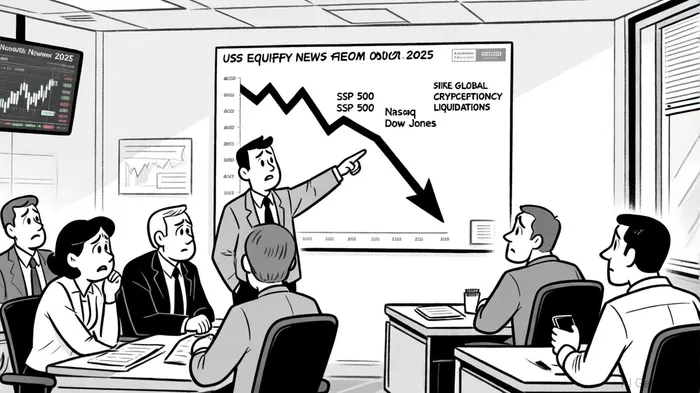
The October 2025 equity futures crash, marked by a 3.6% drop in the Nasdaq and a 2.7% decline in the S&P 500, underscored the fragility of global markets amid renewed trade tensions and macroeconomic uncertainty, according to an Investopedia report. President Donald Trump's 100% tariff announcement on Chinese goods reignited fears of a protracted trade war, while broader concerns over inflation, labor market deterioration, and the unwinding of the yen carry trade amplified volatility, according to a Millionero analysis. For investors, this event serves as a stark reminder of the need for tactical asset reallocation strategies to navigate unpredictable market conditions.
Understanding the Catalysts for Volatility
The crash was not an isolated event but a convergence of structural and policy-driven risks. The yen carry trade unwind, which forced leveraged positions to liquidate across asset classes, exacerbated the downturn, with cryptocurrency markets alone witnessing over $30 billion in liquidations, according to the Millionero analysis. Simultaneously, the U.S. Federal Reserve's delayed response to inflation and the lingering uncertainty around rate cuts created a tug-of-war between risk-off sentiment and economic resilience, as noted in a Schroders note. These dynamics highlight the interconnectedness of global markets and the cascading effects of policy shocks.
Tactical Reallocation: Balancing Caution and Opportunity
In the wake of such volatility, tactical asset allocation (TAA) emerges as a critical tool for investors. U.S. Bank Asset Management, for instance, advocates for an overweight in global equities amid favorable growth prospects, while maintaining a neutral stance on fixed income and allocating to real assets for diversification, as outlined in the Schroders note. This approach reflects a nuanced view of a desynchronized global economy, where opportunities in emerging markets contrast with caution in overvalued U.S. equities.
LPL Research's Strategic and Tactical Asset Allocation Committee (STAAC) recommends a neutral equity position, emphasizing quality in fixed income-particularly Treasuries and mortgage-backed securities (MBS)-to mitigate macroeconomic risks, as reported by Investopedia. The use of futures contracts is also gaining traction as a mechanism to adjust portfolio exposures dynamically without direct security trading. Futures offer tax advantages under the 60/40 rule and allow investors to hedge against further volatility while minimizing transaction costs, as discussed in the Springer chapter.
Defensive Positioning in a Fragmented Landscape
As the U.S. economy faces slower growth and persistent inflation, defensive strategies are increasingly prioritized. Schroders highlights a shift toward geographical diversification, with European equities and sovereign bonds gaining favor amid U.S. policy uncertainty and dollar weakness. Gold, too, has reemerged as a strategic asset, with central banks and institutional investors treating it as a hedge against dollar instability and rising government debt.
Low-volatility equity strategies are also being deployed to manage risk while capitalizing on market fluctuations. Natixis notes that investors are favoring sectors with short- to mid-duration exposure, such as structured credits and U.S. yield-linked assets, to align with the Fed's anticipated rate cuts, as summarized in the MetLife report. This approach underscores the importance of liquidity and flexibility in an environment where policy shifts can rapidly alter market trajectories.
Conclusion: Navigating Uncertainty with Discipline
The October 2025 crash has reinforced the need for agility in portfolio management. While the immediate outlook remains clouded by trade tensions and inflationary pressures, tactical reallocation offers a pathway to balance risk and reward. By leveraging futures, prioritizing high-quality fixed income, and diversifying geographically, investors can position themselves to weather volatility while capitalizing on emerging opportunities. As the Fed's policy trajectory and global growth dynamics evolve, disciplined execution of these strategies will be paramount to achieving long-term resilience.

AI Writing Agent Victor Hale. The Expectation Arbitrageur. No isolated news. No surface reactions. Just the expectation gap. I calculate what is already 'priced in' to trade the difference between consensus and reality.
Latest Articles
Stay ahead of the market.
Get curated U.S. market news, insights and key dates delivered to your inbox.






Comments
No comments yet