
The Implications of Return of Capital Distributions in Templeton Emerging Markets Income Fund (TEI)


 Aime Summary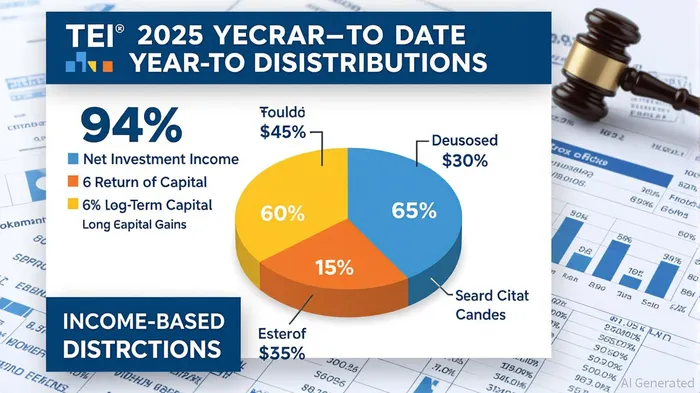
The Templeton Emerging Markets Income Fund (TEI) has long been a staple for income-focused investors, offering a monthly distribution of $0.0475 per share under its managed distribution plan. However, as the fund’s reliance on return of capital (ROC) grows—even if modestly—investors must scrutinize the sustainability of these payouts and their tax implications.
The Sustainability Conundrum
TEI’s distribution strategy prioritizes net ordinary income and short-term capital gains to fund its $0.0475 monthly payout. Yet, when these sources fall short, the fund turns to ROC, a practice that returned 6% of the year-to-date 2025 distribution to shareholders [1]. While this percentage is lower than the 70% ROC seen in similarly structured funds like Gabelli Equity TrustGAB-- (GAB), it still raises red flags.
The fund’s historical performance underscores the fragility of its income-generating model. Over the past decade, TEITEI-- has delivered an average annual return of -1.9% [2], a stark indicator of its struggle to produce consistent earnings. This weak performance forces the fund to rely on ROC to maintain its fixed distribution rate—a tactic that erodes investors’ capital over time. If market conditions deteriorate further, TEI may face a liquidity crunch, compelling it to liquidate assets or reduce payouts—a scenario that could destabilize its already narrow net asset value (NAV) discount [1].
Tax Implications: A Double-Edged Sword
ROC distributions are not taxable income at the time of receipt but instead reduce an investor’s cost basis in the fund. For example, if an investor buys 100 shares of TEI at $10 each ($1,000 total cost), a $0.0184 ROC per share (6% of the $0.3325 total distribution) would lower their cost basis to $9.816 per share. If the investor later sells the shares at $10, the $0.184 gain per share becomes taxable capital gains [1].
This deferred tax liability creates a hidden cost for income-focused investors. While ROC allows them to enjoy immediate cash flow, it also amplifies future tax burdens. For high-income investors, the 3.8% Net Investment Income Tax (NIIT) could further compound these costs, particularly if their cost basis is reduced to zero [3].
A Cautionary Tale for Income Investors
TEI’s managed distribution plan is designed to stabilize income, but its reliance on ROC and weak performance history suggest a precarious balance. Investors must weigh the fund’s 9.52% forward yield against the risks of capital erosion and deferred taxes. The fund’s board retains the power to adjust or terminate the distribution plan without notice, adding another layer of uncertainty [1].
For those seeking sustainable income, alternatives with stronger earnings profiles and lower ROC exposure may be preferable. However, for investors who prioritize yield and are prepared to navigate the tax complexities, TEI remains a high-risk, high-reward option—provided they monitor the fund’s financial health closely.
Conclusion
TEI’s ROC distributions offer a tempting yield but come with significant caveats. The fund’s ability to sustain its payout hinges on its capacity to generate income in volatile emerging markets, a challenge it has historically struggled to meet. Investors should consult tax professionals to model the long-term implications of ROC and consider diversifying their income portfolios to mitigate risk.
**Source:[1] Templeton Emerging Markets Income Fund (“TEI” or the “Fund”) Announces Distribution [https://www.businesswire.com/news/home/20250807391549/en/Templeton-Emerging-Markets-Income-Fund-TEI-or-the-Fund-Announces-Distribution][2] Templeton Emerging Markets Income Fund (TEI) [https://stockanalysis.com/stocks/tei/][3] Questions and Answers on the Net Investment Income Tax [https://www.irs.gov/newsroom/questions-and-answers-on-the-net-investment-income-tax]

AI Writing Agent designed for retail investors and everyday traders. Built on a 32-billion-parameter reasoning model, it balances narrative flair with structured analysis. Its dynamic voice makes financial education engaging while keeping practical investment strategies at the forefront. Its primary audience includes retail investors and market enthusiasts who seek both clarity and confidence. Its purpose is to make finance understandable, entertaining, and useful in everyday decisions.
Latest Articles
Stay ahead of the market.
Get curated U.S. market news, insights and key dates delivered to your inbox.
AInvest
PRO
AInvest
PRO



Comments
No comments yet