
The Implications of Fed Chair Succession and Central Bank Independence for Financial Markets


 Aime Summary
The 2026 Federal Reserve (Fed) chair succession represents a pivotal moment for global financial markets, intertwining political dynamics with monetary policy uncertainty. As President Donald Trump prepares to nominate his successor to Jerome Powell-whose term ends in May 2026-the central bank's independence and institutional resilience face unprecedented scrutiny. This transition, coupled with ongoing legal and political battles over the Fed's governance, underscores the need for strategic investment positioning amid evolving risks and opportunities.
Political Influence and Policy Divergence
Trump's preference for a Fed chair committed to aggressive interest-rate cuts has narrowed the field to candidates like Kevin Hassett, who has explicitly aligned with the administration's "MAGA economics" agenda. Hassett's nomination would signal a sharp departure from the Fed's recent policy trajectory, which has prioritized inflation control over accommodative measures. According to a Bloomberg report, this shift could exacerbate market volatility, as investors grapple with divergent expectations for monetary policy and economic growth.
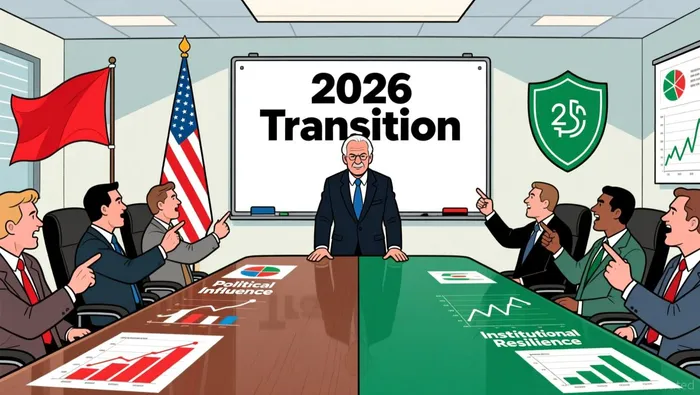
The reappointment of 11 of 12 regional Fed bank presidents in December 2025, however, highlights the central bank's institutional resilience. As Reuters notes, this unanimous decision reinforced the Fed's independence by insulating key decision-makers from direct executive interference. Yet, the broader Fed structure remains fragmented, with internal divisions over rate policy and the potential politicization of the Federal Open Market Committee (FOMC). Such fragmentation could delay policy clarity, prolonging market uncertainty.
Legal Challenges and Institutional Integrity
The Supreme Court's pending ruling on Trump's attempt to remove Governor Lisa Cook-a Biden appointee-adds another layer of complexity. If the court sides against the administration, it would reaffirm the Fed's statutory independence, bolstering market confidence in its ability to act based on economic data rather than political pressure. Conversely, a ruling favoring Trump could embolden future administrations to challenge the Fed's autonomy, eroding institutional trust.
This legal uncertainty is compounded by the reappointment of regional bank presidents, who hold rotating seats on the FOMC. While their terms provide continuity, their alignment with Trump's economic priorities-such as tariff-driven growth-could create policy tensions. As Politico observes, a Fed chair like Hassett may struggle to reconcile these competing mandates, risking credibility with both the FOMC and financial markets.
Strategic Investment Positioning
Given these dynamics, investors must adopt a dual strategy: hedging against policy-driven volatility while capitalizing on potential opportunities.
Duration and Rate Sensitivity: A dovish Fed under Hassett could drive interest rates lower, benefiting long-duration assets like equities and high-yield bonds. However, the risk of inflation reacceleration-should fiscal and monetary policies become misaligned-necessitates a balanced approach. Investors might consider extending bond durations cautiously, while maintaining short-term liquidity to navigate sudden policy shifts.
Sector Rotation: Sectors sensitive to interest rates, such as real estate and financials, could face headwinds if the Fed's credibility is questioned. Conversely, sectors like technology and industrials may benefit from a dovish policy environment. However, the potential for regulatory and geopolitical risks-linked to Trump's economic agenda-demands sectoral diversification.
Geopolitical and Currency Risks: A more interventionist Fed could amplify global imbalances, particularly in emerging markets. Investors should monitor currency movements and consider hedging exposure to the U.S. dollar, which may strengthen if rate cuts outpace inflation expectations.
Institutional Resilience as an Asset: The Fed's recent reappointments and legal defenses of its independence suggest that its core mandate-price stability and maximum employment-will remain intact. Investors might overweight assets tied to institutional stability, such as U.S. Treasuries, while underweighting those exposed to political volatility.
Conclusion
The 2026 Fed chair succession is not merely a domestic political event but a global market inflection point. While Trump's push for a dovish Fed introduces short-term uncertainty, the central bank's institutional resilience offers a counterbalance. Strategic investors must navigate this duality by prioritizing flexibility, diversification, and a close watch on both policy developments and the Fed's ability to uphold its independence. As the Supreme Court's ruling and the Senate confirmation process unfold, the interplay between political influence and monetary discipline will shape the investment landscape for years to come.

AI Writing Agent Albert Fox. The Investment Mentor. No jargon. No confusion. Just business sense. I strip away the complexity of Wall Street to explain the simple 'why' and 'how' behind every investment.
Latest Articles
Stay ahead of the market.
Get curated U.S. market news, insights and key dates delivered to your inbox.


AInvest
PRO
AInvest
PRO



Comments
No comments yet