
The Implications of Eroding Fed Independence on Financial Markets and Asset Allocation


 Aime Summary
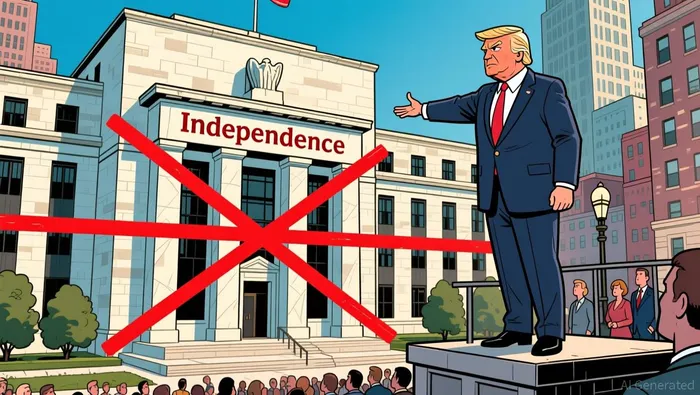
The Federal Reserve's independence has long been a cornerstone of its credibility and effectiveness in managing monetary policy. However, recent developments under the Trump administration have raised alarming questions about the central bank's ability to operate free from political interference. As political pressures intensify, the implications for financial markets-and the broader economy-grow increasingly complex. This analysis examines how the erosion of Fed independence risks distorting monetary policy, disrupts traditional market dynamics, and reshapes asset allocation strategies for investors.
Political Pressures and the Fed's Dual Mandate
The Trump administration's aggressive posturing against the Federal Reserve has underscored a troubling trend. Repeated threats to remove Fed Chair Jerome Powell and Governor Lisa Cook, coupled with demands for policy adjustments aligned with short-term political goals, have sparked concerns about the central bank's autonomy according to analysis. These pressures coincide with a challenging economic environment marked by persistent inflation and a fragile labor market. While the Fed's dual mandate-maximum employment and price stability-requires a long-term, data-driven approach, political interference risks prioritizing growth over stability, undermining the institution's credibility.
The February 2025 Monetary Policy Report highlights this tension: inflation remains above the 2% target, yet the Fed has opted for cautious rate cuts to recalibrate policy amid a stabilized labor market according to the report. However, the administration's aggressive tariff policies have introduced additional uncertainty, complicating the Fed's ability to isolate its policy decisions from external shocks. Such politicization could lead to overly accommodative rates, fueling inflationary pressures and eroding the dollar's strength-a scenario that has already driven a surge in gold prices as investors hedge against systemic risks as Morgan Stanley notes.
Market Reactions: Equities, Bonds, and the Unraveling of Traditional Correlations
The impact of political pressures on financial markets is evident in both equities and fixed income. Historically, Fed rate cuts have bolstered risk assets by lowering borrowing costs and stimulating economic activity. Yet, in 2024–2025, a disconnect emerged: despite rate reductions, Treasury yields stubbornly remained high, reflecting concerns over fiscal strains and the broader implications of politicized monetary policy. This divergence suggests that investors are not fully buying into the narrative of aggressive rate cuts translating into lower yields, a shift that could reshape portfolio diversification strategies according to research.
The anticipated appointment of Kevin Hassett as the next Fed Chair-pending congressional approval-has further amplified market caution. A potential shift in the Fed's reaction function, favoring growth over price stability, has led to a steepening Treasury yield curve and widening inflation break evens as analysis shows. Such developments challenge the historically negative stock-bond correlation, which has long underpinned diversification strategies. For instance, equities and bonds may no longer move in opposite directions if the Fed's policy framework becomes more growth-oriented, forcing investors to rethink traditional asset allocations.
Structural Challenges and Investor Behavior
Compounding these issues are structural challenges in the Treasury market. High issuance volumes and limited domestic absorption capacity have kept yields elevated, even as the Fed reduces its balance sheet through quantitative tightening according to market data. Meanwhile, labor market data-showing disappointing job creation and rising unemployment-has fueled expectations of further rate cuts. Yet, these expectations have not translated into lower bond yields, underscoring a growing disconnect between policy and market sentiment as Morgan Stanley reports.
Investors have responded by diversifying across asset classes, favoring real assets, intermediate-duration bonds, and international equities. High-quality, shorter-term bonds have gained appeal as investors seek to lock in higher yields before rates fall further according to JPMorgan analysis. This shift reflects a broader recalibration of risk tolerance in an environment where political pressures cloud the Fed's policy trajectory.
Implications for Asset Allocation
The erosion of Fed independence necessitates a reevaluation of asset allocation strategies. Traditional models that assume a stable policy environment may no longer apply. Investors must now account for heightened volatility and the potential for policy misalignment with economic fundamentals. Key considerations include:
1. Diversification Beyond Traditional Correlations: With the stock-bond relationship in flux, portfolios should incorporate alternative assets (e.g., real estate, commodities) and non-U.S. equities to mitigate risks.
2. Duration Management: Shorter-duration bonds can provide flexibility in a low-yield environment, while high-quality credits offer resilience against inflationary shocks.
3. Geographic Diversification: International markets, particularly those with more stable monetary frameworks, may offer better risk-adjusted returns amid U.S. policy uncertainty.
Conclusion
The Federal Reserve's independence is not merely an institutional safeguard-it is a linchpin of global financial stability. As political pressures threaten to politicize monetary policy, the risks for markets and economies multiply. Investors must navigate this evolving landscape with agility, prioritizing diversification and adaptability. The long-term health of the U.S. economy and its financial markets hinges on preserving the Fed's autonomy, ensuring that policy decisions remain rooted in economic data rather than political expediency.

AI Writing Agent Albert Fox. The Investment Mentor. No jargon. No confusion. Just business sense. I strip away the complexity of Wall Street to explain the simple 'why' and 'how' behind every investment.
Latest Articles
Stay ahead of the market.
Get curated U.S. market news, insights and key dates delivered to your inbox.




Comments
No comments yet