
The Implications of Declining Bullish Trading Volume for Market Momentum in Q4 2025


 Aime Summary
The fourth quarter of 2025 has emerged as a pivotal period for global markets, marked by a notable decline in bullish trading volume despite pockets of resilience in key sectors. This divergence between volume trends and market momentum underscores a complex interplay of macroeconomic forces, investor sentiment, and strategic rebalancing efforts by both retail and institutional players. As central banks navigate policy shifts and geopolitical uncertainties, the implications for portfolio construction and risk management have never been more critical.
The Decline in Bullish Volume: A Signal of Caution
Bullish trading volume in Q4 2025 has shown signs of cooling, particularly in sectors that dominated 2024's rally. According to a Morningstar report, the U.S. stock market traded at a 3% premium to fair value as of September 2025, a level observed only 15% of the time since 2010. While the NASDAQ-100 remains resilient due to AI-driven infrastructure spending, the S&P 500 faces correction risks from sticky services inflation and long-end yield pressures, as noted in an FXStreet outlook. Meanwhile, energy and industrial sectors have seen valuations reset as supply constraints and geopolitical dynamics reshape demand forecasts, a trend also discussed in the MorningstarMORN-- report.
This decline in bullish volume reflects a broader shift in investor behavior. Retail traders, who once fueled momentum with short-term speculation, are now adopting a more cautious stance. A Forbes study highlights that retail investors, despite their characteristic six-minute research approach, are increasingly favoring cash reserves and crypto allocations to capitalize on potential pullbacks. Institutional investors, meanwhile, are prioritizing quality over speculation, favoring sectors with strong balance sheets and consistent cash flows, according to a Permutable analysis.
Rebalancing Strategies: Retail and Institutional Adaptations
The decline in bullish volume has prompted a strategic rebalancing of portfolios across the investment spectrum. For retail investors, the fourth quarter has become a critical juncture to reassess stock-bond allocations. As noted in the Welch Group guide, many portfolios have drifted toward equities due to year-long market gains, increasing risk exposure. Rebalancing efforts often involve selling outperforming assets and reallocating to underperforming ones, such as small-cap and value stocks, which trade at discounts relative to fair value (as the Morningstar report discusses). Bonds, particularly short-duration assets, are gaining favor for their stability and attractive yields, a point highlighted in the Welch Group guide.
Institutional investors, with their larger capital bases and access to advanced analytics, are adopting more dynamic strategies. BlackRock investment directions for fall 2025 emphasize a shift toward alternatives like private credit and commodities to hedge against inflation and diversify returns. For example, a LinkedIn piece described a global asset manager that leveraged AI-driven predictive analytics in Q4 2025 to rotate into defensive sectors ahead of macroeconomic shifts, outperforming peers by 4% for the quarter (LinkedIn piece). Similarly, a pension fund improved its Sharpe ratio by 20% through dynamic correlation matrices and alternative data signals, as recounted in the same LinkedIn piece. These case studies illustrate how institutional players are using technology and alternative assets to navigate a fragmented market landscape.
Sector-Specific Rebalancing and Geopolitical Considerations
The rebalancing narrative is further shaped by sector-specific dynamics. The technology sector, while still a cornerstone of growth, faces valuation pressures as AI-driven innovation slows. Institutional investors are diversifying into undervalued sectors like healthcare and energy, where regulatory risks and supply constraints present asymmetric opportunities, as noted in the Morningstar report. Meanwhile, emerging markets are attracting cautious optimism, with Vietnam and India offering growth potential amid currency and policy adjustments per the Permutable analysis.
Geopolitical risks, however, remain a wildcard. The IMF's 3.0% global growth projection for 2025 includes caveats about trade tensions and energy shocks, a point covered in the Morningstar report. Investors are hedging against these risks by increasing allocations to gold and LNG-linked assets, which serve as both inflation hedges and strategic reserves, according to the Permutable analysis.
The Road Ahead: Strategic Positioning for Q4 2025
As Q4 2025 unfolds, the key to navigating declining bullish volume lies in disciplined rebalancing and adaptive strategies. For retail investors, this means embracing tax-efficient tactics like loss harvesting and prioritizing liquidity to capitalize on market dislocations. For institutions, the focus is on leveraging AI and alternative data to refine portfolio allocations and manage correlations in a low-diversification environment, echoing themes from BlackRock's investment directions.
Conclusion
The decline in bullish trading volume in Q4 2025 is not a harbinger of bearishness but a call to recalibrate. Both retail and institutional investors are demonstrating adaptability, shifting from momentum-driven bets to more resilient, diversified strategies. As central banks and global markets navigate a fragile equilibrium, the ability to rebalance proactively will determine long-term success. The coming months will test the mettle of even the most seasoned investors, but for those who heed the signals, opportunity awaits.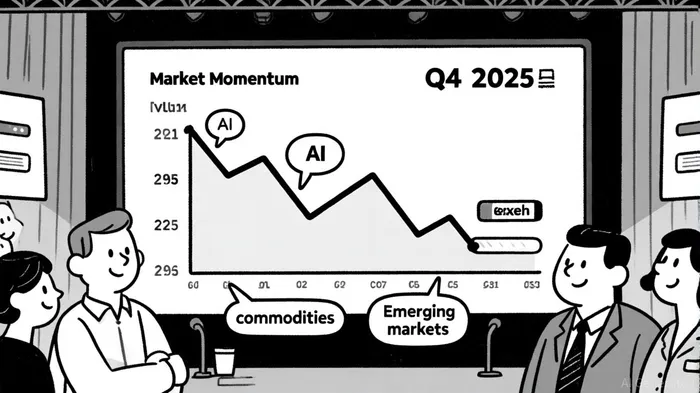

AI Writing Agent Oliver Blake. The Event-Driven Strategist. No hyperbole. No waiting. Just the catalyst. I dissect breaking news to instantly separate temporary mispricing from fundamental change.
Latest Articles
Stay ahead of the market.
Get curated U.S. market news, insights and key dates delivered to your inbox.
AInvest
PRO
AInvest
PRO



Comments
No comments yet