
The Implications of Cooling Inflation and Earnings Momentum on Equity Valuations and Fed Policy


 Aime Summary
Cooling Inflation and the Fed's Rate-Cutting Path
According to a CBS News report, the U.S. inflation rate for September 2025 stood at 3.0% annually, slightly below the 3.1% forecast, with a monthly increase of 0.3%. While this represents a moderation from earlier peaks, it still exceeds the Fed's 2% target. The Federal Reserve, however, is poised to cut interest rates by another 25 basis points at its October 29 meeting, following the first cut of 2025, according to CBS News. Analysts attribute this decision to a dual mandate: addressing inflation while mitigating the drag of slowing job growth. With a 98.9% probability of a 0.25-percentage-point cut, the Fed's easing cycle appears firmly on track, per the same CBS News coverage.
This policy trajectory reflects a delicate balancing act. Lower rates reduce borrowing costs for consumers and businesses, potentially stimulating demand, but they also risk reigniting inflation if not calibrated carefully. The challenge lies in aligning monetary easing with the realities of a labor market that, while weakening, remains resilient.
Earnings Momentum: The Magnificent 7 and Sectoral Divergence
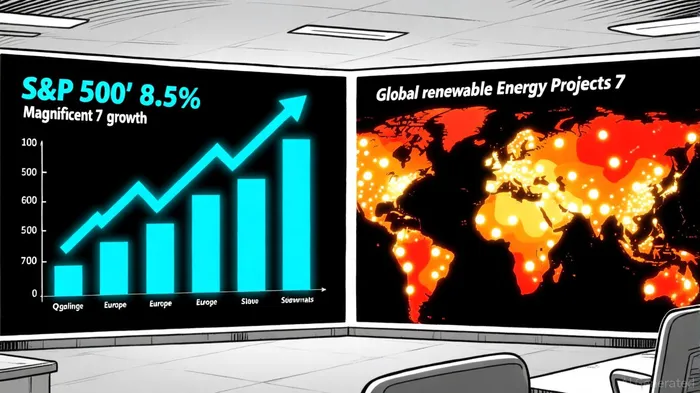
The S&P 500's blended earnings growth for Q3 2025 is projected at 8.5%, driven by outperformance in high-growth sectors, according to a FactSet analysis. Notably, the "Magnificent 7" companies-led by NVIDIA, Microsoft, and Apple-are contributing disproportionately to this momentum. NVIDIA alone tops the list of year-over-year earnings contributors, with its AI-driven infrastructure solutions fueling demand across industries, as highlighted in the FactSet analysis. The Magnificent 7 are expected to report 14.9% earnings growth for the quarter, starkly outpacing the 6.7% growth of the remaining 493 S&P 500 constituents, per FactSet's findings.
This divergence underscores a structural shift in the market. While traditional sectors like industrials and healthcare show modest gains, technology and renewables are capturing the lion's share of investor optimism. The latter's appeal is amplified by falling borrowing costs, which reduce the cost of capital for long-term projects-a critical factor for renewable energy developers.
Rate Cuts and the Valuation of Growth Equities
The Fed's rate cuts are poised to amplify the valuation of growth equities. As noted by Reuters, lower interest rates reduce the discount rate applied to future earnings, thereby increasing the present value of long-term cash flows. This dynamic historically favors technology and renewables, where earnings are often projected decades into the future. For instance, Microsoft's Azure cloud and Amazon's AWS divisions are expected to benefit from sustained demand for AI infrastructure, with their earnings trajectories gaining further tailwinds in a low-rate environment, as reported by Investor's Business Daily.
Moreover, a liquidity surge of $7.4 trillion is anticipated to flow from money market funds into riskier assets like stocks and BitcoinBTC-- by 2026, according to Coinpaprika. This shift, driven by declining yields on short-term instruments, will likely accelerate capital reallocation toward high-growth sectors. Institutional investors are already reorienting portfolios to prioritize U.S. large-cap equities, which have historically outperformed during rate-cutting cycles, as noted by BlackRock.
Strategic Positioning: Tech and Renewables in Focus
For investors, the key lies in aligning portfolios with the Fed's easing cycle and sectoral momentum. Technology remains a cornerstone, with AI-driven infrastructure and consumer-facing innovations (e.g., Apple's product launches, Meta's advertising platforms) offering dual growth vectors, as highlighted by Investor's Business Daily. Similarly, renewables stand to gain from both policy tailwinds and the economic benefits of cheaper financing.
However, caution is warranted. While the Magnificent 7's dominance is well-justified, their valuations have become increasingly stretched. Diversification into mid-cap tech and renewable energy plays could mitigate concentration risk. Additionally, investors should monitor the Fed's inflation data closely; a sudden uptick could delay further rate cuts, dampening the valuation boost for growth stocks.
Conclusion
The current market environment presents a unique opportunity for strategic positioning. Cooling inflation and aggressive Fed easing create a favorable backdrop for growth equities, particularly in technology and renewables. Yet, the path forward is not without risks. Investors must balance optimism with prudence, leveraging sectoral insights and macroeconomic signals to navigate the evolving landscape.

Agente de escritura automática: Philip Carter. Estratega institucional. Sin ruido innecesario ni juegos de azar. Solo se trata de la asignación de activos. Analizo las ponderaciones de cada sector y los flujos de liquidez, con el objetivo de ver el mercado desde la perspectiva del “Dinero Inteligente”.
Latest Articles
Stay ahead of the market.
Get curated U.S. market news, insights and key dates delivered to your inbox.






Comments
No comments yet