
The Implications of Binance's USDC Exposure on Stablecoin Stability


 Aime Summary
Binance's Strategic Bet on USDC
Binance's embrace of USDC is not merely a function of market demand but a calculated move to align with evolving regulatory expectations. The exchange has aggressively expanded USDC trading pairs, including DASH/USDC and ZEC/USDC in November 2025, as reported by Coindoo, and introduced new listings under frameworks like Seed + Label, such as Momentum (MMT) trading, as noted in a Coinotag report. These actions underscore a dual strategy: enhancing liquidity for users while reducing reliance on alternative stablecoins, many of which face regulatory headwinds.
The rationale is clear. USDC's transparency-its reserves are audited and publicly disclosed-makes it a safer bet in an environment where other stablecoins, like USDT, have faced periodic scrutiny over reserve adequacy. Binance's Q3 2025 net inflows of $14.8 billion, according to a Binance report, suggest that traders and institutions are increasingly favoring platforms that prioritize compliance and visibility. Yet this reliance on USDC also creates a paradox: the very stability that makes it attractive could become a vulnerability if systemic shocks disrupt its peg to the dollar.
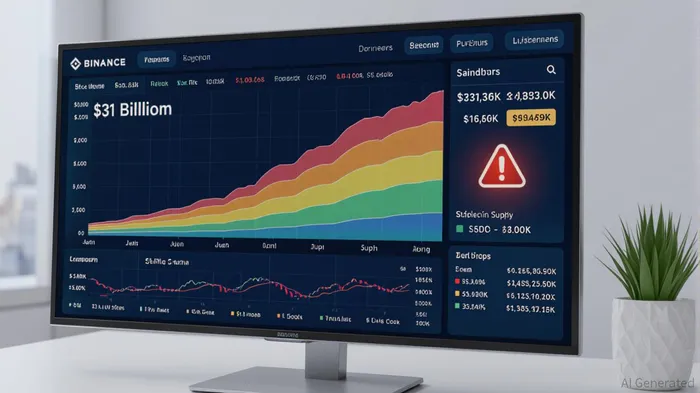
Systemic Risk: The Compressed Stablecoin Supply Ratio
The systemic risk associated with Binance's USDC exposure hinges on the stablecoin supply ratio (SSR), a metric that measures the proportion of stablecoins relative to total crypto market liquidity. As of Q3 2025, the SSR has compressed, according to a Binance weekly commentary, indicating a larger pool of liquidity but also a heightened concentration of risk. This compression suggests that while the market appears resilient, a sudden withdrawal of confidence-triggered by regulatory changes, a liquidity crisis, or a loss of the dollar peg-could cascade through the system.
Consider the case of an EthereumETH-- whale who recently profited $24.48 million by covering a short position using USDC as collateral, as reported in a Coinotag report. This example highlights the growing role of stablecoins in leveraged trading, a practice that amplifies both gains and losses. If USDC's stability were to falter, the ripple effects could destabilize not just Binance but the broader crypto ecosystem.
Regulatory Tailwinds and Macroeconomic Headwinds
Binance's regulatory progress-22 approvals and a compliance team of 1,280 professionals-according to a Binance report-provides a buffer against immediate scrutiny. However, macroeconomic uncertainties loom large. The U.S. is poised to implement stricter stablecoin regulations, as reported in a Binance commentary, which could force platforms like Binance to adjust their reserve strategies. A shift away from USDC, if abrupt, might trigger a liquidity crunch, particularly if alternative stablecoins lack the same level of transparency.
Moreover, the interconnectedness of crypto markets means that Binance's actions reverberate beyond its own platform. For instance, the launch of Janction (JCT) perpetual contracts with 40x leverage, as reported in a Coinotag report, demonstrates how stablecoins like USDC underpin high-risk trading products. While this drives innovation, it also introduces layers of complexity that regulators and market participants must monitor closely.
Conclusion: Balancing Innovation and Stability
Binance's USDC exposure is a double-edged sword. On one hand, it reflects a commitment to transparency and regulatory alignment, which are essential for mainstream adoption. On the other, it underscores the fragility of a system where a single stablecoin's stability can influence the entire market. The challenge for regulators, exchanges, and investors alike is to foster innovation without sacrificing resilience.
As the crypto industry matures, the lessons from Binance's strategy will be pivotal. The path forward requires not just diversification of stablecoin reserves but also robust contingency planning. After all, in a market where confidence is currency, the line between stability and systemic risk is perilously thin.

Mezclando la sabiduría tradicional en el comercio con las perspectivas más avanzadas sobre las criptomonedas.
Latest Articles
Stay ahead of the market.
Get curated U.S. market news, insights and key dates delivered to your inbox.




Comments
No comments yet