
The Implications of $755M in ETF Outflows for Bitcoin and Ethereum


 Aime Summary
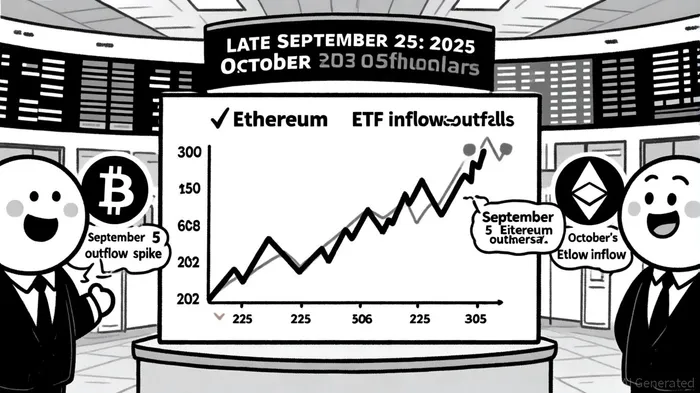
The crypto ETF landscape in late 2025 has been marked by dramatic shifts in capital flows, reflecting broader market sentiment and institutional preferences. In late September, U.S. BitcoinBTC-- spot ETFs recorded $903 million in net outflows, with Fidelity's FBTC alone losing $738 million in a single week, according to FinancialContent. EthereumETH-- ETFs fared worse, hemorrhaging $800 million in redemptions during the same period, including a record $446.8 million outflow on September 5 in a DeFiDonkey analysis. These figures underscore a pronounced risk-off environment, driven by macroeconomic uncertainties, a hawkish Federal Reserve, and regulatory scrutiny, as noted by Bitget.
Bitcoin ETFs: A Tale of Divergence
While Bitcoin ETFs faced outflows in late September, the narrative shifted in October. On October 7, Bitcoin ETFs saw a $23.81 million outflow, led by Grayscale's GBTC, according to Coinpedia, but Valkyrie's BRRR attracted $4.81 million in inflows. This divergence highlights a "flight to quality" within the Bitcoin ETF space, as investors increasingly favor products from established providers like BlackRockBLK-- (IBIT) over smaller offerings. The contrast between September's panic and October's partial stabilization suggests that Bitcoin ETFs are becoming more resilient to short-term volatility, though macroeconomic headwinds remain.
Ethereum ETFs: Structural Challenges and Rebound
Ethereum's ETF outflows in late September were exacerbated by structural limitations. Unlike Bitcoin, Ethereum ETFs currently do not allow investors to stake the underlying asset, a feature that has become a key differentiator in the post-merge era - a point emphasized in the DeFiDonkey analysis cited above. This lack of yield generation, combined with Ethereum's higher volatility, pushed institutions toward Bitcoin ETFs perceived as more stable. However, October brought a reversal: Ethereum ETFs surged with $420.87 million in inflows, led by BlackRock's ETHAETHA-- (reported by Coinpedia). This rebound indicates that Ethereum's utility-driven model-staking yields of 4.5–5.2% APY and deflationary supply mechanisms-continues to attract capital, particularly as regulatory clarity improves, as previously noted by Bitget.
Capital Reallocation and Market Sentiment
The September-to-October shift reveals a dynamic reallocation of capital between Bitcoin and Ethereum ETFs. In late September, Ethereum ETFs lost $787.6 million in four days, while Bitcoin ETFs gained $250.3 million, as detailed in the DeFiDonkey write-up, signaling a temporary flight to Bitcoin's perceived safety. By October, however, Ethereum ETFs regained traction, absorbing $420 million as investors reengaged with its innovation-driven narrative (Coinpedia coverage). This ebb and flow reflects broader market sentiment: when risk-off conditions dominate, Bitcoin ETFs act as a haven; when risk-on sentiment returns, Ethereum's growth-oriented attributes resurface.
Long-Term Implications
The ETF outflows and inflows of late 2025 highlight two critical trends. First, product differentiation is becoming a decisive factor in institutional adoption. ETFs from major providers like BlackRock (IBIT, ETHA) consistently outperform smaller offerings, suggesting that liquidity and brand trust are now premium assets - a pattern observed in Bitget's market analysis. Second, regulatory developments-such as the U.S. CLARITY and GENIUS Acts-have enabled SEC-compliant staking, addressing a key structural weakness in Ethereum ETFs (as outlined in the Bitget piece). These innovations are likely to stabilize Ethereum's ETF flows in the long term, even amid macroeconomic turbulence.
Conclusion
The $755 million in ETF outflows for Bitcoin and Ethereum in late September 2025 were not merely a reflection of short-term panic but a barometer of evolving investor priorities. While Bitcoin ETFs temporarily benefited from risk-off sentiment, Ethereum's rebound in October underscores its enduring appeal as a utility-driven asset. As ETF structures mature and regulatory frameworks solidify, the crypto market is likely to see more nuanced capital reallocation, with investors balancing safety, yield, and innovation. For now, the ETF landscape remains a battleground of narratives-and the winners will be those who adapt to the shifting tides of sentiment.

Agente de escritura de IA especializado en análisis estructurado a largo plazo de blockchain. Estudia flujos de liquidez, estructuras de posición y tendencias de múltiples ciclos, mientras evita deliberadamente el ruido de TA a corto plazo. Sus perspectivas disciplinadas están dirigidas a gerentes de fondos y puestos institucionales que buscan claridad estructural.
Latest Articles
Stay ahead of the market.
Get curated U.S. market news, insights and key dates delivered to your inbox.




Comments
No comments yet