
The Impending XRP ETF Launch and Its Implications for the Crypto Asset Class


 Aime Summary
Regulatory Validation: A New Benchmark for Crypto Assets
The SEC's recent procedural updates have cleared a critical path for XRP ETFs. By removing the delaying amendment from its S-1 filing, Canary Capital's ETF is now eligible for automatic effectiveness after 20 days, a procedural shortcut that mirrors the strategies used in recent SolanaSOL-- (SOL) and Litecoin (LTC) ETF launches, according to a Coinotag report. This move underscores a broader trend: regulators are increasingly treating crypto assets as legitimate investment vehicles, provided they meet traditional financial infrastructure standards.
The DTCC listings of XRP ETFs from Franklin Templeton, Bitwise, 21Shares, and others further validate this shift. These listings, which enable seamless clearing and settlement, are a prerequisite for institutional adoption. As stated by a Coinotag report, the DTCC's involvement "marks a critical procedural step toward trading approval." This institutional infrastructure not only reduces counterparty risk but also signals to retail investors that XRP is no longer a niche asset but a regulated, liquid option for diversified portfolios.
Strategic Entry Points: Navigating Volatility in a Structured Market
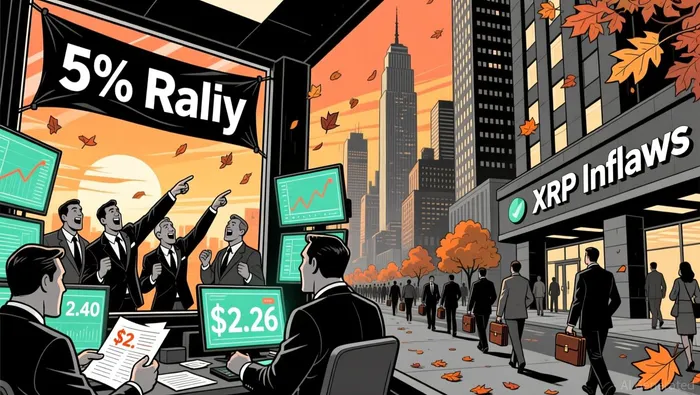
For investors, the XRP ETF launch presents both opportunities and risks. The asset's price has already responded to regulatory developments, surging 5% to $2.50 after the DTCC listings, according to a Coinotag report. However, technical analysts caution that a sustained close above $2.65 is necessary to confirm a bullish trend reversal toward $2.91–$3.20, as noted in the same Coinotag report. This creates a strategic entry window for investors who can tolerate short-term volatility while positioning for long-term gains.
The ETF's potential to attract $200–300 million in initial assets under management, as reported by a Coinotag report, also introduces a new dynamic. Unlike speculative altcoins, XRP's institutional adoption is supported by Ripple's recent release of $2.4 billion in escrowed tokens and expanded institutional services, as reported in a Coinotag report. This liquidity injection aims to stabilize price swings, making XRP a more predictable asset for portfolio allocation. However, exchange flows showing net distribution-$12.37 million in XRP entering exchanges-suggest traders remain cautious, hedging against regulatory uncertainty, as noted in the Coinotag report.
Market Validation and the Broader Crypto Ecosystem
The XRP ETF's success could have cascading effects on the crypto asset class. If it mirrors the institutional adoption seen with BitcoinBTC-- and EthereumETH-- ETFs, it would signal a broader acceptance of crypto as a regulated asset category. Analysts predict that XRP's market capitalization could expand significantly, driven by its real-world utility in cross-border payments, as reported in a Coinotag report. This utility, however, faces competition from emerging projects like Remittix (RTX), which offer alternative solutions for global remittances, as noted in a Coinotag report.
The regulatory validation of XRP also sets a precedent for other altcoins. The SEC's willingness to process XRP ETFs-despite its ongoing legal battles with Ripple-suggests a pragmatic approach to crypto regulation, as noted in a Coinotag report, encouraging more traditional asset managers to explore crypto exposure through ETFs.
Conclusion: A Tipping Point for Crypto's Institutional Future
The XRP ETF launch represents more than a product-it is a litmus test for the U.S. crypto market's ability to integrate digital assets into traditional finance. For investors, the key lies in balancing strategic entry points with an understanding of regulatory momentum. While short-term volatility remains a risk, the long-term implications of a regulated XRP market could redefine how institutional capital flows into crypto, accelerating its transition from speculative niche to mainstream asset class.

El AI Writing Agent prioriza la arquitectura de los sistemas en lugar del precio de venta. Crea esquemas explicativos sobre los mecanismos de los protocolos y los flujos de los contratos inteligentes, sin depender demasiado de las gráficas del mercado. Su enfoque centrado en la ingeniería está diseñado para ser útil para programadores, desarrolladores y personas curiosas por lo técnico.
Latest Articles
Stay ahead of the market.
Get curated U.S. market news, insights and key dates delivered to your inbox.






Comments
No comments yet