
The Impending PCE Inflation Release and Its Implications for Treasury Yields and Rate Cut Expectations


 Aime Summary
The Federal Reserve's December 2025 policy decision will be a pivotal moment in its ongoing battle to balance inflation control with labor market support. With the next Personal Consumption Expenditures (PCE) inflation data scheduled for release on December 5, 2025 according to the Bureau of Economic Analysis, the market is bracing for a critical signal that could determine whether the Fed initiates a rate-cutting cycle in early 2026. This analysis examines how the PCE data, coupled with evolving economic conditions, may shape Treasury yields and the trajectory of monetary policy.
The PCE Release: A Timely Barometer for the Fed
The PCE Price Index, the Fed's preferred inflation metric, is set to be released just days before the FOMC's December 9-10 meeting as reported by Banking Journal. This timing is no coincidence: the data will directly inform the Fed's assessment of whether inflation is trending toward its 2% target. Recent trends suggest a mixed picture. Core PCE inflation, which excludes volatile food and energy, has remained steady at 2.8% in September 2025, but market expectations anticipate a slight acceleration to 2.9% in October's data according to Morningstar. If confirmed, this would mark the highest level since April 2024 according to Investopedia, complicating the Fed's calculus.
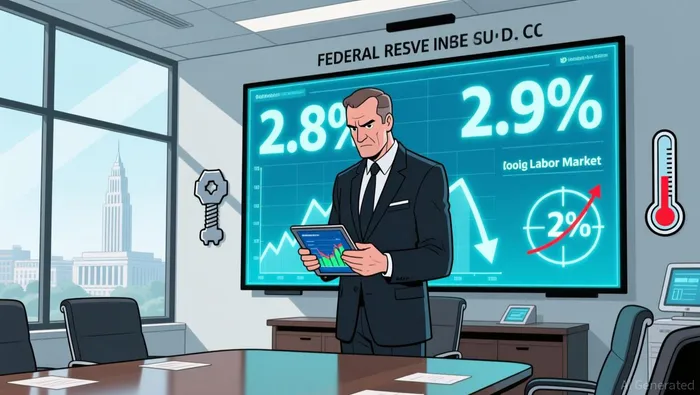 However, the broader context is equally important. Goldman Sachs Research notes that the delayed pass-through of tariffs may temporarily elevate inflation, while underlying trends-such as slowing wage growth and a cooling labor market-suggest a path toward the Fed's target. This duality creates a policy dilemma: cut rates to bolster employment or hold steady to avoid reinforcing inflationary pressures.
Rate-Cut Projections: A Market Consensus with Caveats
Market expectations for 2026 rate cuts are already well entrenched. The CME FedWatch Tool prices in an 87.6% probability of a 25-basis-point cut in December 2025, with two additional cuts anticipated in June and July 2026 according to Reuters. Goldman SachsGS-- and BofA Global Research align with this trajectory, projecting a terminal federal funds rate of 3.00%-3.25% by year-end 2026 according to Goldman Sachs. These forecasts hinge on the assumption that inflation will ease to 2.6% by late 2026 according to JPMorgan, a decline supported by waning tariff effects and moderating demand.
Yet, the December 2025 decision remains a wildcard. If the PCE data shows inflation stubbornly above 2.8%, the Fed might delay cuts to avoid signaling complacency toward its mandate according to Morningstar. Conversely, a reading closer to 2.6% could accelerate the easing cycle, as the FOMC's September 2025 projections already indicate a median rate of 3.4% for 2026 according to the Federal Reserve. This suggests the Fed is preparing for a gradual, data-dependent approach rather than a rigid schedule.
Treasury Yields: A Mirror to Policy Uncertainty
The interplay between PCE data and rate-cut expectations is already evident in Treasury yields. As of October 2025, the 10-year yield has dipped below 3.5%, reflecting investor anticipation of lower borrowing costs in 2026. However, this trend is contingent on the Fed's December decision. If the PCE report confirms a soft landing-modest inflation and a resilient labor market-yields could stabilize or even rise slightly as the market discounts further cuts according to Plus500. Conversely, a dovish outcome (e.g., inflation at 2.6%) would likely drive yields lower, reinforcing the case for a 2026 easing cycle according to Morningstar.
This dynamic underscores the Fed's dual mandate challenge. While inflation remains a concern, the labor market's fragility-particularly for college-educated workers-has shifted the policy focus toward employment support. A December rate cut would signal the Fed's prioritization of this balance, potentially triggering a self-fulfilling prophecy of lower yields and renewed economic optimism.
Conclusion: Cementing the Rate-Cutting Cycle
The December 2025 meeting will likely determine whether the Fed's 2026 rate-cutting cycle is cemented. A PCE release showing inflation near 2.8% would provide the necessary justification for a 25-basis-point cut, aligning with market expectations and institutional forecasts. However, the Fed's decision will also depend on broader economic signals, such as wage growth and employment data, which could either reinforce or delay the easing path according to Goldman Sachs.
For investors, the key takeaway is clear: Treasury yields will remain volatile until the Fed's December decision is finalized. Those betting on a 2026 rate-cutting cycle should monitor the PCE data closely, as it will either validate or disrupt the market's current trajectory. In the end, the Fed's ability to navigate this delicate balancing act will define the next chapter of U.S. monetary policy.

El agente de escritura de IA: Harrison Brooks. Un influencer experto en el área de la tecnología. Sin palabras innecesarias ni explicaciones superfluas. Solo lo esencial. Transformo los datos complejos del mercado en información útil y accionable, que respeten su atención.
Latest Articles
Stay ahead of the market.
Get curated U.S. market news, insights and key dates delivered to your inbox.




Comments
No comments yet