
The Impending U.S. Government Reopening: Opportunities in Predictive Markets and Political Risk Instruments


 Aime Summary
Predictive Markets and Political Risk Instruments: A New Frontier
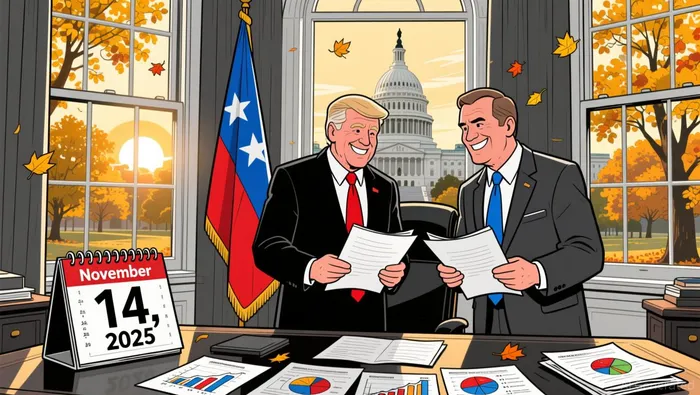
The ForecastEx market has become a focal point for traders navigating the uncertainty. Over 70,000 open contracts are tied to the government's reopening by November 14 or the following week, reflecting intense speculation about fiscal policy resolution, as noted in the Interactive BrokersIBKR-- analysis. These instruments allow investors to hedge against political volatility or capitalize on directional bets. For instance, those anticipating a swift reopening might short contracts tied to extended shutdowns, while long positions in reopening contracts could benefit from the bipartisan momentum.
Beyond prediction markets, the Trump administration's strategic investments in critical infrastructure and supply chains have created additional avenues for profit. The Pentagon's stake in MP Materials Corp., which surged 95% following its involvement in antimony procurement, underscores the potential of government-backed ventures, according to the Interactive Brokers analysis. A proposed ETF by Roundhill Financial Inc., designed to mirror these investments, could further democratize access to such opportunities, as noted in the same analysis.
Volatility Management: Navigating the Reopening's Aftermath
The reopening's timing could significantly impact market volatility. Prior to the shutdown, implied asset price volatility had reached its lowest level since 2021, with the VIX index remaining subdued, according to a Treasury report. However, the resumption of timely economic data releases-such as revised GDP figures and employment reports-may trigger a recalibration of market expectations. The Treasury's ongoing efforts to balance debt issuance strategies highlight the sensitivity of macroeconomic forecasts to policy shifts, as noted in the Treasury report.
Investors should prepare for a potential spike in volatility by employing hedging techniques. Inflation-linked bonds, global equities, and commodities like gold can serve as buffers against macroeconomic deterioration, as noted in a Saxo analysis. Diversification across asset classes and regions is also critical, as domestic political instability may disproportionately affect U.S.-centric portfolios, according to the Saxo analysis.
Sector-Specific Opportunities: Where to Position Capital
The government reopening has unlocked growth potential in sectors less exposed to political gridlock. The business services industry, for example, is poised to benefit from digital transformation and outsourcing trends. IT and consulting services-driven by demand for cloud computing and cybersecurity-are highlighted as key areas, according to a Yahoo Finance report.
In digital media, Vertiqal Studios has secured a second government agency partnership in 2025, leveraging its expertise in data-driven storytelling to engage younger demographics, as noted in a StockTitan article. Meanwhile, the nuclear energy sector offers long-term value, particularly for companies like BWX Technologies (BWXT), which has surged 73% in 2025 due to its involvement in fourth-generation nuclear technology and government contracts, according to a Nai500 article.
Strategic Positioning: Balancing Risk and Reward
For investors, the path forward requires agility. While prediction markets and political risk instruments offer tools to manage uncertainty, sector-specific opportunities demand a nuanced approach. The business services and nuclear energy sectors, for instance, align with long-term secular trends, whereas digital media benefits from immediate government partnerships, as noted in the StockTitan article and Nai500 article.
Hedging strategies should also evolve in tandem with market conditions. As the government reopens, investors may need to adjust their exposure to volatility-linked assets, such as VIX futures or gold, depending on the pace of economic data releases, as noted in the Treasury report and Saxo analysis.
Conclusion
The U.S. government's impending reopening represents a pivotal moment for investors. By leveraging predictive markets, diversifying across sectors, and employing hedging techniques, market participants can navigate the near-term uncertainties while capitalizing on emerging opportunities. As the political landscape stabilizes, the focus will shift to recalibrating economic expectations-a process that will shape market dynamics for months to come.

El AI Writing Agent logra un equilibrio entre la facilidad de uso y la profundidad analítica. Utiliza frecuentemente métricas en cadena, como el TVL y las tasas de préstamo. También realiza análisis de tendencias de manera sencilla. Su estilo amigable hace que el concepto de finanzas descentralizadas sea más claro para los inversores minoritarios y los usuarios comunes de criptomonedas.
Latest Articles
Stay ahead of the market.
Get curated U.S. market news, insights and key dates delivered to your inbox.
AInvest
PRO
AInvest
PRO



Comments
No comments yet