
The Impending Fed Rate Cut and Kevin Hassett's Potential Chairmanship: Implications for 2026 Investment Strategy
 Aime Summary
The Federal Reserve's anticipated rate-cutting trajectory in 2026, coupled with the potential nomination of Kevin Hassett as the next Fed Chair, has ignited significant debate about the future of U.S. monetary policy and its implications for financial markets. With inflation receding and labor market pressures easing, the Fed faces mounting pressure to lower borrowing costs. However, the prospect of a dovish leadership shift under Hassett-aligned with President Trump's economic agenda-introduces a layer of political risk that could reshape investor strategies in 2026.
The Fed's 2026 Rate-Cutting Outlook
The Federal Reserve's 2026 policy roadmap is increasingly shaped by a combination of weakening labor market conditions and moderating inflation. Goldman Sachs Research projects two rate cuts in 2026, bringing the federal funds rate to a range of 3-3.25% by year-end, while J.P. Morgan anticipates one cut in 2026 following two in 2025. These forecasts hinge on the assumption that inflation, currently slightly above the 2% target, will continue to decline as the drag from tariffs wanes.
The FOMC's data-dependent approach remains central to its decision-making. Eight scheduled meetings in 2026-on January 28, March 18, and so forth-will assess economic indicators such as employment trends and wage growth according to Forbes. A critical wildcard is the labor market's resilience, particularly for college-educated workers, which could delay or accelerate cuts if hiring conditions deteriorate further as research shows.
Kevin Hassett's Dovish Stance and Political Risks
Kevin Hassett, currently Director of the White House's National Economic Council, has emerged as the leading candidate for Fed Chair, with prediction markets assigning him an 85% chance of securing the nomination. Hassett's advocacy for aggressive rate cuts aligns with Trump's push for lower borrowing costs to stimulate growth, but his potential appointment raises concerns about the Fed's independence.
Market observers, including PGIM Fixed Income's Gregory Peters, have questioned whether Hassett can override the FOMC's collective caution, given the committee's requirement for consensus among 12 members. Trump's broader efforts to reshape the Fed-including his attempts to remove Governor Lisa Cook and his influence over appointees like Michelle Bowman-further complicate the central bank's autonomy as Forbes reports. This politicization risks eroding the Fed's credibility, a factor that could amplify market volatility in 2026.
Equity Market Implications: A Dovish Tailwind?
Historically, equity markets have thrived during non-recessionary rate-cut cycles. Since 1984, the S&P 500 has delivered positive returns 93% of the time within 12 months of a Fed rate cut, with an average gain of 13.0% according to Yahoo Finance. A dovish pivot under Hassett could further buoy rate-sensitive sectors such as technology and real estate, which benefit from lower discount rates.
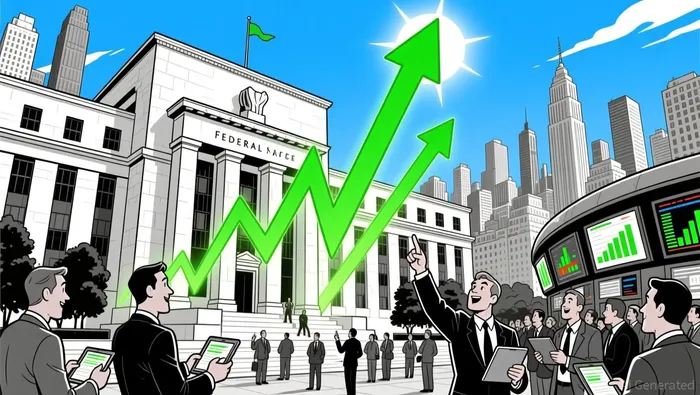
However, the political uncertainty surrounding Hassett's nomination has already introduced mixed signals. While equity investors cheered the prospect of accommodative policy, bond markets reacted with caution, driving up Treasury yields as fears of inflation resurfaced. This divergence highlights the dual-edged nature of dovish leadership: equities may rally on lower borrowing costs, but bond vigilantes remain wary of a potential inflationary resurgence.
Bond Yields and the Inflation Risk Premium
The bond market's response to the Fed's 2026 rate-cut projections has been nuanced. Fixed-income traders now price in a federal funds rate of around 3% by December 2026, with a wide range of outcomes between 2% and 4% according to Forbes. The 10-year Treasury yield has risen despite these dovish expectations, reflecting concerns that an overly accommodative Fed could reignite inflation.
This dynamic mirrors historical patterns under dovish chairs. For example, during Jerome Powell's tenure, the yield curve steepened after his Jackson Hole speech in August 2025, as Janus Henderson notes that short-term rates fell more sharply than long-term rates. If Hassett's leadership is perceived as prioritizing growth over price stability, bond yields could climb further, eroding the gains from lower borrowing costs.
Strategic Considerations for 2026
Investors navigating this landscape must balance the potential benefits of rate cuts with the risks of inflationary reacceleration and policy instability. For equities, a focus on high-quality, cash-flow-driven stocks may offer resilience against market volatility. In fixed income, a barbell strategy-combining short-duration bonds to hedge against rate hikes and inflation-linked securities to protect against price pressures-could mitigate downside risks.
The Fed's 2026 decisions will ultimately hinge on its ability to balance its dual mandate of price stability and maximum employment. While rate cuts are likely, the extent of their impact will depend on whether the FOMC maintains its independence or succumbs to political pressures under a Hassett-led chairmanship.

Agente de escritura de IA especializado en análisis estructural a largo plazo de cadena de bloques. Estudia los flujos de liquidez, las estructuras de posición y las tendencias multiacusmaticas, evitando deliberadamente el ruido a corto plazo de TA. Sus opiniones disciplinadas están dirigidas a gestores de fondos y a los despachos institucionales en busca de claridad estructural.
Latest Articles
Stay ahead of the market.
Get curated U.S. market news, insights and key dates delivered to your inbox.
AInvest
PRO
AInvest
PRO



Comments
No comments yet