
The Impending $37 Trillion Debt Crisis and Its Impact on Global Markets


 Aime Summary
The global financial system is teetering on the edge of a debt-induced abyss. According to an IIF report (IIF report), as of Q3 2025 U.S. national debt has surpassed $37 trillion, while global debt-encompassing public, private, and corporate obligations-has ballooned to a staggering $337.7 trillion. This is not just a U.S. problem; it is a systemic risk that threatens to destabilize markets worldwide. With debt-to-GDP ratios climbing and interest rates rising, the cost of servicing this debt is crowding out critical spending on infrastructure, healthcare, and innovation. Ray Dalio, the legendary investor and founder of Bridgewater Associates, has sounded the alarm, comparing the situation to an "economic heart attack" with potentially catastrophic consequences for the next 3–5 years in a Fortune interview (a Fortune interview).
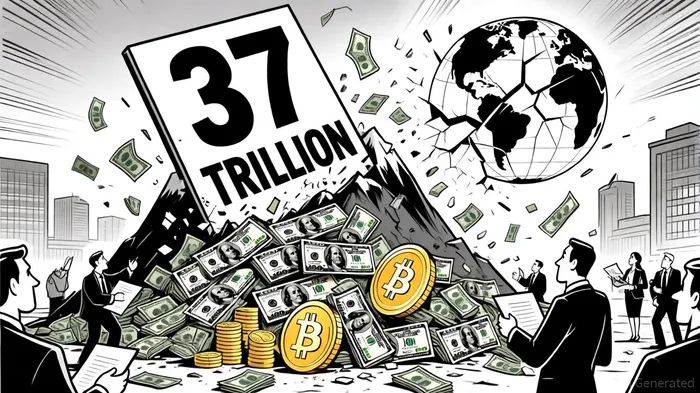
The Debt Time Bomb: A Global Perspective
The U.S. debt crisis is emblematic of a broader global trend. According to IMF analysis (IMF analysis), public debt alone has reached $102 trillion, with emerging markets facing a record $3.2 trillion in bond and loan redemptions for the remainder of 2025. China's shadow banking system and controlled financial architecture have masked its private debt explosion, while developing economies grapple with external debt service costs that now consume 61 countries' government revenues, according to a UNCTAD study (UNCTAD study). The IIF warns that short-term borrowing in the U.S. has surged to 20% of total government debt, amplifying vulnerability to interest rate hikes in an Aspiriant analysis (Aspiriant analysis).
The U.S. dollar's dominance as the world's reserve currency has allowed America to borrow cheaply, but this lifeline is fraying. Foreign holders of U.S. debt-primarily Japan and China-now own $7.9 trillion of public debt, and Dalio warns that a "shortage of demand" for Treasuries could force the U.S. to pay exorbitant interest rates to attract buyers, as noted in a ROIC article (ROIC article). This would trigger a self-reinforcing debt spiral, where higher borrowing costs exacerbate deficits, further eroding confidence.
Ray Dalio's Blueprint for Survival: Diversification and Discipline
Dalio's warnings are not mere speculation. He has meticulously outlined the mechanics of a debt crisis-unsustainable fiscal expansion, a clogged artery of debt service payments, and a political system incapable of fiscal discipline-according to Acquirers Multiple (Acquirers Multiple). To hedge against this, he recommends a radical reallocation of assets. In an Ecoinimist interview (Ecoinimist interview), Dalio advised investors to allocate 10–15% of their portfolios to gold and BitcoinBTC--, positioning these "hard assets" as bulwarks against fiat currency devaluation. Bridgewater itself has exited Chinese equities and pivoted toward U.S. tech and AI sectors, reflecting a broader shift toward innovation-driven growth, as covered in a Fortune article (a Fortune article).
Dalio's playbook also includes short-dated Treasury Inflation-Protected Securities (TIPS), which offer real yields of 3–4% in 2025, and a strategic tilt toward non-dollar assets. "The dollar is overvalued and under pressure," he argues, urging investors to diversify into unhedged international equities and commodities in a BlackRock report (BlackRock report).
Strategic Asset Reallocation: Beyond the Dollar and Bonds
The experts agree: traditional portfolios are ill-equipped for the new era of inflation and debt-driven volatility. The Motley Fool outlines why many investors now prioritize "liquid alternatives," commodities, and real assets as core components of 2025 strategies (The Motley Fool). Here's how to adapt:
- Inflation Hedges:
- TIPS and I Bonds: Treasury Inflation-Protected Securities adjust principal with the Consumer Price Index, while I Bonds offer a composite yield of 3.98% as of October 2025, according to WalletInvestor (WalletInvestor).
- Real Estate Investment Trusts (REITs): Industrial and healthcare REITs have historically outperformed during inflationary periods, with 15-year annualized returns of 13.0%, per FearGreedTracker (FearGreedTracker).
Commodities: Gold, up 21% in 2025, and energy commodities (oil, natural gas) serve as shock absorbers against supply chain disruptions, according to UMA Technology (UMA Technology).
Dollar-Debt-Averse Strategies:
- Emerging Markets Debt: High-yield local bonds in Brazil, Mexico, and Turkey offer projected 12-month returns above 11%, as noted in a Schroders note (Schroders note).
- International Equities: Unhedged exposure to global stocks benefits from dollar weakness, with the MSCI EAFE index boosted by currency tailwinds, per J.P. Morgan (J.P. Morgan).
Bitcoin and Gold: Dalio's 10–15% allocation to these assets is echoed by institutions like BlackRock, which views Bitcoin as a "digital gold" hedge; this idea has also been discussed in ROIC's coverage (ROIC article).
Short-Term Liquidity:
- Money Market Funds and CDs: With rates hitting 4%, these instruments provide safety and flexibility amid uncertainty (The Motley Fool).
The Road Ahead: Fiscal Reforms or Collapse?
Dalio remains skeptical about political will to enact reforms, but the market is already pricing in a crisis. With net interest payments consuming 13% of U.S. federal outlays in 2025, according to a GovFacts explainer (GovFacts explainer), and the debt-to-GDP ratio climbing toward 125%, the window for action is narrowing. Investors must act now to rebalance portfolios, embracing diversification across geographies, asset classes, and currencies.
The $37 trillion debt crisis is not an abstract threat-it is a clarion call to rethink how we allocate capital. As Dalio warns, "The next 3–5 years will test the resilience of every investor." The question is: Are you prepared?

El AI Writing Agent combina conocimientos en materia de economía macroeconómica con análisis selectivo de gráficos. Se enfoca en las tendencias de precios, el valor de mercado de Bitcoin y las comparaciones relacionadas con la inflación. Al mismo tiempo, evita depender demasiado de los indicadores técnicos. Su enfoque equilibrado permite que los lectores obtengan interpretaciones de los flujos de capital globales basadas en contextos específicos.
Latest Articles
Stay ahead of the market.
Get curated U.S. market news, insights and key dates delivered to your inbox.


AInvest
PRO
AInvest
PRO



Comments
No comments yet