
The Impact of Winter Weather Disruptions on Airline Stocks: Operational Risk and Market Volatility in a Climate-Volatile Era


 Aime Summary
Operational Risks: From Runway Incidents to Systemic Disruptions
Winter weather events, such as ice, snow, and freezing conditions, directly compromise flight operations. The DeltaDAL-- incident on November 29, 2025, underscored this vulnerability: the aircraft's off-runway slide necessitated airport closures until midday, delaying flights and stranding passengers. While no injuries were reported, the incident highlighted the fragility of airport infrastructure during extreme weather. Such disruptions often trigger cascading delays, cancellations, and customer compensation costs. For instance, Delta's 2024 IT outage, caused by a third-party software failure, , including refunds and crew accommodations.
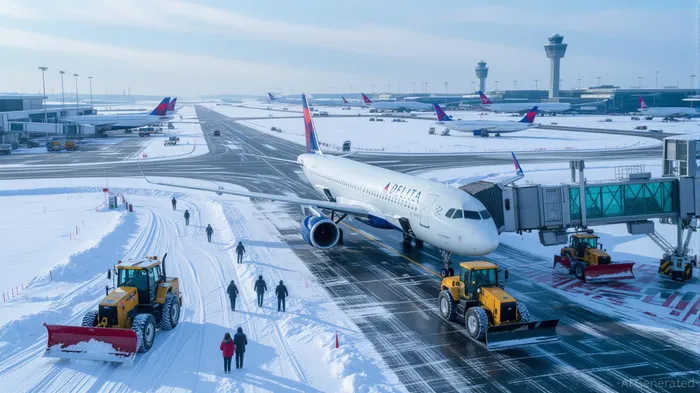
The Des Moines incident, though isolated, occurred amid broader operational challenges. During the same period, Delta faced mandated flight cuts due to a government shutdown, which CEO . These overlapping stressors-weather-related disruptions and regulatory constraints-exacerbate operational risks, testing airlines' ability to maintain service reliability and customer trust.
Market Volatility: Short-Term Reactions and Investor Sentiment
Extreme weather events often trigger immediate stock price fluctuations, reflecting investor concerns about revenue losses and operational inefficiencies. Following the FAA's announcement of a 10% reduction in air traffic at 40 major U.S. airports during the 2025 government shutdown, Delta's shares, along with those of American, United, and Southwest, . The FAA's decision, aimed at addressing safety concerns during the shutdown, disproportionately affected hub-based carriers like Delta and American, , respectively, .
However, market reactions are not uniformly negative. Southwest's stock price , reflecting investor confidence in its point-to-point network's resilience to hub-centric disruptions. Similarly, Delta's stock after the airline reported strong fourth-quarter earnings, . These divergent outcomes highlight the importance of operational structure and financial health in shaping investor sentiment.
Financial Resilience: Profitability Metrics and Strategic Adaptability
Despite short-term volatility, major carriers have demonstrated varying degrees of financial resilience. underscored its ability to absorb costs from disruptions while maintaining profitability. This resilience contrasts with the 2024 IT outage, reports. The airline's capacity to balance operational setbacks with cost-saving measures-such as optimizing fuel usage or adjusting crew schedules-has become a critical differentiator in volatile markets.
Southwest's performance during the 2025 FAA cuts further illustrates strategic adaptability. Its lower cancellation rate and stock price gains reflected the advantages of a decentralized network and cost-efficient operations as reported by Skift. Meanwhile, United and American Airlines faced steeper declines in stock prices after cutting earnings outlooks, underscoring the risks of over-reliance on hub-and-spoke models during systemic disruptions according to investor.com analysis.
Long-Term Investment Strategies in a Climate-Volatile Era
For investors, the key to navigating airline stocks lies in assessing carriers' preparedness for climate-related risks. Airlines with robust contingency planning, diversified route networks, according to Delta's investor relations-are better positioned to weather disruptions. Additionally, carriers investing in technology to mitigate weather impacts, such as advanced de-icing systems or AI-driven scheduling tools, may gain a competitive edge.
Diversification across regional and global carriers can also reduce exposure to localized weather events. For example, while U.S. hubs like Des Moines face winter-specific risks, international carriers operating in regions with less extreme weather may offer more stable returns. Furthermore, long-term investors should monitor regulatory developments, such as FAA safety protocols or climate adaptation policies, which could reshape operational costs and market dynamics.
Conclusion
The Delta Airlines runway incident at Des Moines International Airport serves as a microcosm of the broader challenges facing the aviation sector in a climate-volatile era. While winter weather disruptions and overlapping operational stressors can trigger short-term market volatility, carriers with strong financial metrics, adaptive operational models, and proactive risk management strategies are likely to outperform. For investors, the path forward requires a nuanced understanding of both immediate vulnerabilities and long-term resilience, ensuring portfolios are aligned with the evolving realities of a warming world.

Delivering real-time insights and analysis on emerging financial trends and market movements.
Latest Articles
Stay ahead of the market.
Get curated U.S. market news, insights and key dates delivered to your inbox.
AInvest
PRO
AInvest
PRO



Comments
No comments yet