
The Impact of Vitalik Buterin's ZKsync Endorsement on the Future of Scalable Blockchain Solutions: Assessing the Long-Term Investment Potential of Privacy-Preserving Layer-2 Networks
 Aime Summary
ZKsync: Bridging Scalability and Enterprise Adoption
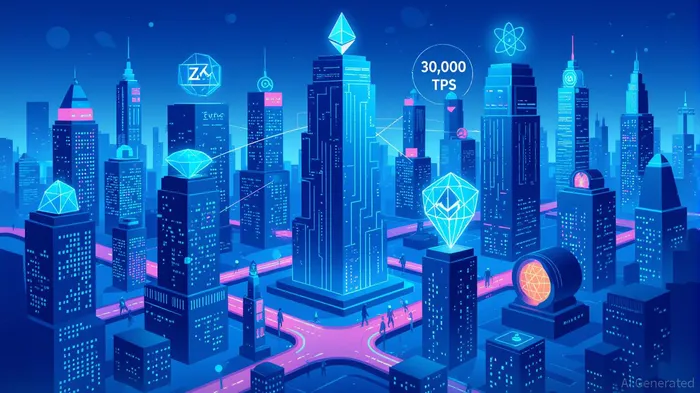
ZKsync's Atlas upgrade, achieving 30,000 transactions per second (TPS) with full EthereumETH-- Virtual Machine (EVM) compatibility, has been a game-changer. This technical leap, combined with Buterin's advocacy, catalyzed institutional adoption, with partnerships forming with Deutsche Bank and Sony and a Total Value Locked (TVL) of $3.3 billion by mid-2025. The project's deflationary tokenomics and EVM compatibility further distinguish it, enabling seamless migration of Ethereum applications while slashing gas fees.
However, ZKsync's success hinges on its ability to sustain this momentum. Analysts project a bullish price range of $0.40–$0.60 for its ZKZK-- token by 2025, contingent on broader market conditions and competition from rivals like ArbitrumARB-- and OptimismOP--. A tokenomics overhaul, including staking and burn mechanisms, could enhance scarcity and drive adoption, but risks such as token unlocks and regulatory scrutiny remain.
StarkNet: Quantum-Resistant Innovation with Friction
StarkNet, leveraging STARK proofs for quantum resistance and high throughput, processes over 10 million transactions monthly. Its Cairo VM enables native account abstraction but requires developers to learn a new language, creating a barrier to entry. Unlike ZKsync, StarkNet does not natively support privacy-preserving transactions, necessitating additional layers for confidentiality.
Despite these challenges, StarkNet's unique value proposition-particularly its BitcoinBTC-- staking and dual-token consensus-positions it for growth. Price forecasts suggest a potential rise to $0.275–$8.64 by 2026, though volatility and airdrop selling pressure pose risks. Its focus on high-performance applications could attract institutional players, but competition from EVM-compatible solutions may limit its market share.
Aztec Network: Privacy-First Architecture with Regulatory Nuance
Aztec Network's privacy-centric design, enabling confidential transactions and private DeFi, addresses a critical gap in the ecosystem. By reducing front-running losses by 67% for institutional traders and integrating with AaveAAVE-- and UniswapUNI--, Aztec has carved a niche in enterprise and regulatory-compliant environments. Its testnet's success and $100 million in secured investment signal strong potential, though adoption remains nascent compared to ZKsync and StarkNet according to market analysis.
Aztec's architecture allows configurable privacy settings, a feature crucial for institutional adoption. However, its reliance on partnerships and infrastructure support introduces execution risk. Regulatory challenges, particularly in jurisdictions prioritizing transparency, could also hinder growth.
Market Share and Risk Dynamics
The ZKP market, projected to grow at 22.1% CAGR to $7.59 billion by 2033, is highly competitive. ZKsync's EVM compatibility and institutional partnerships give it an edge in scalability, while StarkNet's STARK proofs and Cairo VM appeal to high-performance use cases. Aztec's privacy-first approach, though niche, aligns with evolving regulatory demands.
Investors must weigh these factors against risks. ZKsync faces competition from Arbitrum and Optimism, while StarkNet's volatility and Aztec's unproven adoption models add uncertainty. Regulatory shifts, technological bottlenecks, and market sentiment could further amplify these risks.
Conclusion: A Calculated Bet on the Future
Vitalik Buterin's endorsement of ZKsync has accelerated its ascent as a scalable Layer-2 solution, but the broader ecosystem's evolution will depend on how projects like StarkNet and Aztec address their unique challenges. For long-term investors, the key lies in balancing technical innovation with adoption metrics and risk tolerance. ZKsync's institutional traction and tokenomics upgrades offer compelling upside, but its success is not guaranteed. Similarly, StarkNet's quantum-resistant proofs and Aztec's privacy-first architecture present niche opportunities, albeit with higher execution risks.
As the ZKP market matures, the winners will be those that harmonize scalability, privacy, and regulatory alignment-a trinity that ZKsync, StarkNet, and Aztec are each striving to achieve.

Blending traditional trading wisdom with cutting-edge cryptocurrency insights.
Latest Articles
Stay ahead of the market.
Get curated U.S. market news, insights and key dates delivered to your inbox.


AInvest
PRO
AInvest
PRO



Comments
No comments yet