
The Impact of Urban Development on Sports Real Estate: Fenway Park and the Green Monster at Risk
 Aime Summary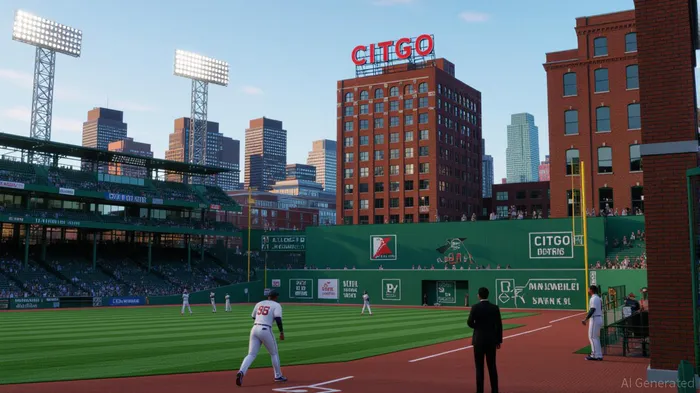
Boston's Fenway Park, a 111-year-old baseball cathedral, has long been a linchpin of the city's cultural and economic identity. But as Fenway Sports Group (FSG) pushes forward with its $1.6 billion Fenway Corners development—a seven-story office and retail complex adjacent to the Green Monster—the intersection of real estate, urban planning, and sports tourism is under scrutiny. The project, which replaces a parking garage and storage facility with a 129-foot-tall structure, raises critical questions: Can a historic sports venue coexist with modern urban development without losing its soul? And what does this signal for the broader valuation of sports real estate in an era of gentrification and shifting fan expectations?
The Green Monster's Shadow: A Clash of Eras
The proposed 55 Lansdowne Street building, set to begin construction in 2026, is designed to house FSG's headquarters and 250,000 square feet of mixed-use space. While developers emphasize its “gritty” brick facade and pass-through connectivity to the Mass Pike, critics argue the structure's height—nearly 10 feet taller than the Green Monster—could alter Fenway's iconic skyline. The Citgo sign, a beloved landmark visible from the park, may also face partial obstruction from certain vantage points. For fans, the Green Monster is not just a wall but a symbol of nostalgia, where home runs hang in the air against a blue sky, framed by the sign's glowing letters.
Urban planners and architects have voiced concerns that the building's scale could disrupt the “intimate” atmosphere that makes Fenway unique. “Fenway's magic lies in its contradictions: a 100-year-old park in a 21st-century city,” says Boston University architecture professor Emily Carter. “This project risks turning the area into a corporate extension of the ballpark rather than a complementary urban space.”
Sports Tourism and Real Estate: A Double-Edged Sword
Fenway Park's economic impact is undeniable. Over the past five years, Boston bars and restaurants near the park have seen a 60% revenue boost on game days, driven by tourists and locals alike. The area's real estate has also benefited: property values in the Fenway-Kenmore neighborhood have risen 12% annually since 2020, outpacing Boston's citywide average. This growth is partly attributed to the park's role as a cultural anchor, drawing visitors who spend on hotels, dining, and retail.
However, the proposed development could shift this dynamic. While the new building may attract office workers and event-driven foot traffic, it could also displace smaller businesses that rely on game-day crowds. A 2023 study by the Boston Institute for Urban Research found that stadium-adjacent areas often see a “transfer of wealth” rather than net economic gains, with rising rents pricing out long-time residents and independent operators.
Lessons from Wrigley Field and Beyond
The case of Chicago's Wrigley Field offers a cautionary tale. Wrigleyville, once a blighted neighborhood, transformed into a tourist hub after the Cubs' 2003 renovations. Property values soared, but so did displacement rates. A 2022 report by the Urban Land Institute noted that while Wrigleyville's real estate appreciated by 25% post-renovation, 40% of long-term residents were priced out. The area now faces criticism for prioritizing visitors over locals, with bars and restaurants catering to tourists rather than the community.
Similarly, Detroit's Little Caesars Arena, opened in 2017, spurred $2 billion in surrounding development but also sparked debates over gentrification. A 2024 analysis by the Detroit Economic Growth Corporation found that while the arena district saw a 15% increase in property values, nearby neighborhoods experienced stagnant growth and rising inequality.
The Investment Angle: Risks and Opportunities
For investors, the Fenway Corners project highlights the duality of sports real estate. On one hand, developments near iconic venues can drive short-term gains through tourism and commercial activity. On the other, they risk eroding the very assets that make these locations valuable. The key lies in balancing preservation with progress.
FSG's project, for instance, could appeal to institutional investors seeking exposure to Boston's urban core. The building's penthouse event space and retail floors may attract high-end tenants, while the pass-through to the Mass Pike could enhance connectivity. However, the project's success hinges on its ability to preserve Fenway's character. If the Green Monster becomes a backdrop for corporate branding rather than a symbol of baseball history, the long-term valuation of the area—and the park itself—could suffer.
A Blueprint for the Future
The broader lesson for cities is clear: sports real estate must evolve without erasing its roots. The “arena-anchored” model, as studied in Columbus, Ohio, and Detroit, Michigan, shows that success comes from bundling amenities—residential, retail, and cultural—into walkable, mixed-use districts. Columbus's Arena District, for example, combined a stadium with arts venues and restaurants, creating a 24/7 destination that boosted property values by 18% in a decade.
For Boston, the challenge is to replicate this balance. The Fenway Corners project could become a model if it prioritizes community input, affordable housing, and public spaces. Conversely, if it leans too heavily on corporate interests, it risks becoming another Wrigleyville—where tourism thrives but local identity fades.
Conclusion: Preserving the Past, Investing in the Future
The Green Monster may be at risk, but so is the future of sports real estate as a force for inclusive growth. Investors must weigh the immediate returns of urban development against the long-term value of cultural preservation. In Boston, the stakes are high: a building that could either enhance Fenway's legacy or diminish it. As FSG moves forward, the world will be watching to see if the Red Sox can hit a home run—or if the Monster will be left in the shadows.

Delivering real-time insights and analysis on emerging financial trends and market movements.
Latest Articles
Stay ahead of the market.
Get curated U.S. market news, insights and key dates delivered to your inbox.


AInvest
PRO
AInvest
PRO



Comments
No comments yet