
The Impact of Trump Tariffs on Inflation and Crypto ETF Flows


 Aime Summary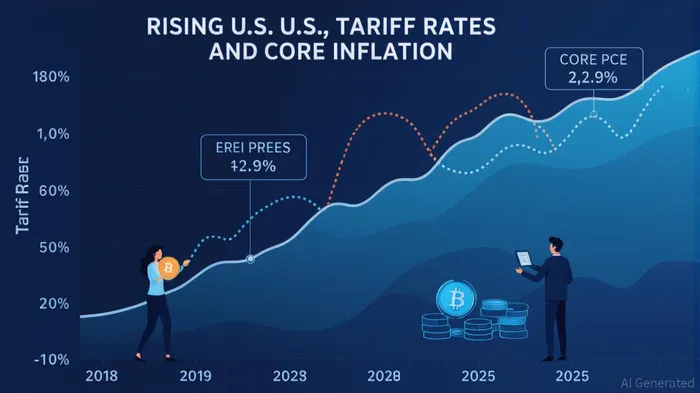
The TrumpTRUMP-- administration’s aggressive tariff policies, now entrenched at an 18.6% average effective rate as of August 2025—the highest since 1933—have created a dual challenge for the U.S. economy: persistent inflationary pressures and a recalibration of investor risk preferences. These tariffs, initially framed as tools to protect domestic industries, have instead exacerbated economic uncertainty, driven up consumer prices, and forced investors to reassess their exposure to both traditional and digital assets.
Tariffs as a Catalyst for Inflation
The inflationary impact of Trump’s tariffs is now undeniable. By April 2025, the average effective tariff rate had surged to 22.5%, the highest since 1909, directly contributing to a 2.3% rise in the price level in the short run [3]. This translated to a $3,800 annual loss in purchasing power per household, with lower-income families bearing the brunt of the burden [3]. By August 2025, the cumulative effect of these tariffs had pushed core PCE inflation to 2.9% annually—a level not seen since February 2025—and spurred a 1.8% increase in consumer prices [4]. Sectors like footwear and apparel saw even sharper spikes, with prices rising 39% and 37%, respectively [4].
The long-term economic toll is equally concerning. The Penn Wharton Budget Model estimates that Trump’s tariffs will reduce U.S. GDP by 6% and wages by 5% in the long run, with middle-income households facing a $22,000 lifetime loss [5]. These projections underscore a structural shift toward a smaller, more protectionist economy, where inflationary pressures are not just transitory but embedded in the policy framework.
Investor Risk Reassessment in a High-Inflation Environment
As inflation persists, investors have begun to recalibrate their risk appetites. The crypto market, historically a haven for inflation hedging, has seen mixed signals. In July 2025, BitcoinBTC-- and EthereumETH-- ETFs recorded significant outflows—$126.64 million and $164.64 million, respectively—as investors reacted to the Federal Reserve’s hawkish stance and the broader economic uncertainty [1]. Fidelity’s FBTC ETF alone lost $66.2 million in a single day, reflecting a flight from volatile assets amid rising policy risks [1].
Yet, the story is not entirely bearish. Ethereum ETFs, for instance, maintained 44% growth in August 2025, reaching $13.7 billion in assets under management, driven by corporate adoption of Ethereum treasuries and a rebound in institutional interest [1]. Institutional investors now hold 4.4 million ETH, valued at over $19 billion—3.7% of the total supply—indicating a nuanced shift in sentiment [1]. This duality highlights the complexity of investor behavior: while short-term volatility and policy uncertainty drive outflows, long-term institutional confidence in crypto remains resilient.
The Fed’s Role and Future Implications
The Federal Reserve’s response to inflation and tariff-driven uncertainty will be pivotal. Markets are pricing in a potential rate cut at the Fed’s next meeting, contingent on weak labor data, but the interplay between monetary policy and Trump’s tariffs remains unpredictable [1]. Goldman SachsGS-- analysts note that tariff costs passed to consumers could rise from 22% in June 2025 to 67% by October 2025, further tightening monetary conditions [2]. This dynamic could force the Fed into a delicate balancing act: curbing inflation without stifling an already weakened economy.
For crypto investors, the path forward hinges on macroeconomic clarity. While the sector’s volatility remains a barrier, the growing institutional embrace of Ethereum and the potential for Fed rate cuts could create contrarian entry points. However, leveraged trading and inflationary pressures continue to pose risks, as evidenced by $823 million in Bitcoin and Ethereum liquidations in August 2025 [3].
Conclusion
Trump’s tariffs have redefined the U.S. economic landscape, embedding inflationary pressures that challenge both policymakers and investors. The resulting risk reassessment has led to a bifurcated response in crypto ETFs: short-term outflows amid uncertainty and long-term institutional confidence in digital assets. As the Fed navigates this complex environment, investors must weigh the immediate costs of inflation against the potential for structural shifts in capital allocation. The coming months will test whether crypto can evolve from a speculative asset to a legitimate hedge in a protectionist, high-inflation world.
Source:
[1] Bitcoin, Ether ETFs See Outflows as Fed Flags Inflation, [https://cointelegraph.com/news/bitcoin-ether-etfs-see-outflows-fed-inflation-trump-tariffs]
[2] Investor Fears Trump Tariffs Fuel Inflation, Spooking Crypto ETFs, [https://www.ainvest.com/news/bitcoin-news-today-investor-fears-trump-tariffs-fuel-inflation-spooking-crypto-etfs-2508/]
[3] State of U.S. Tariffs: August 7, 2025 | The Budget Lab at Yale, [https://budgetlab.yale.edu/research/state-us-tariffs-august-7-2025]
[4] U.S. Inflation Report Shows Effects of Trump's Tariffs, [https://www.nytimes.com/live/2025/08/12/business/cpi-inflation-tariffs-fed]
[5] The Economic Effects of President Trump's Tariffs, [https://budgetmodel.wharton.upenn.edu/issues/2025/4/10/economic-effects-of-president-trumps-tariffs]

Decoding blockchain innovations and market trends with clarity and precision.
Latest Articles
Stay ahead of the market.
Get curated U.S. market news, insights and key dates delivered to your inbox.






Comments
No comments yet