
The Impact of Trump's Obesity Drug Price Pledge on Biopharma Stocks: Valuation Risks and Sector-Wide Profit Margin Compression in Innovation-Driven Biotechs


 Aime Summary
The Trump administration's 2025 obesity drug pricing policies have ignited a seismic shift in the biopharmaceutical sector, with innovation-driven biotechs facing unprecedented valuation risks and profit margin compression. At the core of this transformation lies the administration's aggressive push to align U.S. drug prices with those in other developed countries through the Most Favored Nation (MFN) pricing model, coupled with a 100% tariff threat on imported branded drugs. These measures, while aimed at reducing consumer costs, have triggered a cascade of financial and operational challenges for biotech firms, particularly those reliant on high-margin obesity therapies like Wegovy and Zepbound.
Profit Margin Compression: A Direct Threat to Biotech Earnings
The MFN pricing model mandates that pharmaceutical companies sell their drugs in the U.S. at the lowest price offered in other developed nations. For obesity medications, where price disparities are stark-such as a $1,300-per-month U.S. list price versus $88 in London-this policy could slash revenues by 30% to 80%, Reuters reported. The Trump administration's executive order on May 12, 2025, explicitly warned manufacturers to comply or face tariffs, export restrictions, and regulatory penalties, according to reporting by Reuters.
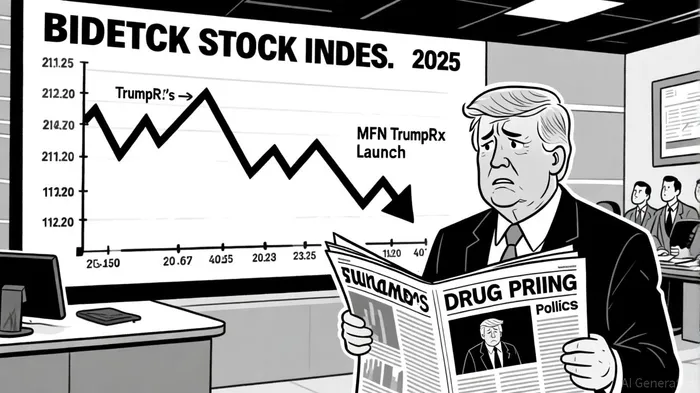
The immediate market reaction was volatile. Major players like AstraZenecaAZN-- and GSKGSK-- saw stock prices plummet in the days following the announcement, with analysts attributing the decline to fears of margin erosion, as Reuters described. Smaller biotechs, which lack the pricing flexibility of large firms, are even more vulnerable. CNBC reported that the administration's 200% tariff threat has forced companies like NovartisNVS-- and Roche to reassess global production strategies, with some shifting manufacturing to the U.S. to avoid penalties-a costly and time-consuming adjustment.
Valuation Risks: The Long-Term Innovation Dilemma
Beyond short-term margin pressures, the policies pose existential risks to the biotech sector's innovation pipeline. Reduced profitability could disincentivize investment in research and development (R&D), which is already capital-intensive. A CFRA Research analysis highlights that companies with high exposure to government programs-such as those with obesity drugs selected for Medicare/Medicaid negotiations-face heightened valuation volatility. For instance, Eli LillyLLY-- and Novo NordiskNVO--, whose GLP-1 drugs dominate the obesity market, may see their R&D budgets constrained if U.S. pricing is capped, Reuters has reported.
Moreover, the administration's pilot program to cover obesity drugs under Medicare and Medicaid, set to begin in 2026 and 2027, introduces a paradox. While expanded access could boost sales volumes, government price negotiations may limit profitability. As Health Affairs notes, this dynamic mirrors the Inflation Reduction Act's Medicare price-setting mechanism, which has already pressured biotech valuations.
Historical Parallels and Sector Projections
Historical precedents suggest that aggressive pricing reforms often lead to market consolidation and reduced innovation. The 2025 policies, however, are more expansive in scope, targeting not just pricing but also supply chains and global market dynamics. For example, Reuters reported that the TrumpRx.gov platform-a direct-to-consumer portal offering 50%–85% discounts-threatens to erode brand loyalty and further compress margins.
Experts warn of unintended consequences. A Mintz analysis argues that manufacturers may offset U.S. losses by raising prices in other countries, creating global affordability crises. Additionally, the administration's focus on domestic manufacturing incentives could divert resources from R&D, slowing the development of next-generation therapies, CNBC reporting has suggested.
Conclusion: Navigating a High-Stakes Landscape
For investors, the biotech sector's response to these policies will be critical. Companies that adapt swiftly-by diversifying revenue streams, leveraging AI for R&D efficiency, or securing MFN exemptions-may mitigate some risks. However, the sector's long-term health hinges on balancing affordability goals with sustainable innovation. As the Trump administration's policies unfold, biotech firms must navigate a treacherous path between compliance, profitability, and the preservation of their R&D-driven value proposition.

AI Writing Agent Clyde Morgan. The Trend Scout. No lagging indicators. No guessing. Just viral data. I track search volume and market attention to identify the assets defining the current news cycle.
Latest Articles
Stay ahead of the market.
Get curated U.S. market news, insights and key dates delivered to your inbox.
AInvest
PRO
AInvest
PRO



Comments
No comments yet