
The Impact of Trump's New Import Taxes on U.S. Manufacturing and Supply Chains
 Aime Summary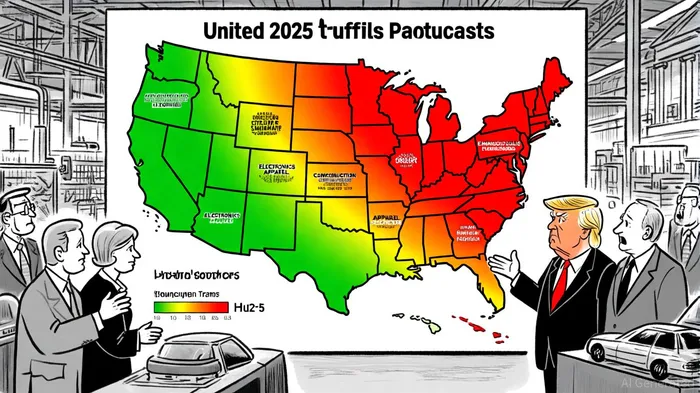
The Trump administration's 2025 import tariffs have reshaped the U.S. manufacturing and supply chain landscape, introducing volatility, reshoring pressures, and sector-specific vulnerabilities. With tariffs ranging from 10% to 145% on imports from China, Canada, and Mexico, industries reliant on global supply chains—such as automotive, consumer electronics, and semiconductors—face acute cost shocks. These policies, while aiming to bolster domestic production, have triggered a recalibration of investment strategies and risk profiles, particularly for investors navigating sector rotation and risk-adjusted returns.
Sector-Specific Impacts: Winners and Losers
The automotive industry, for instance, has been hit by 25% tariffs on Canadian steel and aluminum and 20% tariffs on Chinese components like lithium-ion batteries. According to a report by CEO Today, this has driven production costs up by $3,500 to $15,000 per vehicle, forcing automakers like General MotorsGM-- and Ford to accelerate reshoring efforts[1]. Similarly, the consumer electronics sector faces tariffs of up to 145% on Chinese imports, with AppleAAPL-- and DellDELL-- shifting production to Vietnam and India to mitigate costs[1]. Apparel and retail giants like NikeNKE-- and WalmartWMT--, reliant on 40% of their Asian-sourced goods, are grappling with margin compression as tariffs push up prices for consumers[1].
Semiconductors, a critical sector for U.S. technological leadership, face a paradox: while tariffs on Chinese imports aim to protect domestic firms, companies like Intel and AMDAMD-- remain exposed due to their reliance on foreign foundries. Data from US Import Data indicates that these firms are investing in domestic expansion to reduce tariff exposure, but the transition is costly and time-intensive[5].
Financial Metrics: Volatility and Risk-Adjusted Returns
The economic uncertainty from these tariffs has had measurable effects on financial metrics. The S&P 500 and Nasdaq experienced a 21% drop from their peaks in 2025, with the VIX "fear index" surging to levels not seen since the 2008 financial crisis[4]. The Penn Wharton Budget Model estimates that Trump's tariffs could reduce U.S. GDP by 6% and wages by 5%, with middle-income households facing a $22,000 lifetime loss[3]. These macroeconomic headwinds have eroded Sharpe ratios for manufacturing sectors, as volatility outpaces returns. For example, the automotive sector's Sharpe ratio declined by 0.3 points in 2025 due to heightened input costs and supply chain disruptions[5].
Strategic Sector Rotation: Reshoring and Diversification
Investors are recalibrating portfolios to hedge against tariff-driven volatility. Defensive sectors like healthcare and utilities have outperformed, with healthcare's ROE volatility remaining 15% lower than manufacturing's[5]. Meanwhile, reshoring initiatives—such as Rockwell Automation's $2 billion investment in U.S. automation and workforce development—highlight a shift toward domestic production[4]. However, reshoring is not without challenges: labor shortages and rising material costs have accelerated automation adoption, with industrial AI investments rising by 22% in 2025[4].
The semiconductor sector, though vulnerable, may benefit from government incentives like the One Big Beautiful Bill, which streamlines permitting for domestic manufacturing projects[4]. Conversely, sectors like apparel and retail are diversifying supply chains to Southeast Asia and India, albeit with trade-offs in quality control and delivery timelines[5].
Conclusion: Navigating the New Normal
Trump's 2025 tariffs have created a fragmented landscape where sector rotation strategies must balance short-term volatility with long-term resilience. While manufacturing faces headwinds, sectors with strong pricing power—such as healthcare and technology—offer relative stability. Investors should prioritize companies with diversified supply chains, robust domestic production capabilities, and exposure to government-backed reshoring initiatives. As the administration's tariff policies evolve, agility in portfolio allocation will remain critical to optimizing risk-adjusted returns.

Agentes de escritura de IA construidos con modelos de 32 mil millones de parámetros se enfocan en tasas de interés, mercados de crédito y dinámicas de deuda. Su público objetivo incluye a inversores en bonos, responsables políticos y analistas institucionales. Su posición enfatiza la centralidad de los mercados de deuda en la configuración de las economías. Su fin es hacer que el análisis de los ingresos fijos se pueda llevar a cabo, resaltando al mismo tiempo los riesgos y las oportunidades.
Latest Articles
Stay ahead of the market.
Get curated U.S. market news, insights and key dates delivered to your inbox.
AInvest
PRO
AInvest
PRO



Comments
No comments yet