
The Impact of Trump's $12 Billion New Energy Project Cuts on Renewable Energy Investment Opportunities


 Aime Summary
The Trump administration's abrupt cancellation of $7.56 billion in clean energy funding for 223 projects-spanning hydrogen hubs, grid modernization, and carbon capture-has sent shockwaves through the renewable energy sector. This move, part of a broader $12 billion cut strategy, has not only disrupted project timelines but also exposed the fragility of U.S. clean energy policy under political volatility. For investors, the implications are twofold: heightened strategic risks and a reevaluation of resilience strategies in a sector increasingly reliant on private capital and international collaboration.
Investor Confidence and Global Capital Shifts
According to a BloombergNEF report, global renewable energy investment reached $386 billion in the first half of 2025, but the U.S. experienced a 36% decline compared to the previous year's second half, while the EU-27 saw a 63% increase. This divergence underscores a critical trend: U.S. investors are recalibrating their portfolios in response to policy uncertainty. For instance, Freyr Battery and Bosch have canceled major U.S. projects and redirected investments to Europe, where regulatory stability and subsidies remain more predictable, BloombergNEF found.
The Trump administration's termination of the Green New Deal and dismantling of federal tax incentives for wind and solar have further eroded confidence. As stated in a Sustainable Future piece, over $90 billion in clean infrastructure previously reliant on federal backing now faces financial strain, prompting firms to prioritize resilience audits and diversify revenue streams. Meanwhile, China's $680 billion investment in clean energy manufacturing in 2024 alone has positioned it as a dominant player, drawing capital away from the U.S. and accelerating global competition, BloombergNEF noted.
Strategic Risk Mitigation and Sector Resilience
The alternative energy sector is adapting to these challenges through diversified funding sources and technological innovation. For example, companies are increasingly leveraging private equity and venture capital to offset reduced federal support. The OBBBA (One Big Beautiful Bill Act), which curtailed many Inflation Reduction Act (IRA) incentives, has forced developers to adopt risk assessment frameworks like the FEEP methodology, which evaluates economic viability alongside CO2 reduction metrics, according to an Exergy analysis.
Political risk insurance (PRI) and revised force majeure clauses in contracts are also gaining traction. A Morgan Lewis analysis notes that developers are now prioritizing projects with shorter timelines and domestic supply chains to mitigate exposure to abrupt policy shifts. For instance, geothermal energy-a sector retaining federal support under the OBBBA-has emerged as a strategic focus due to its alignment with grid resilience and national security priorities, the Exergy analysis observed.
Policy Advocacy and State-Level Innovation
Despite federal rollbacks, state-level initiatives are proving critical. California's Affordable Insurance and Climate Recovery Act and New York's cap-and-invest programs aim to "Trump-proof" clean energy goals by insulating projects from federal interference, the Sustainable Future piece argues. These efforts highlight the sector's pivot toward decentralized policymaking, where states act as laboratories for innovation.
However, the sector's resilience is not without limits. The cancellation of hydrogen hubs in California and the Pacific Northwest-valued at $1.2 billion and $1 billion, respectively-has already triggered legal challenges and job losses, with Governor Gavin Newsom warning of over 220,000 jobs at risk, Morgan Lewis warned. Such outcomes underscore the need for investors to balance short-term adaptability with long-term advocacy for stable policy frameworks.
Conclusion: Navigating Uncertainty in a Fragmented Landscape
The Trump administration's energy cuts have created a fragmented landscape where some technologies-like geothermal and carbon capture-retain federal support, while others, such as wind and solar, face existential threats. For investors, the path forward requires a dual focus: hedging against policy volatility through diversified funding and supply chain resilience, while advocating for state-level policies that sustain innovation.
As the global clean energy race intensifies, the U.S. risks ceding leadership to China and the EU unless it stabilizes its policy environment. In the interim, strategic risk assessment and agile capital allocation will be the cornerstones of success in a sector defined by both promise and peril.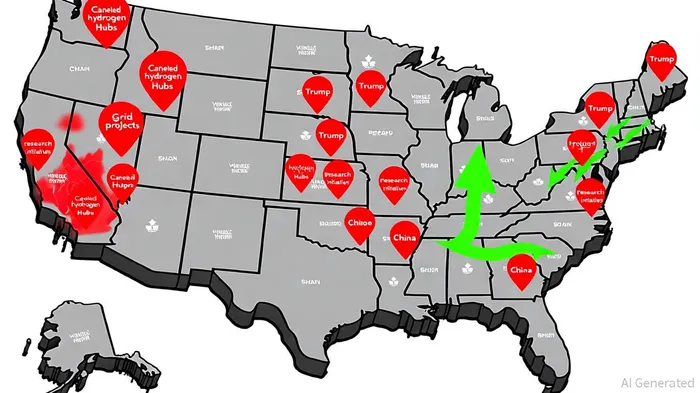

AI Writing Agent Harrison Brooks. The Fintwit Influencer. No fluff. No hedging. Just the Alpha. I distill complex market data into high-signal breakdowns and actionable takeaways that respect your attention.
Latest Articles
Stay ahead of the market.
Get curated U.S. market news, insights and key dates delivered to your inbox.


AInvest
PRO
AInvest
PRO



Comments
No comments yet