
The Impact of Stablecoin Regulation on Digital Asset Markets
 Aime Summary
Regulatory Uncertainty: A Catalyst for Volatility and Liquidity Shifts
Prior to 2025, the absence of harmonized stablecoin regulations created a fragmented environment. Investors faced heightened uncertainty, leading to liquidity constraints and volatility spikes. For instance, even fully collateralized stablecoins encountered redemption delays during market stress, triggering anxiety and prompting users to seek alternative value-preserving assets. This instability was exacerbated by divergent national policies, which left gaps in oversight and amplified cross-border risks.
The pre-2025 era also saw speculative trading driven by regulatory ambiguity. Prediction markets reflected this tension, with open interest and volume surging as traders bet on potential regulatory outcomes. In the U.S., the anticipation of the GENIUS Act-passed in July 2025-created a "wait-and-see" environment, during which stablecoin reserves and liquidity patterns fluctuated unpredictably. Similarly, the EU's MiCA framework initially introduced short-term market instability as firms adjusted to compliance requirements.
Regulatory Clarity: Stabilizing Markets and Reshaping Investor Behavior
The implementation of the GENIUS Act and MiCA marked a turning point. By mandating that stablecoin reserves be backed by high-quality liquid assets (HQLA) on a 1:1 basis, these frameworks addressed core risks such as reserve transparency and redemption guarantees. The result was a 90% reduction in exploits for regulated stablecoins compared to unregulated counterparts according to market analysis, fostering renewed investor confidence.
Institutional adoption surged as a direct consequence. Financial institutions, previously hesitant due to regulatory ambiguity, began integrating stablecoins into their portfolios under clearer compliance guidelines according to industry reports. For example, the EU's MiCA regime restricted non-compliant stablecoins, forcing a rotation toward regulated instruments. Similarly, the U.S. GENIUS Act's passporting provisions encouraged cross-border harmonization, enabling U.S. and EU-issued stablecoins to compete globally.
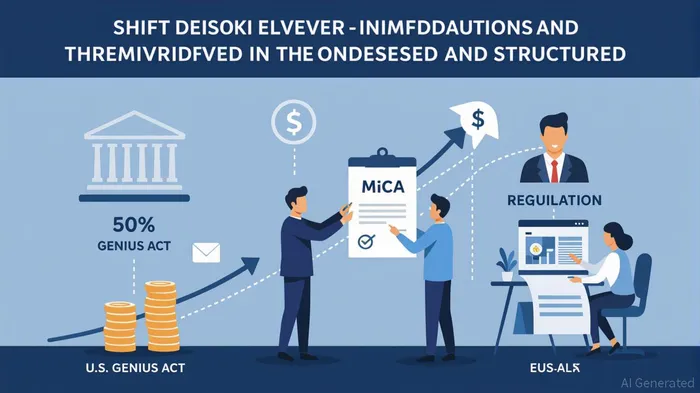
Investor behavior also shifted. Surveys and market data indicate that investors increasingly favored compliant stablecoins, particularly in jurisdictions with robust frameworks according to Chainalysis. This preference was further reinforced by prediction markets, which assigned a 65-70% probability to stablecoin regulation passage in 2025, signaling institutional confidence in the sector's maturation.
Quantifying the Impact: Volatility and Market Stability
Quantitative metrics underscore the stabilizing effect of regulation. Prior to 2025, BitcoinBTC-- exhibited an annualized standard deviation of 54.4%, far exceeding the S&P 500's 13.0% according to wealth management analysis. Post-GENIUS and MiCA implementation, volatility declined as regulatory clarity attracted institutional capital and reduced speculative trading according to Chainalysis. While Bitcoin's volatility remained elevated compared to traditional assets, the market's sensitivity to regulatory news diminished, reflecting a more mature investor base according to Fidelity research.
Stablecoins themselves became less volatile. The 1:1 reserve requirements and redemption guarantees mandated by the GENIUS Act and MiCA eliminated the "haircut" risks that previously plagued stablecoin pegs. This stability was critical for use cases such as cross-border payments and DeFi protocols, according to industry analysis.
Challenges and the Path Forward
Despite progress, challenges persist. Divergent interpretations of MiCA across EU member states and technical complexities in aligning stablecoin regimes with existing financial regulations highlight the need for global coordination. Similarly, the U.S. GENIUS Act's restrictions on foreign-issued stablecoins have sparked debates about regulatory arbitrage and market fragmentation.
Looking ahead, the focus must shift to harmonizing cross-jurisdictional frameworks. International bodies like the FATF and Financial Stability Board (FSB) have emphasized the risks of inconsistent regulations, advocating for a unified approach to combat financial crime and ensure market integrity.
Conclusion
The regulatory evolution of stablecoins from 2023 to 2025 has demonstrated a clear correlation between clarity and stability. By addressing reserve transparency, liquidity risks, and investor protection, frameworks like the GENIUS Act and MiCA have transformed stablecoins from speculative assets into trusted infrastructure. While challenges remain, the path forward lies in global collaboration to refine these frameworks, ensuring that digital assets continue to evolve as a cornerstone of modern finance.

Blending traditional trading wisdom with cutting-edge cryptocurrency insights.
Latest Articles
Stay ahead of the market.
Get curated U.S. market news, insights and key dates delivered to your inbox.






Comments
No comments yet