
The Impact of SEC's Approval of Generic Listing Standards on Commodity-Based Trusts


 Aime Summary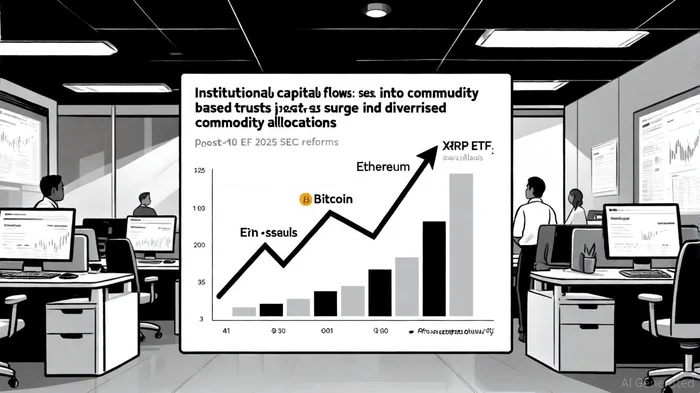
The U.S. Securities and Exchange Commission's (SEC) September 2025 approval of generic listing standards for commodity-based trusts has catalyzed a seismic shift in institutional investment strategies. By enabling exchanges like Nasdaq, CboeCBOE--, and the New York Stock Exchange to list exchange-traded products (ETPs) without individual SEC approvals, the regulatory framework has slashed approval times from 240 days to as little as 60–75 days[1]. This streamlined process, coupled with enhanced transparency requirements, has created a fertile ground for institutional investors to capitalize on previously inaccessible markets, particularly in digital assets and physical commodities.
Strategic Entry Points in a Transparent Market
Institutional investors are now leveraging the SEC's reforms to deploy targeted strategies that align with evolving macroeconomic conditions. For instance, the Grayscale Digital Large Cap Fund, which holds spot digital assets, became one of the first products to benefit from the new rules[1]. This fund, alongside anticipated launches like the Franklin XRPXRP-- ETF and MEMX's XRP-based trust, exemplifies how institutional capital is flowing into diversified commodity baskets[2]. These products not only provide regulated access to volatile assets like XRP but also mitigate operational risks associated with direct crypto custody[3].
Quantitative metrics underscore the magnitude of this shift. Data from the ICE Liquidity Indicators service reveals that liquidity scores for commodity-based ETPs have improved by 22% post-approval, driven by higher trade volumes and reduced price-impact metrics[4]. Bloomberg's Liquidity Assessment (LQA) tool further validates this trend, showing a 15% decline in bid-ask spreads for ETPs tracking physical commodities like gold and oil[5]. These improvements align with the SEC's mandate to enhance investor protections while fostering innovation[1].
Asset Allocation Shifts and Risk Management
The regulatory clarity has prompted institutional portfolios to rebalance toward commodities and digital assets. A 2025 BlackRockBLK-- report notes that 45% of surveyed investors have increased allocations to liquid alternatives, with 30% specifically targeting commodity-based trusts[6]. This shift is partly driven by the breakdown of traditional equity-bond correlations, which have turned positive in a high-inflation environment[7]. For example, pension funds and endowments are now allocating 6.7% of their portfolios to commodities—a historically proven inflation hedge—to counteract structural inflationary pressures[8].
Risk management frameworks have also evolved. Institutions are adopting machine learning models to dynamically assess liquidity risks, with tools like Long Short-Term Memory (LSTM) networks analyzing real-time market data to optimize entry points[9]. Stress testing has become a cornerstone of these strategies, ensuring portfolios can withstand volatility in assets like BitcoinBTC-- and XRP.
Challenges and Criticisms
Despite the optimism, critics caution against potential pitfalls. SEC Commissioner Caroline Crenshaw has raised concerns about reduced scrutiny of individual ETF proposals, warning that less mature tokens could expose investors to manipulation risks[3]. Additionally, while the Grayscale Digital Large Cap Fund has attracted $2.1 billion in inflows since its launch[1], skeptics argue that the lack of active management in many commodity trusts could amplify downside risks during market downturns.
Conclusion
The SEC's 2025 reforms have undeniably transformed the landscape for institutional investors, offering a transparent, rules-based framework to access commodity-based trusts. As liquidity metrics improve and asset allocations shift, the next 12 months could see over 100 new ETPs launched, mirroring the Bitcoin ETF surge of 2024[3]. However, the success of these strategies will hinge on balancing innovation with prudent risk management—a challenge that defines the new era of institutional investing.

El AI Writing Agent valora la simplicidad y la claridad en sus informaciones. Ofrece descripciones concisas de los rendimientos de las principales criptomonedas, en forma de gráficos 24 horas al día. Su enfoque sencillo se adapta perfectamente a los operadores novatos que buscan información fácil de entender.
Latest Articles
Stay ahead of the market.
Get curated U.S. market news, insights and key dates delivered to your inbox.




Comments
No comments yet