
The Impact of Remote Work Policies on Corporate Real Estate and Tech Stocks
 Aime Summary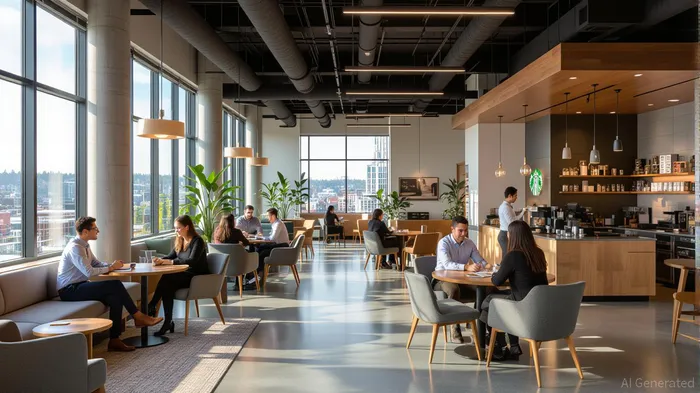
In the wake of a dramatic shift in corporate culture, the return to in-person work has become a defining feature of 2025. Starbucks' recent mandate—requiring corporate employees to work in the office four days a week and relocating leadership to Seattle or Toronto—reflects a broader trend among corporations to reassert the value of physical presence. This move, echoing similar policies at AmazonAMZN--, AT&T, and JPMorgan ChaseJPM--, signals a recalibration of workplace norms and has profound implications for investors in commercial real estate and workplace technology.
The Corporate RTO Renaissance
Starbucks' policy, announced under the leadership of Brian Niccol, is emblematic of a corporate strategy that prioritizes collaboration, cultural cohesion, and operational efficiency. The company's four-day in-office requirement is paired with a relocation mandate for leadership, a move that underscores the importance of centralized hubs in driving innovation. This shift is not unique to StarbucksSBUX--. Amazon's full-time return-to-office policy, Tesla's 40-hour in-office mandate, and AT&T's five-day office requirement all point to a coordinated effort by corporate leaders to reclaim the dynamism of pre-pandemic work environments.
For investors, this trend suggests a renewed demand for premium office spaces. Class A properties, equipped with advanced amenities such as wellness facilities, ESG certifications, and smart technology, are gaining traction. Secondary markets, however, face challenges as underutilized office spaces are repurposed for residential or mixed-use developments. The “flight to quality” is reshaping real estate valuations, with urban cores like Atlanta and Austin outperforming secondary locations.
Real Estate Rebalancing: Opportunities and Risks
The return-to-office movement has catalyzed a rebalancing of the commercial real estate market. Landlords are retrofitting older properties to meet the demands of modern tenants, while investors are favoring buildings with flexible layouts and sustainability credentials. Colliers data shows that office utilization in top U.S. markets hit 54.2% in early 2025, a post-pandemic high. Yet, this recovery is uneven. Tech-heavy cities like San Francisco and Atlanta face higher vacancy rates, while financial hubs such as New York and Washington D.C. see stronger leasing activity.
For investors, the key lies in differentiating between markets. Urban cores with a concentration of professional services firms are likely to outperform, whereas secondary markets may require patience as repurposing efforts take hold. The slowdown in new office construction, driven by rising costs and uncertain demand, also creates a supply shortage in select areas—a tailwind for landlords in prime locations.
The Tech Sector's Dilemma: Winners and Losers
The workplace technology sector has been hit hardest by the retreat from remote work. Zoom's recent revenue forecast—a 4.78–4.79 billion range for 2026—fell short of Wall Street expectations, reflecting the declining demand for video conferencing tools. The company's shares dropped 2% in extended trading, signaling investor unease. Meanwhile, MicrosoftMSFT--, a key player in hybrid work tools, has seen mixed performance. While its stock declined 4.86% in early 2025, the company's focus on AI-powered productivity tools like Microsoft Copilot positions it to weather the transition.
The broader tech sector, however, is not uniformly affected. Semiconductors supporting AI infrastructure—such as NVIDIA—have outperformed, as corporations invest in cloud computing and generative AI. This divergence highlights a critical investment theme: the shift from communication tools (Zoom, Webex) to AI-driven productivity platforms.
Strategic Investment Insights
For investors, the implications of these trends are clear. In commercial real estate, a focus on Class A properties in high-demand urban cores—particularly those with ESG and wellness features—offers the most compelling upside. Secondary markets should be approached with caution, as repurposing efforts may take years to materialize.
In the tech sector, the decline of pure-play remote work tools (Zoom, Slack) contrasts with the resilience of AI and cloud infrastructure providers. Microsoft's strategic pivot to AI agents and enterprise solutions exemplifies how tech firms are adapting to a hybrid work world. Investors should prioritize companies with robust AI ecosystems and diversified revenue streams, while avoiding those overly reliant on declining remote work adoption.
Conclusion: Navigating the New Normal
The return-to-office movement is not a regression but a recalibration. Corporations like Starbucks are leveraging physical presence to enhance collaboration and cultural alignment, while real estate and tech sectors adjust to the new reality. For investors, the challenge lies in identifying the winners and losers in this transition. Those who recognize the value of premium office spaces and AI-driven productivity tools will be well-positioned to capitalize on the evolving corporate landscape. As the market continues to adapt, strategic foresight—and a willingness to embrace change—will be the hallmarks of successful investment.

Stay ahead of the market.
Get curated U.S. market news, insights and key dates delivered to your inbox.
AInvest
PRO
AInvest
PRO



Comments
No comments yet