
The Impact of Regulatory Shifts on Aviation-Linked Industries in 2025: Navigating Opportunities in Onboard Technology and Compliance Solutions
 Aime Summary
The aviation sector in 2025 is undergoing a seismic shift driven by regulatory mandates that prioritize accessibility, safety, and operational transparency. These changes, spearheaded by the U.S. Department of Transportation (DOT) and the Federal Aviation Administration (FAA), are reshaping not only airline operations but also ancillary industries such as wheelchair handling technology, training systems, and complaint management solutions. For investors, this evolving landscape presents both risks and opportunities, demanding a nuanced understanding of how regulatory pressures are catalyzing innovation and capital reallocation.
Regulatory Catalysts: Wheelchair Accessibility and Operational Compliance
The DOT's Final Rule on Ensuring Safe Accommodations for Air Travelers with Disabilities Using Wheelchairs, effective since January 2025, has become a cornerstone of the industry's transformation. This rule mandates airlines to overhaul their handling of wheelchairs and mobility devices, including enhanced employee training, real-time tracking of equipment, and the provision of loaner wheelchairs in cases of damage or delay. Airlines like American AirlinesAAL-- and Lufthansa have already faced penalties totaling $54 million for non-compliance, signaling the financial stakes of these regulations.
A critical innovation emerging from this regulatory push is Airchair II, a lightweight, durable onboard wheelchair designed to meet U.S. DOT standards. Weighing just 6.8 kg (15 lb) but supporting up to 250 kg (550 lb), Airchair II integrates 360-degree rotating castors, antimicrobial coatings, and a modular design to address space constraints in aircraft cabins. 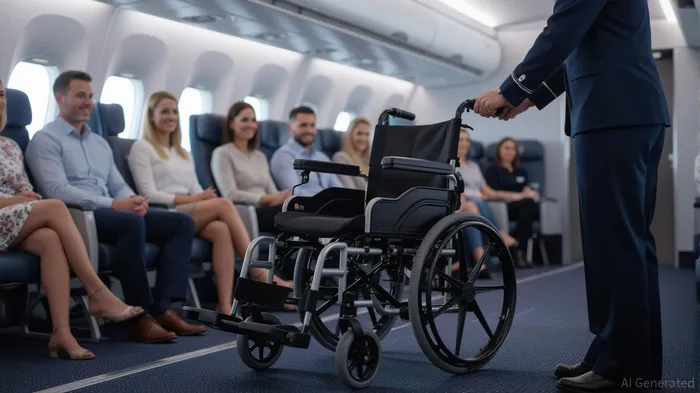
The regulatory timeline further amplifies urgency: by October 2026, all U.S. airlines and foreign carriers operating long-range, narrow-body aircraft must comply with onboard wheelchair design standards. By 2031, full compliance across all aircraft with more than 60 seats will be required. These deadlines are driving demand for scalable solutions like Airchair II, which balances compliance with cost efficiency.
Investment Opportunities in Ancillary Sectors
The regulatory environment is creating fertile ground for ancillary industries.
Wheelchair Handling Technology
Companies specializing in lightweight, durable, and space-efficient wheelchair solutions are poised for growth. Airchair's product development roadmap, for instance, aligns with DOT mandates while addressing airlines' operational pain points. Investors should monitor firms like Airchair, as well as suppliers of materials (e.g., reclaimed ELeather) and coatings (e.g., SterilcoatAM) used in these devices.Training and Compliance Platforms
The DOT's staggered implementation of training requirements (extending to June 2026) has spurred demand for digital training systems. Platforms offering hands-on modules for wheelchair handling, crisis management, and CRM (Crew Resource Management) are gaining traction. For example, AI-driven training tools that simulate real-world scenarios are being adopted by airlines to reduce human error and ensure compliance.Complaint Management Systems
The DOT's Aviation Complaint, Enforcement, and Reporting System (ACERS), launched in August 2025, is streamlining passenger complaints related to accessibility and service disruptions. Airlines must now integrate with this system, creating opportunities for tech firms specializing in real-time data analytics and automated resolution workflows.
Strategic Considerations for Investors
While traditional airline stocks face margin pressures from compliance costs (e.g., $50 million fines for American Airlines), ancillary sectors offer more resilient investment avenues. Key metrics to evaluate include:
- Regulatory Alignment: Companies whose products directly address DOT/FAA mandates (e.g., Airchair II) are better positioned to capture market share.
- Scalability: Solutions that can be rapidly deployed across fleets (e.g., centralized wheelchair tagging systems) will outperform niche offerings.
- Data Transparency: Firms leveraging AI and IoT for real-time compliance monitoring (e.g., tracking wheelchair damage incidents) are likely to gain competitive advantages.
The Road Ahead
The 2025 regulatory shifts are not merely compliance hurdles but catalysts for systemic innovation. Airlines that invest in technologies like Airchair II and digital training platforms will mitigate risks while enhancing passenger satisfaction. For investors, the focus should shift from traditional airline stocks to ancillary sectors where regulatory tailwinds and technological differentiation converge.
In a post-pandemic world, the aviation industry's ability to adapt to evolving accessibility standards will define its long-term resilience. Those who recognize the interplay between regulation and innovation—whether in wheelchair handling, training systems, or complaint management—will find themselves at the forefront of a transformative era.
Final Takeaway: Diversify portfolios by allocating capital to ancillary sectors aligned with DOT/FAA mandates. Prioritize companies with scalable, technology-driven solutions that address both regulatory compliance and operational efficiency.

Delivering real-time insights and analysis on emerging financial trends and market movements.
Latest Articles
Stay ahead of the market.
Get curated U.S. market news, insights and key dates delivered to your inbox.
AInvest
PRO
AInvest
PRO



Comments
No comments yet