
The Impact of Reciprocal Tariffs on U.S. Equity Markets and Strategic Opportunities for Investors
The U.S. equity market landscape in early 2025 has been reshaped by the most sweeping tariff policies in nearly a century. The April 2025 reciprocal tariff announcements, which imposed a minimum 10% duty on all imports and escalated duties on key trading partners, have reignited market volatility, disrupted supply chains, and altered the trajectory of economic growth. These tariffs—echoes of the protectionist Smoot-Hawley era—now force investors to confront a new reality of trade friction, inflationary pressures, and geopolitical uncertainty. Amid this turbulence, certain sectors are proving resilient, while others face headwinds. Here's how to navigate the chaos.
The Tariff Shock and Market Volatility
The April tariffs marked a dramatic escalation. By raising the average U.S. tariff rate to 23%, the administration triggered a $400 billion tax increase—the largest since 1968—and sent shockwaves through global markets. 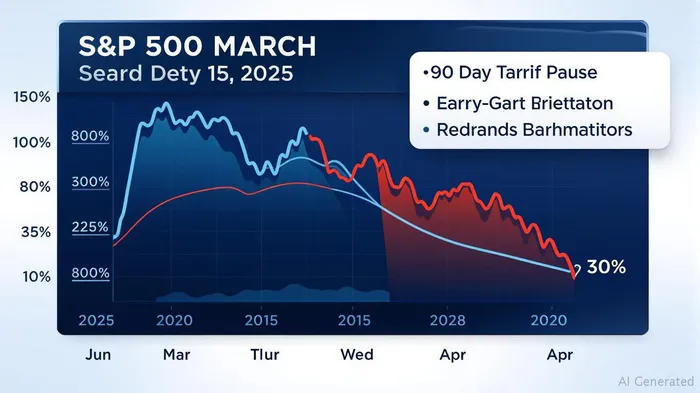
The immediate impact was stark:
- Tech and Consumer Discretionary sectors led declines, with the Nasdaq underperforming as investors priced in higher input costs and reduced corporate spending.
- Auto stocks plunged as 25% tariffs on imports pushed vehicle prices up 11.4%, denting demand. Retail sales fell 0.9% in June 2025, with auto sales dropping 3.5%.
- Bond markets found refuge, with the 10-year Treasury yield collapsing from 4.8% in January to 3.93% by April as investors sought safety.
Sector Analysis: Where to Find Resilience
Technology: Cloud Computing as a Safe Haven
While the broader tech sector faced headwinds, companies with dominant cloud infrastructure—like MicrosoftMSFT-- and Alphabet—outperformed. Their recurring revenue models and global scale insulate them from near-term tariff impacts, making them prime holdings for long-term portfolios.Consumer Staples: A Buffer Against Inflation
As disposable income growth slows, defensive sectors like consumer staples—think Procter & Gamble or Coca-Cola—are likely to outperform. These companies benefit from inelastic demand and pricing power, even as broader retail sales stagnate.Industrials: Navigating Trade Winds
Industrials face mixed pressures. Higher steel and aluminum tariffs have disrupted sectors like autos, but infrastructure spending could offset some losses. Companies with diversified supply chains—like CaterpillarCAT-- or 3M—may weather volatility better than those reliant on imported components.
The Fed's Dilemma and Inflation Risks
The Federal Reserve now walks a tightrope. While GDP growth forecasts were slashed to 1.6% for 2025, core inflation is expected to hit 3.1%—well above the 2% target. A delayed rate-cut cycle, coupled with tariff-driven price spikes, creates a stagflationary environment.
Strategic Opportunities for Investors
Diversify Globally
Developed international equities, such as the MSCIMSCI-- EAFE Index, rose 6.86% in March 2025 as a “flight to safety” from U.S. trade tensions. Emerging markets, while riskier, may offer asymmetric returns if global growth stabilizes.Hedge with Bonds and Alternatives
Treasuries remain a refuge: the Bloomberg Aggregate Bond Index gained 3% year-to-date through April. Private markets—such as real estate or infrastructure—can also reduce exposure to public market volatility.Avoid Growth Stocks in Overvalued Sectors
Growth stocks, particularly in tech and consumer discretionary, remain vulnerable to earnings downgrades. Focus on companies with strong balance sheets and pricing power, like cloud leaders or healthcare firms.
Key Takeaways for Investors
- Stay Disciplined: Panic selling or abrupt portfolio shifts are rarely rewarded. Wealth Enhancement's analysis underscores that long-term strategies outperform reactive decisions.
- Focus on Quality: Allocate to sectors and companies with pricing power, global scale, and minimal supply-chain exposure to tariffs.
- Monitor Policy Developments: Legal challenges to IEEPA tariffs (which a court ruled unlawful) could reduce effective tariff rates, reshaping forecasts.
Conclusion
The tariff era of 2025 is a test of investor resolve. While near-term volatility persists, disciplined allocation to resilient sectors, global diversification, and strategic hedging with bonds can mitigate risks. History shows that markets eventually price in uncertainty—and those who avoid panic-driven decisions will find opportunities in the chaos.
In this new era of trade friction, patience and diversification remain the investor's best tools.

Stay ahead of the market.
Get curated U.S. market news, insights and key dates delivered to your inbox.
AInvest
PRO
AInvest
PRO



Comments
No comments yet