
The Impact of the Farmers' Almanac's Closure on Climate-Related Industries


 Aime Summary
The closure of the Farmers' Almanac in 2025 marks the end of a 208-year-old institution that once provided weather forecasts and agricultural guidance rooted in a blend of folklore and rudimentary science. While its predictions were often criticized for being marginally better than random chance-relying on sunspots, , and lunar cycles-the almanac served as a cultural touchstone for farmers, gardeners, and even , as noted in a
Union Bulletin report. Its disappearance has left a void in risk assessment practices across agriculture, energy, and insurance sectors, accelerating the adoption of . This article examines how these industries are adapting and identifies investment opportunities in the emerging technologies filling the gap.
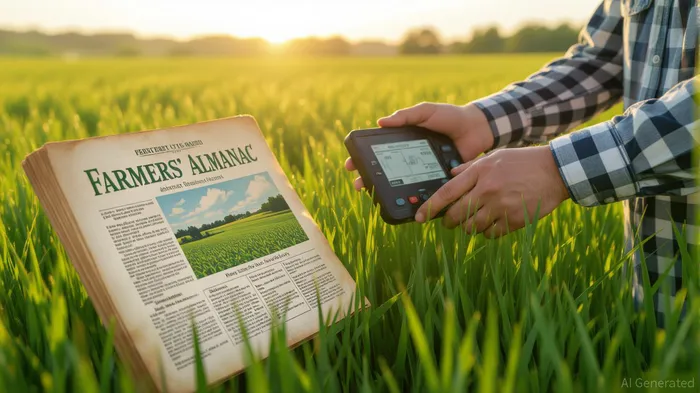
Agriculture: From Lunar Cycles to AI-Driven Precision
The agricultural sector's reliance on the Farmers' Almanac has historically been a mix of tradition and necessity. With its closure, farmers are increasingly turning to data-driven tools to mitigate climate risks. For example, a joint venture between Internet Initiative Japan (IIJ) and SonySONY-- Semiconductor Solutions is deploying high-precision soil moisture sensors and irrigation navigation services to optimize crop yields and resource use, as detailed in a
Sony press release. These tools enable real-time decision-making, reducing dependency on historical weather patterns that are becoming less reliable due to climate change.
The shift is also evident in AI-driven greenhouse systems, such as those developed by (UAE) and Shouguang Colorful Manor (China), which use biological pollination and climate-resilient technologies to sustain production in harsh environments, as noted in the
Union Bulletin report. Such innovations are critical as labor shortages and extreme weather events disrupt traditional farming cycles. Investors should note the growing demand for smart agriculture startups, particularly those addressing mechanization and precision technologies, as described in a
DataM Intelligence report.
Energy: AI and Automation to Mitigate Climate Risks
The energy sector is leveraging advanced AI and automation to address risks exacerbated by the almanac's closure. Infosys recently unveiled an AI Agent designed to streamline energy operations by processing well logs, images, and reports to predict challenges and automate reporting, as detailed in a
ScanX article. This technology enhances safety and efficiency while reducing non-productive time-a critical advantage as climate-induced disruptions, such as flooding, threaten infrastructure.
Automated defenses are also gaining traction. For instance, 's automated flood barriers at Cummins' Engine Plant in Indiana activate without human intervention, ensuring operational continuity during extreme weather, as reported in a
World Economic Forum story. Such solutions are part of a broader trend toward smart protection systems, including IoT sensors and geothermal energy projects partially derisked through insurance coverage for exploratory drilling, as described in an
EDF blog post.
Insurance: Rethinking Risk in a Climate-Changed World
The insurance industry is undergoing a paradigm shift as it abandons outdated risk strategies tied to the Farmers' Almanac. In 2025, , , as reported in a
Risk & Insurance article. Instead, carriers are adopting AI-driven, property-level risk models and innovative products like , which provides automatic payouts based on predefined weather metrics, as discussed in an
IFPRI blog.
Startups like ZestyAI are at the forefront of this transformation, offering AI tools to refine risk scoring and pricing, as noted in the
Risk & Insurance article. However, adoption lags due to challenges such as data reliability and workflow integration, as reported in the same
Risk & Insurance article. Regulatory pressures are also pushing insurers to disclose climate risks transparently, with 15 U.S. jurisdictions requiring annual , as described in a
ClimateX post. These trends highlight the sector's pivot toward data-driven, transparent -a shift that investors should closely monitor.
Investment Opportunities in Climate-Tech
The closure of the Farmers' Almanac has catalyzed a surge in climate-tech innovation, creating fertile ground for investors. Key trends in 2025 include:
1. Clean Energy and Electrification: Policies like the U.S. Inflation Reduction Act are driving investments in renewables and storage, despite concerns over potential policy rollbacks, as noted in a
GreenTech Substack post.
2. : Startups addressing labor shortages and operational efficiency-such as those developing AI-enhanced planting machines-are gaining traction, as described in a
DataM Intelligence report.
3. : The integration of AI into and sustainable infrastructure is attracting crossover investment from tech and energy sectors, as detailed in a
GreenTech Substack post.
Emerging startups like Climate X, which provides insurers with reliable climate data, and UL Solutions, which expands , exemplify the sector's dynamism, as reported in a
Marketscreener article. is also rising, , as noted in a
GreenTech Substack post.
Conclusion
The Farmers' Almanac may have closed its pages, but its legacy lives on in the urgency it has created for modern risk assessment tools. Agriculture, energy, and insurance sectors are no longer relying on lunar cycles but on AI, IoT, and to navigate climate uncertainties. For investors, the closure represents not a loss but an opportunity to back the next generation of climate-tech solutions-those that will redefine resilience in a warming world.

Delivering real-time insights and analysis on emerging financial trends and market movements.
Latest Articles
Stay ahead of the market.
Get curated U.S. market news, insights and key dates delivered to your inbox.




Comments
No comments yet