
The Impact of ERCOT's RTC+B Launch on Grid-Connected Battery Assets and Energy Storage Investment
 Aime Summary
A New Era for Battery Modeling and Market Participation
Prior to RTC+B, batteries were treated as separate generators and loads, a dual-model framework that limited their flexibility and efficiency. The new design simplifies this by treating batteries as unified assets with a state-of-charge (SoC) model, enabling them to charge and discharge dynamically based on real-time grid conditions. This change not only improves dispatch efficiency but also eliminates outdated constructs like Supplemental Ancillary Service Markets (SASMs), replacing them with tools such as Day-Ahead AS-Only Offers.
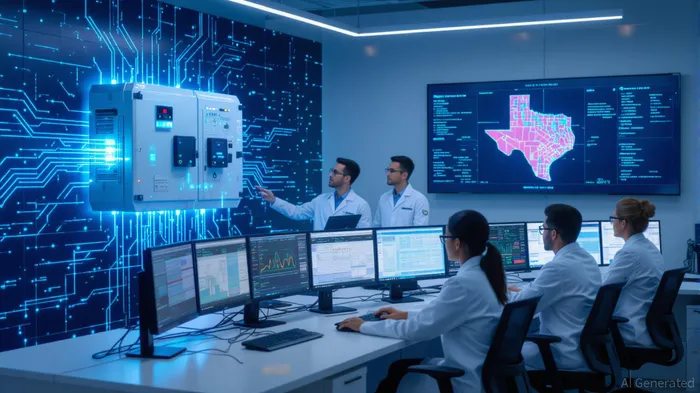 The financial implications are twofold. First, batteries can now participate in real-time ancillary service bidding, a capability previously restricted to day-ahead markets. This opens new revenue streams for operators. Second, the co-optimization of energy and ancillary services reduces manual interventions, lowering operational costs and improving grid reliability. However, this efficiency comes at a cost: the scarcity premiums that batteries once captured during peak demand or supply disruptions may diminish as the market becomes more responsive and less volatile according to analysis.
Revenue Streams and Price Volatility: A Double-Edged Sword
Data from the first half of 2025, prior to RTC+B's implementation, reveals a market characterized by low volatility. Day-Ahead (DA) and Real-Time (RT) energy prices rarely exceeded $500/MWh, with 42% of battery revenue derived from ancillary services. Top-performing assets captured up to 119% of their DA Target Block 2 (TB2) capacity, while the median asset achieved only 56% according to Q1 2025 performance data. This disparity highlights the challenge of aligning operational strategies with market conditions.
Post-RTC+B, the co-optimization of energy and ancillary services is expected to narrow the gap between DA and RT prices, increasing liquidity but reducing the volatility that once drove high returns. For example, in a case study involving a solar cliff event, batteries under RTC+B were re-dispatched to provide regulation up services, freeing up cheaper CCGT units and reducing system costs by 2.7%. Similarly, during over-forecasted solar generation, batteries stored excess energy, avoiding curtailment and cutting costs by 5.5% according to performance analysis. These scenarios underscore the value of batteries in stabilizing the grid but suggest that their role as arbitrageurs in volatile markets may diminish.
Risk-Adjusted Returns: Sharpe Ratios and Volatility Metrics
The pre-RTC+B era saw limited risk-adjusted returns for battery assets, largely due to low volatility. A Q1 2025 analysis found that the top-performing battery earned $16.06/kW, capturing 73% of its DA TB2, while the median asset earned just $5.03/kW. The Sharpe ratios for these assets were constrained by the lack of price swings necessary to generate high risk-adjusted returns.
Post-RTC+B, the market is expected to see more stable but potentially lower returns. By co-optimizing energy and ancillary services, the program reduces the likelihood of sudden price spikes, which historically drove battery revenues. However, this stability could improve Sharpe ratios by lowering volatility. For instance, the replacement of ORDCs with ASDCs allows for more precise pricing of ancillary services, reducing the uncertainty that previously plagued reserve markets.
That said, the new market complexity introduces operational risks. Battery operators must now navigate stricter performance standards and frequent redispatch events, which could impact state-of-charge management and profitability according to market analysis. While the long-term financial implications remain uncertain, the shift toward real-time co-optimization suggests a transition from scarcity-driven returns to efficiency-driven gains.
Strategic Implications for Clean Energy Investors
For investors, the key takeaway is adaptability. The RTC+B framework demands a shift in operating strategies, with a focus on node-specific approaches that balance DA and RT market participation. Top performers post-RTC+B are likely to be those that layerLAYER-- in DA energy and ancillary services while leveraging real-time flexibility.
Moreover, the projected annual savings of $2.5–$6.4 billion in wholesale markets could attract new capital to the sector, but investors must weigh these benefits against the reduced scarcity premiums. The market's increased efficiency may favor larger, more sophisticated operators with advanced analytics capabilities to optimize real-time bidding.
Conclusion
ERCOT's RTC+B represents a transformative step for Texas energy markets, offering both opportunities and challenges for battery storage investors. While the program enhances grid reliability and reduces operational costs, it also reshapes revenue dynamics by diminishing scarcity-driven returns and increasing operational complexity. For clean energy investors, success in this new landscape will hinge on strategic adaptability, technological sophistication, and a nuanced understanding of risk-adjusted returns. As the market evolves, those who embrace the RTC+B paradigm will be best positioned to capitalize on the next phase of energy storage innovation.

Mezclando la sabiduría tradicional en el comercio con las perspectivas más avanzadas sobre criptomonedas.
Latest Articles
Stay ahead of the market.
Get curated U.S. market news, insights and key dates delivered to your inbox.






Comments
No comments yet