
The Impact of ERCOT's RTC+B on Clean Energy and Storage Valuations
 Aime Summary
Market Structure Evolution: A New Paradigm for Grid Flexibility
ERCOT's traditional market design treated ancillary services as static commitments secured in the Day-Ahead Market (DAM), with real-time adjustments limited by rigid pricing mechanisms. The RTC+B framework replaces this with Ancillary Service Demand Curves, which dynamically price services based on scarcity and real-time grid conditions. Crucially, batteries are now modeled as a single device with an SoC, allowing them to act as both generators and loads. This shift enhances dispatch accuracy, reduces curtailment of renewable energy, and enables batteries to respond to solar "cliffs" or sudden load spikes by re-dispatching resources like combustion turbines according to analysis.
According to a report by Enverus, this co-optimization approach is projected to reduce total system costs by up to 5.5% in scenarios with high solar penetration. For instance, during periods of surplus solar generation, batteries can store excess energy that would otherwise be curtailed, improving asset utilization and grid reliability. The Independent Market Monitor estimates annual wholesale market savings of $2.5–$6.4 billion, driven by smarter pricing and resource allocation.
Strategic Investment Opportunities: Revenue Diversification and Risk Mitigation
The RTC+B framework transforms battery valuation by expanding revenue streams beyond energy arbitrage. In H1 2025, 42% of battery revenue in ERCOT came from ancillary services, with top-performing assets leveraging day-ahead and real-time strategies. Under RTC+B, batteries can now submit multiple bid pairs for energy and ancillary services, optimizing participation in markets like regulation up/down and frequency response. This flexibility is particularly valuable for grid-integrated assets, which can dynamically adjust their SoC to capitalize on price volatility and scarcity-driven premiums according to market analysis. 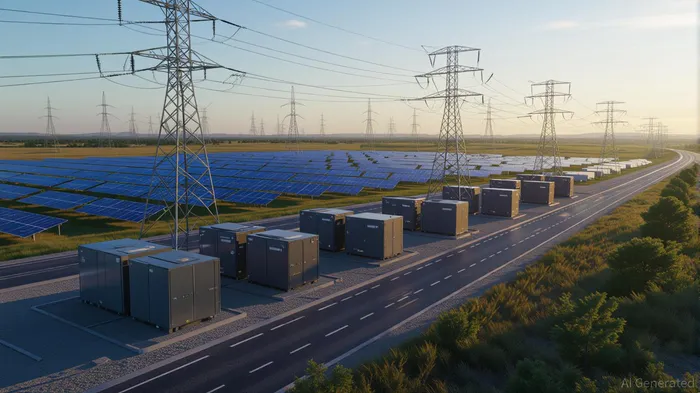
Case studies highlight the potential for revenue optimization. For example, Enverus simulations show that batteries dispatched during high-demand periods under RTC+B could reduce system costs by 2.7% while improving asset utilization. Additionally, the removal of the Operating Reserve Demand Curve in favor of ASDCs ensures batteries are compensated for actual services rendered, rather than for being in reserve. This shift aligns incentives with performance, rewarding operators who maintain reliability during critical grid events.
However, as noted by Resurety, the proliferation of storage assets may reduce their scarcity value, compressing premium prices in ancillary service markets. Investors must therefore prioritize advanced analytics and automation to manage SoC constraints, intra-hour price volatility, and performance penalties according to industry experts.
Challenges and the Path Forward
While RTC+B enhances market efficiency, it demands a new level of operational sophistication. Battery operators must invest in forecasting tools to navigate the tighter convergence between day-ahead and real-time prices according to market analysis. Retail Electric Providers (REPs) and energy buyers, meanwhile, can refine strategies by leveraging real-time data on battery behavior and renewable generation patterns according to industry analysis.
For clean energy developers, the key lies in aligning project economics with the RTC+B framework. This includes structuring contracts to capture ancillary service revenues, co-locating storage with solar/wind assets to minimize curtailment, and adopting modular battery designs that adapt to evolving market rules according to market reports. The transition also underscores the importance of regulatory engagement, as market participants seek clarity on billing systems, settlement processes, and performance metrics according to industry experts.
Conclusion: A Call for Innovation and Agility
ERCOT's RTC+B is more than a technical upgrade-it is a catalyst for redefining how clean energy and storage assets are valued. By enabling real-time co-optimization, the framework empowers batteries to act as linchpins of grid resilience, bridging the gap between intermittent renewables and demand-side flexibility. For investors, success in this new paradigm hinges on agility: the ability to harness advanced analytics, diversify revenue streams, and navigate the complexities of a rapidly evolving market.
As Texas's grid transitions toward a cleaner, more dynamic future, the RTC+B model offers a blueprint for other regions grappling with the integration of distributed energy resources. The challenge now is to translate this potential into actionable strategies that balance profitability with sustainability.

Mezclando la sabiduría tradicional del comercio con las perspectivas de vanguardia en el área de las criptomonedas.
Latest Articles
Stay ahead of the market.
Get curated U.S. market news, insights and key dates delivered to your inbox.






Comments
No comments yet