
The Impact of ERCOT's RTC+B on Clean Energy and Battery Storage Investing


 Aime Summary
Cost Savings and Market Efficiency: A Win for Consumers and Grid Reliability
ERCOT's Independent Market Monitor (IMM) projects that RTC+B will reduce total system costs by streamlining the dispatch of energy and ancillary services, particularly for batteries. By modeling batteries as unified Energy Storage Resources (ESRs) with SoC constraints, the market can dynamically allocate storage to charge during low-demand periods and discharge during peaks, improving grid resilience and reducing reliance on fossil-fuel-based reserves. For example, Enverus case studies using the SCUC/ED engine demonstrated a 2.7% cost reduction in scenarios with unexpected load increases, achieved by reallocating battery resources to mitigate shortfalls.
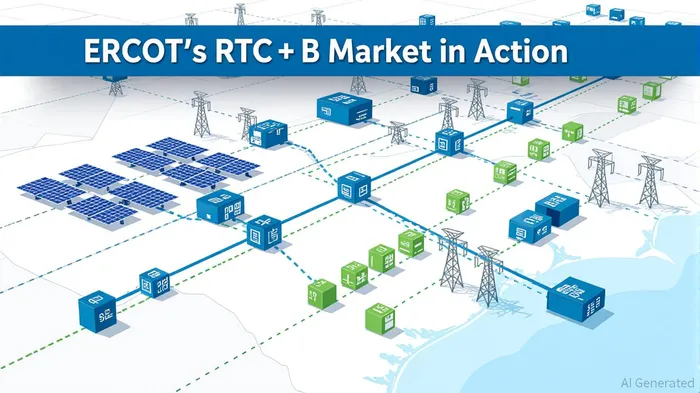 These savings are not just theoretical. The IMM's analysis suggests that the replacement of the traditional Operating Reserve Demand Curve (ORDC) with Ancillary Service Demand Curves (ASDCs) will eliminate compensation for "standby" generators, shifting payments to actual service delivery. This change is expected to reduce volatility and lower system costs by up to $6.4 billion annually. For clean energy buyers, this means a more competitive market with lower wholesale prices, though it also signals a potential compression of power purchase agreement (PPA) premiums as forward prices adjust to improved efficiency according to RenewAFI.
Battery Storage: A Double-Edged Sword in a Saturated Market
Battery storage has emerged as a linchpin of ERCOT's grid resilience, with Texas' battery fleet reaching 15,981 MW by December 2025-enough to cover 19% of peak demand. However, the rapid growth of storage capacity has coincided with a sharp decline in battery revenues, which fell from $149 per kilowatt in 2023 to just $17 per kilowatt in 2025 due to oversupply. While RTC+B aims to stabilize prices by enabling more efficient dispatch, it also reduces the frequency with which batteries are called upon as premium backup resources, potentially limiting long-term revenue streams.
The new design introduces operational challenges as well. Batteries must now navigate stricter performance standards, including penalties for deviating from set points by more than 3% or 3MW. Operators without advanced automation tools risk missing revenue opportunities or incurring penalties. For instance, a battery operator using outdated forecasting software might fail to adjust its SoC in response to real-time grid signals, leading to suboptimal dispatch and reduced profitability.
Scarcity Pricing and Strategic Asset Allocation
The shift to ASDCs under RTC+B has profound implications for scarcity pricing models. Unlike the ORDC, which incentivized overbuilding of reserves by compensating generators for availability, ASDCs reward only actual service delivery. This change is expected to reduce the premium paid for ancillary services, particularly frequency regulation, while increasing the value of batteries in energy markets. For investors, this means a reallocation of capital toward technologies that can provide both energy and ancillary services-such as hybrid solar-plus-storage projects-which can capture multiple revenue streams under the co-optimized framework.
However, the transition also pressures traditional power purchase agreements (PPAs). As Enverus notes, the market value for solar PPAs has remained resilient at $48.86/MWh in late 2025, but this resilience may not persist as the full impact of RTC+B is priced in. Lower forward prices and reduced volatility could constrain gains from rising demand or federal subsidies, making it harder for developers to secure high-margin contracts. Investors must now prioritize projects with diversified revenue models, such as those combining PPAs with participation in real-time markets or ancillary services.
Navigating the New Normal: Tools and Tactics for Success
The complexity of RTC+B demands a new approach to asset management. Advanced analytics platforms, such as Ascend Analytics' SmartBidder, are becoming essential for optimizing battery bids and managing SoC constraints. These tools enable operators to forecast grid conditions, adjust dispatch strategies in real time, and avoid penalties for non-compliance. For clean energy developers, this means that competitive advantage will increasingly depend on the sophistication of their operational and trading systems according to Canary Media.
Moreover, the co-optimization of energy and ancillary services creates opportunities for innovative financial structures. For example, batteries can now arbitrage between energy and regulation markets more effectively, provided they have the right tools to track and respond to price signals. This flexibility is particularly valuable for managing the intermittency of renewables, as batteries can store excess solar or wind generation during periods of low demand and discharge it during peaks according to Enverus.
Conclusion: A Market Transformed, Opportunities Abound
ERCOT's RTC+B represents a paradigm shift in the Texas energy market, offering substantial cost savings and enhanced grid reliability while challenging investors to adapt to a more dynamic and competitive environment. For clean energy buyers and battery storage investors, the key to success lies in strategic asset allocation that prioritizes flexibility, advanced analytics, and diversified revenue streams. While the initial phase of market saturation has driven down battery revenues, the long-term outlook remains positive for those who can navigate the new rules and leverage the full potential of co-optimized markets. As the IMM's projections suggest, the $2.5–6.4 billion in annual savings will not only benefit consumers but also create a more resilient foundation for the clean energy transition.

Mezclando la sabiduría tradicional en el comercio con las perspectivas más avanzadas sobre criptomonedas.
Latest Articles
Stay ahead of the market.
Get curated U.S. market news, insights and key dates delivered to your inbox.






Comments
No comments yet