
The Impact of ERCOT's RTC+B on Battery Storage and Clean Energy Markets
 Aime Summary
Market Efficiency and Projected Savings
ERCOT's RTC+B framework replaces the previous ORDC with ASDCs, enabling granular pricing for specific grid services and co-optimizing energy and ancillary services simultaneously. This shift is projected to deliver annual savings of $2.5–$6.4 billion by reducing system costs, avoiding renewable curtailment, and enhancing resource utilization. According to Resurety, the policy's real-time co-optimization could lower energy prices by up to 5.5% in scenarios where batteries are re-dispatched to address solar generation shortfalls or mid-day energy surpluses. For energy buyers, these savings represent a compelling case for long-term investment in grid infrastructure that aligns with the new market dynamics.
Battery Integration and Revenue Opportunities
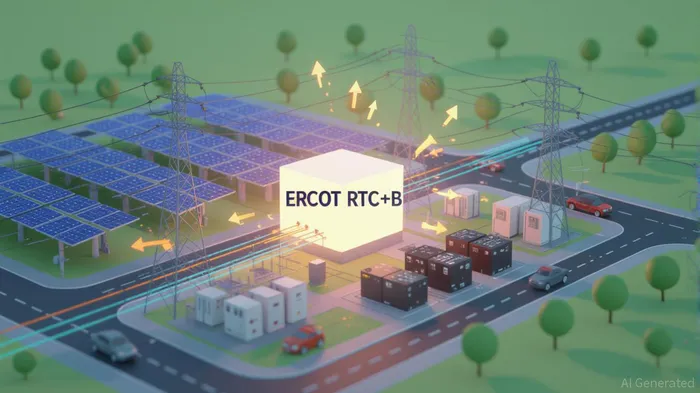 The RTC+B policy models battery energy storage resources as single devices with a state-of-charge (SoC), rather than separate generators and loads. This simplification eliminates the need for dual datasets and allows batteries to participate more flexibly in both energy and ancillary services markets. Case studies from Enverus demonstrate the tangible benefits: in a "Solar Cliff" scenario, batteries re-dispatched to address sudden solar generation drops avoided ancillary service price spikes and reduced total system costs by 2.7%. Similarly, the "Mid-Day Soak and Shift" case highlighted a 5.5% cost reduction by storing excess solar energy and discharging during peak demand.
For storage operators, these capabilities open new revenue streams. The policy enables participation in day-ahead and real-time markets, with batteries now able to bid ancillary services directly into the real-time co-optimization process. However, the transition is not without hurdles. Battery operators face stricter minimum SoC requirements for ancillary services and unpredictable reassignment of resources between energy and reserve markets. These complexities necessitate advanced forecasting and optimization tools, increasing operational costs but also creating a competitive edge for firms that adopt cutting-edge analytics.
Challenges and Market Volatility
While RTC+B promises efficiency gains, it has introduced short-term volatility. On its first day of operation, day-ahead clearing prices for non-spin reserve services tripled compared to the previous day under similar conditions, as some battery operators withdrew from ancillary service markets amid uncertainty. According to Canary Media, reduced battery participation in ancillary services could compress traditional revenue streams, particularly for operators reliant on arbitrage opportunities.
Regulatory incentives, however, offer a counterweight. Texas's Backup Power Package Program, for instance, provides grants for hybrid systems combining solar, storage, and backup generators, while property tax exemptions and PACE financing reduce upfront costs for commercial and public operators. These incentives, coupled with the projected $6.4 billion in annual savings, create a favorable environment for strategic investments in grid infrastructure.
Strategic Investment Considerations
For investors, the key lies in aligning with market participants that can navigate the new complexity. Firms like Habitat Energy emphasize the importance of adaptive strategies, such as leveraging real-time market signals and optimizing SoC management to maximize value capture. According to Habitat Energy, the shift from physical to financial day-ahead commitments increases market volatility but also creates opportunities for agile operators to capitalize on price differentials.
Regional comparisons further highlight Texas's competitive edge. While other states grapple with fragmented regulatory frameworks, ERCOT's unified market design and robust incentive programs position it as a leader in energy storage adoption. For example, Colorado's recent regulatory mandates for utilities like Xcel Energy to adopt flexible DER tariffs illustrate how Texas's proactive approach could outpace neighboring markets in attracting capital.
Conclusion
ERCOT's RTC+B policy marks a generational shift in grid management, with batteries emerging as central players in ensuring reliability and cost efficiency. While the transition period has exposed operational and financial risks, the long-term benefits-ranging from multi-billion-dollar savings to enhanced renewable integration-underscore the strategic value of investing in energy storage and grid infrastructure. For investors willing to navigate the complexities of real-time co-optimization, the Texas market offers a unique opportunity to shape the future of clean energy.

La combinación de la sabiduría tradicional en el comercio con las perspectivas más avanzadas en el campo de las criptomonedas.
Latest Articles
Stay ahead of the market.
Get curated U.S. market news, insights and key dates delivered to your inbox.






Comments
No comments yet