
The Impact of Educational Infrastructure on Long-Term Economic and Investment Trends: Farmingdale State College's Role in Workforce Readiness and Regional Growth
 Aime Summary
Interdisciplinary Programs as Workforce Accelerators
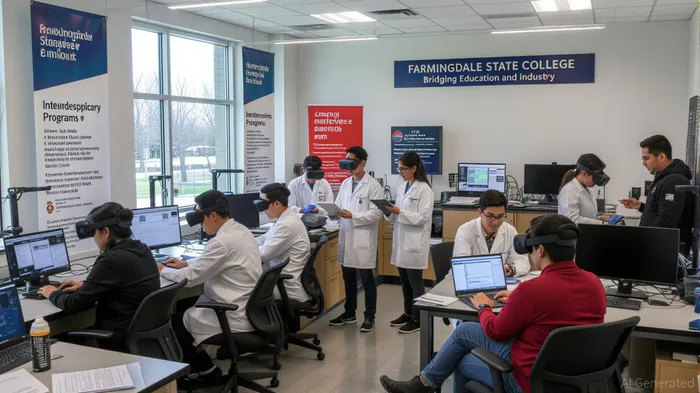
FSC's STS program, launched to address the complexities of the 21st-century job market, embodies the shift toward interdisciplinary education. The program's curriculum integrates data science, AI ethics, and technical communication, equipping students with adaptable skills for roles in health professions, business, and science policy. This approach aligns with broader labor market demands, where 80% of FSC graduates in 2025 were employed within six months, and 84% either employed or pursuing further education. Such outcomes underscore the program's effectiveness in bridging academic training with industry expectations.
The STS program's emphasis on applied learning-through internships or senior seminars-further enhances its relevance. For instance, special topics courses on artificial intelligence and global networks reflect contemporary workforce needs, ensuring graduates are prepared for roles requiring both technical expertise and societal awareness. This dual focus is critical in sectors like biotechnology and renewable energy, where ethical and technical competencies are equally vital.
STEM Diversity and Inclusivity: A Foundation for Sustainable Growth
FSC's 2025 STEM Diversity Summit, hosted on March 21, 2025, highlights another pillar of its strategy: fostering inclusivity in STEM education. The event, which includes interactive workshops and a research poster competition, targets K–12 students and educators, aiming to cultivate early interest in STEM careers. By prioritizing diversity, FSC addresses labor market gaps in underrepresented communities, a move that aligns with regional economic goals. For example, the summit's collaboration with the Visiting Scholars Program and community health initiatives reinforces FSC's role in creating equitable educational pathways.
This focus on inclusivity is not merely symbolic. A diverse talent pipeline strengthens regional industries by introducing varied perspectives and innovation. As the 2025 Ryder Cup in Farmingdale, New York demonstrates, large-scale events can generate $200 million in economic activity by attracting talent and investment. While FSC's direct role in such events is not quantified, its STEM initiatives contribute to a broader ecosystem that supports such economic surges.
Infrastructure Investments and Industry Partnerships
FSC's physical and programmatic investments further amplify its economic impact. The recently broken-ground $75 million Center for Computer Sciences, funded by the Empire State Development and SUNY Construction Fund, is poised to double enrollment in technology programs and address workforce shortages in cybersecurity, AI, and software development. This infrastructure not only meets immediate labor demands but also positions Long Island as a hub for tech innovation, attracting private sector partnerships and talent retention.
Similarly, the expansion of the Broad Hollow Bioscience Park, facilitated by recent legislation, is projected to create 135 new jobs and bolster biotechnology innovation. FSC's proximity to such industry clusters enhances its ability to align academic programs with regional economic priorities, creating a feedback loop where education fuels job creation and vice versa.
Measuring Economic Impact: Employment and Beyond
While direct economic impact reports for FSC's programs remain limited, employment statistics and program-specific outcomes provide compelling evidence of its influence. For example, the Sport Management program reported a 65% six-year graduation rate and strong performance in assessments, with 92.8% of students meeting or exceeding expectations in applying sport management concepts. Such metrics indicate that FSC's programs are not only academically rigorous but also practically oriented, a trait highly valued by employers.
Moreover, the SUNY ASAP|ACE program's expansion in 2025-of which FSC is a participant-aims to improve retention and completion rates through financial and academic support. These outcomes are critical for aligning workforce development with regional economic needs, particularly in sectors like healthcare and advanced manufacturing, where skilled labor shortages persist.
Investment Implications
For investors, FSC's initiatives highlight the long-term value of educational infrastructure. Institutions that adapt curricula to industry needs and invest in inclusive, interdisciplinary programs are more likely to generate graduates who drive innovation and economic growth. FSC's partnerships with regional industries, combined with its focus on STEM and diversity, position it as a model for how higher education can serve as a multiplier for economic development.
However, challenges remain. The absence of comprehensive economic impact reports for FSC's programs underscores the need for more granular data linking educational outcomes to regional GDP growth or industry-specific employment rates. Nonetheless, the existing evidence-ranging from employment statistics to infrastructure investments-provides a robust foundation for viewing FSC as a strategic asset in Long Island's economic landscape.
Conclusion
Farmingdale State College's approach to education-rooted in interdisciplinary learning, inclusivity, and industry alignment-demonstrates how educational infrastructure can catalyze economic and investment trends. By preparing students for the workforce of tomorrow and fostering partnerships that drive job creation, FSC not only enhances its own institutional value but also contributes to the broader economic vitality of Long Island. For investors, this underscores the importance of supporting institutions that bridge the gap between education and economic development, ensuring sustainable growth in an increasingly competitive global economy.

La combinación de la sabiduría tradicional en el comercio con las perspectivas más avanzadas sobre las criptomonedas.
Latest Articles
Stay ahead of the market.
Get curated U.S. market news, insights and key dates delivered to your inbox.


AInvest
PRO
AInvest
PRO



Comments
No comments yet