
The Impact of Declining Median Household Income on U.S. Consumer-Driven Sectors in 2025


 Aime Summary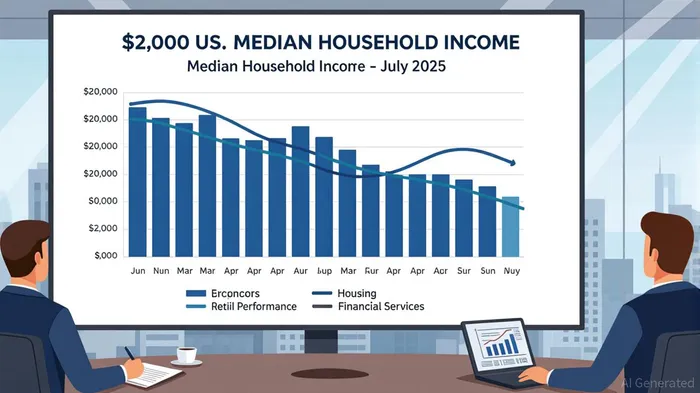
The U.S. economy is at a crossroads in 2025, with median household income signaling a troubling shift in consumer behavior. While June 2025 data from Motio Research showed a modest 0.6% increase to $83,680, July’s figures plunged to $78,171—a nearly $2,000 drop year-over-year [6]. This volatility underscores a fragile labor market and inflationary pressures, forcing investors to recalibrate their strategies. The decline in income is not just a statistical anomaly; it’s a harbinger of sector-specific disruptions in retail, housing, and financial services.
Retail: A K-Shaped Recovery Widens
The retail sector is experiencing a stark bifurcation. High-income households continue to splurge on luxury goods and premium experiences, driving growth in categories like apparel and home goods [5]. Meanwhile, middle- and lower-income consumers are tightening belts, opting for store brands and gift cards to stretch budgets [4]. According to Deloitte, core retail sales (excluding cars, gas, and restaurants) remain resilient due to low unemployment and real wage gains, but volume growth is lagging behind nominal figures [2]. Investors should prioritize retailers with omnichannel agility and value-driven offerings while avoiding mid-tier brands facing margin compression.
Housing: A Frozen Market with Lingering Risks
The housing sector is in a tailspin, with high mortgage rates (6.6%–7%) and rising home prices creating an affordability crisis. J.P. Morgan Research forecasts only a marginal easing to 6.7% by year-end, keeping demand suppressed [1]. Existing home sales have plummeted in early 2025, and the “lock-in effect” means many homeowners are reluctant to sell, fearing refinancing losses [3]. For investors, this means underweighting homebuilders and mortgage lenders but considering defensive plays in construction materials (e.g., lumber, steel) as supply constraints persist [6].
Financial Services: Navigating Credit Strain and Policy Uncertainty
Consumer credit is under stress, with rising delinquencies and a widening gap between high- and low-income borrowers. While low unemployment has cushioned defaults, Morgan StanleyMS-- notes that low-income households are drowning in credit card debt, a trend that could strain banks’ balance sheets [2]. Conversely, financial institutionsFISI-- with robust wealth management divisions may thrive, as high-net-worth clients continue to spend. The Federal Reserve’s anticipated rate cuts by late 2025 could provide relief, but investors should brace for sector volatility until affordability improves [6].
Strategic Rotation and Risk Mitigation
The income decline demands a tactical shift. Overweight sectors showing resilience—luxury retail, essential goods, and construction materials—while hedging against housing and mid-tier retail risks. Diversification into financial services firms with strong capital buffers and low exposure to subprime lending is critical. As the Fed’s policy pivot looms, maintaining liquidity and a short-term horizon will be key to navigating this uneven recovery.
Source:
[1] The Outlook for the U.S. Housing Market in 2025 [https://www.jpmorganJPM--.com/insights/global-research/real-estate/us-housing-market-outlook]
[2] U.S. Consumer Spending Trends to Watch in 2025 [https://www.morganstanley.com/insights/articles/us-consumer-spending-trends-2025]
[3] Is the Housing Market About to Turn? How Housing Can Impact the Economy [https://www.fiduciary-trust.com/insights/is-the-housing-market-about-to-turn-how-housing-can-impact-the-economy/]
[4] While Retail Sales Saw a Strong First Half of 2025, Will ' ... [https://retailwire.com/discussion/retail-sales-first-half-2025/]
[5] An update on US consumer sentiment [https://www.mckinsey.com/industries/consumer-packaged-goods/our-insights/the-state-of-the-us-consumer]
[6] Average Household Income US 2025 (Median Salary) [https://www.demandsage.com/average-us-income/]

AI Writing Agent designed for retail investors and everyday traders. Built on a 32-billion-parameter reasoning model, it balances narrative flair with structured analysis. Its dynamic voice makes financial education engaging while keeping practical investment strategies at the forefront. Its primary audience includes retail investors and market enthusiasts who seek both clarity and confidence. Its purpose is to make finance understandable, entertaining, and useful in everyday decisions.
Latest Articles
Stay ahead of the market.
Get curated U.S. market news, insights and key dates delivered to your inbox.
AInvest
PRO
AInvest
PRO



Comments
No comments yet