
The Impact of Dave Ramsey's 401(k) Pause Advice on Retirement Portfolios


 Aime Summary
Ramsey's Debt-First Philosophy: Stability Over Growth
Dave Ramsey's core recommendation remains unchanged: individuals with significant debt should pause 401(k) contributions until they are debt-free. This 12- to 18-month "debt snowball" approach focuses on paying off the smallest debts first, creating momentum and reducing financial stress. Ramsey argues that eliminating debt provides a psychological foundation for long-term financial health, enabling individuals to redirect funds toward retirement once their balance sheets are stable. For those without employer matches, he emphasizes that high-interest debt (often above 7–12%) should take precedence over retirement savings.
However, this strategy assumes a level of income stability and emergency savings that many households lack. Critics note that pausing contributions forfeits employer matches-often 4–5% of salary-which are effectively free money according to financial experts. For example, a 30-year-old earning $60,000 who forgoes a 4% match would miss out on $2,400 annually, compounding to over $100,000 in lost savings by retirement according to market analysis.
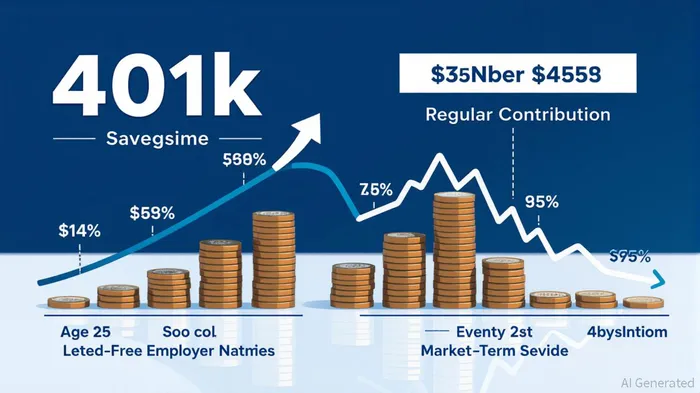
Expert Critiques: The Cost of Forgone Compounding
Financial advisors like David Tenerelli and Brenton Harrison advocate for a balanced approach. They recommend contributing enough to secure the full employer match while directing excess cash toward high-interest debt according to financial experts. This dual strategy allows individuals to benefit from compounding growth and market rebounds while reducing debt burdens. For instance, a 25-year-old with $20,000 in credit card debt at 18% interest could save $3,600 annually in interest by paying it off, but also lose out on 15% of gross income in retirement savings if they pause 401(k) contributions according to a 2025 analysis.
The 2025 market environment exacerbates these trade-offs. With average 401(k) balances declining by 3% in Q1 2025 due to trade-related volatility according to Fidelity data, pausing contributions risks missing critical rebounds. Behavioral finance research underscores this: investors who halt contributions during downturns often sell at losses, locking in underperformance according to Sequoia Capital. For younger investors, dollar-cost averaging-continuing contributions during market dips-can mitigate this risk by purchasing shares at lower prices according to Sequoia Capital.
Market Volatility and Behavioral Biases
Market volatility in 2024–2025 has heightened emotional decision-making, a key concern in behavioral finance. During sharp downturns, investors tend to overreact, selling assets at low prices to avoid further losses according to investment analysts. This "panic selling" is amplified by constant negative news cycles, which skew perceptions of long-term risks according to AARP research. Ramsey's advice to pause 401(k) contributions during such periods may inadvertently reinforce these biases, as debt repayment offers a tangible sense of progress compared to the abstract nature of market recovery.
Conversely, maintaining contributions during volatility can counteract emotional reactions. A 2025 study by Sequoia Capital highlights that investors who stayed the course during the 2008 crisis and 2000 dot-com crash outperformed those who paused by 30–40% over 15 years according to market research. For retirees or near-retirees, however, the calculus shifts: preserving liquidity and focusing on dividend-paying stocks may outweigh the benefits of compounding according to financial advisors.
The Middle Ground: Context-Dependent Strategies
The optimal approach depends on individual circumstances. For those with employer matches, contributing the minimum to secure the match while targeting high-interest debt (e.g., credit cards or payday loans) is widely recommended according to financial experts. Without matches, prioritizing debt with interest rates exceeding typical market returns (e.g., 12%+) becomes more justifiable according to financial experts.
In 2025, advisors also emphasize the role of emergency savings. Ramsey's recommendation to build a small emergency fund before pausing 401(k) contributions is critical, as 70% of advisors cite market volatility as a top stressor for clients according to financial research. A $1,000–$2,000 cushion can prevent debt relapse during income shocks, aligning with both Ramsey's and critics' goals according to personal finance analysis.
Conclusion: Balancing Discipline and Flexibility
Dave Ramsey's 401(k) pause advice reflects a disciplined, behavior-driven approach to debt elimination, but its effectiveness hinges on market conditions and individual risk profiles. While critics highlight the long-term costs of forgoing employer matches and compounding, Ramsey's emphasis on psychological stability and emergency preparedness cannot be ignored. In volatile markets, a middle-ground strategy-securing employer matches while targeting high-interest debt-offers a pragmatic path forward. Ultimately, the decision to pause 401(k) contributions must be tailored to one's financial situation, balancing the urgency of debt repayment with the irreplaceable power of compound growth.

Delivering real-time insights and analysis on emerging financial trends and market movements.
Latest Articles
Stay ahead of the market.
Get curated U.S. market news, insights and key dates delivered to your inbox.


AInvest
PRO
AInvest
PRO



Comments
No comments yet