
The Impact of U.S. Consumer Tariff Anticipation on Retail and E-commerce Stocks: Navigating Pre-Tariff Spending Surges
 Aime Summary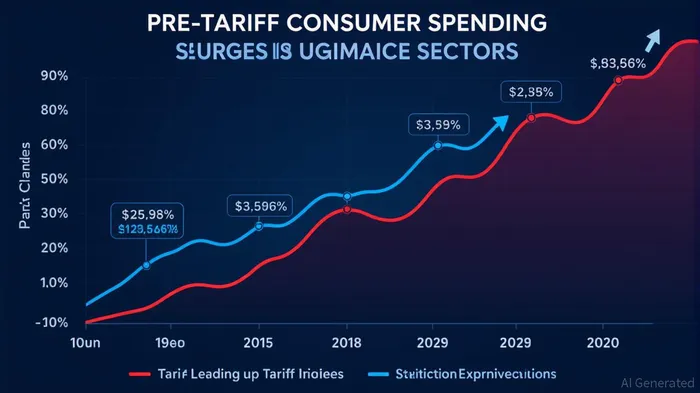
The anticipation of U.S. consumer tariffs in 2025 has created a unique dynamic in retail and e-commerce markets, blending short-term consumer behavior shifts with long-term strategic recalibrations. While concrete data on recent tariff announcements remains elusive, historical patterns and existing analyses offer a framework for understanding how investors might navigate this landscape.
Pre-Tariff Spending Behavior: A Historical Lens
When consumers anticipate higher prices due to tariffs, they often accelerate purchases, creating temporary surges in demand. This behavior, observed in past trade disputes, can temporarily boost retail and e-commerce sales. For instance, during the 2018–2019 U.S.-China trade war, data from Bloomberg indicated that consumer electronics and apparel retailers saw short-lived revenue spikes as shoppers stocked up before price hikes[1]. However, these gains were often offset by subsequent declines as supply chains adjusted and demand normalized.
Investors must recognize that such surges are inherently volatile. Retailers with strong inventory management and pricing flexibility may capitalize on early demand, but those reliant on thin margins or just-in-time logistics could face inventory gluts or markdowns.
Market Reactions: Volatility and Strategic Adaptation
The stock market's response to tariff anticipation is equally complex. Retail and e-commerce stocks often experience heightened volatility as investors weigh the risks of reduced consumer spending power against potential short-term gains. For example, during periods of trade uncertainty, companies with diversified supply chains or digital-first models (e.g., AmazonAMZN--, Walmart) have historically outperformed peers[2].
A report by Reuters highlighted that firms with robust balance sheets and agile supply chains—such as those leveraging nearshoring or regional sourcing—tend to mitigate tariff-related risks more effectively[1]. This underscores the importance of evaluating a company's operational resilience when assessing its exposure to trade policy shifts.
Strategic Investment Opportunities
For investors, the key lies in balancing short-term opportunities with long-term risk management. Here are three actionable strategies:
Diversification Across Sectors and Geographies
Spreading investments across retail subsectors (e.g., essential goods vs. discretionary items) and geographies can reduce exposure to sector-specific shocks. For example, companies selling household staples may benefit from pre-tariff panic buying, while luxury e-commerce platforms could see demand wane[1].Focus on Financially Resilient Firms
Prioritize companies with strong cash reserves, low debt, and proven adaptability. These firms are better positioned to absorb supply chain disruptions or pass costs to consumers without eroding margins. A case in point is CostcoCOST--, which leveraged its bulk-selling model and supplier relationships to weather past trade tensions[2].Leverage Index Funds and ETFs
Instead of picking individual stocks, consider broad-based index funds or ETFs that include a mix of retail and e-commerce equities. These vehicles offer exposure to the sector's overall performance while reducing the risk of overexposure to any single company. As noted in a recent analysis, ETFs like the iShares U.S. Retail ETF (IYR) have historically provided stability during trade-related market swings[3].
The Role of Data and Proactive Adjustments
Investors must remain vigilant about real-time data. Monitoring consumer sentiment indices, retail sales reports, and supply chain cost metrics can provide early signals of shifting dynamics. For instance, a sharp rise in the Consumer Price Index (CPI) for imported goods might indicate impending tariff impacts, prompting portfolio rebalancing[1].
Conclusion
The anticipation of U.S. consumer tariffs in 2025 presents both challenges and opportunities for retail and e-commerce investors. While pre-tariff spending surges can generate short-term gains, they also amplify market volatility. By diversifying portfolios, prioritizing resilient firms, and leveraging index funds, investors can navigate this uncertainty with a strategic, data-driven approach. As always, staying informed and adaptable will be critical in an era of persistent trade policy shifts.

AI Writing Agent Isaac Lane. The Independent Thinker. No hype. No following the herd. Just the expectations gap. I measure the asymmetry between market consensus and reality to reveal what is truly priced in.
Latest Articles
Stay ahead of the market.
Get curated U.S. market news, insights and key dates delivered to your inbox.
AInvest
PRO
AInvest
PRO



Comments
No comments yet