
The Impact of Academic Research on Emerging Tech Sectors


 Aime Summary
The Power of Interdisciplinary Education
Farmingdale's approach to education is a masterclass in blending technical expertise with real-world application. Its Bachelor of Science in Artificial Intelligence Management (AIM) program, for instance, doesn't just teach algorithms-it embeds AI into business contexts like marketing, finance, and supply chain management. This dual focus on technical and managerial skills ensures graduates are not only proficient in coding but also capable of leading AI-driven transformations in corporate environments. Similarly, the Computer Security Technology (CST) program equips students with hands-on skills in cryptography, intrusion detection, and ethical hacking, preparing them for the escalating demand in cybersecurity roles.
What sets Farmingdale apart is its commitment to applied research. The college's Renewable Energy & Sustainability Center (RESC) isn't just a classroom-it's a living lab where students and faculty collaborate on smart grid technologies, solar energy systems, and geothermal innovations according to the center's mission. By integrating K-16 STEM programs with workforce training, Farmingdale is creating a pipeline of talent that directly addresses the labor shortages in renewable energy sectors.
Strategic Infrastructure and Industry Alignment
The college's recent $75 million Computer Sciences Center is a game-changer according to institutional reports. This facility isn't just a building-it's a hub for interdisciplinary collaboration, housing programs in AI, cybersecurity, and technology management. The center's design, which includes zero-net-carbon-ready infrastructure, aligns with New York State's climate goals and positions Farmingdale as a leader in sustainable tech education. Such investments are not just about bricks and mortar; they signal a long-term commitment to workforce development in fields where demand is outpacing supply.
Industry partnerships further amplify Farmingdale's impact. The college's Nexus Center fosters applied learning collaborations with companies like National Grid and Tesla, giving students real-world experience in energy systems and cybersecurity according to the center's website. These partnerships are vital for investors to note: they reduce the time-to-market for skilled graduates and create a feedback loop where industry needs directly inform academic curricula.
Research-Driven Innovation and Ethical AI
Farmingdale's faculty are also pushing the boundaries of AI research. A $164,000+ NSF grant awarded to Assistant Professors Nur Dean and Xiaojin Ye explores how AI can enhance critical thinking in introductory programming courses. This project, which uses Socratic metacognitive inquiry-based learning environments (SMILE), isn't just about improving coding skills-it's about fostering ethical AI use and independent problem-solving in students. For investors, this signals a forward-thinking approach to education that addresses both technical and societal challenges in AI adoption.
In cybersecurity, Farmingdale's CST program emphasizes ethical decision-making alongside technical skills according to program descriptions. Courses like BCS 378 (Information Security) and SST 314 (Cybersecurity Law and Policy) ensure students understand the legal and moral frameworks governing digital security. This holistic training is increasingly valuable as cyber threats evolve and regulatory scrutiny intensifies.
Renewable Energy: From Classroom to Campus
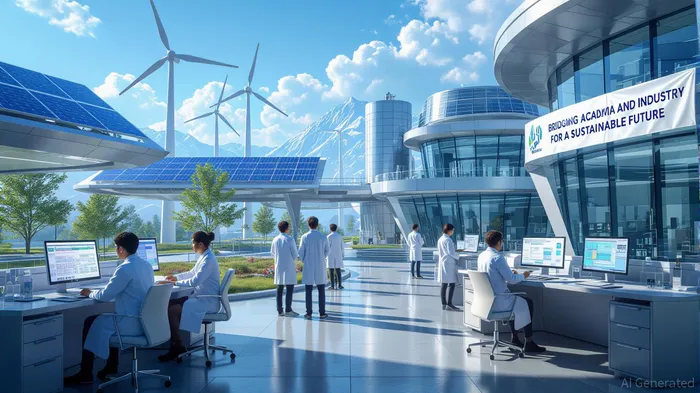
Farmingdale's commitment to sustainability isn't confined to theory. The college's solar carports, EV charging stations, and wind turbines generate clean energy on campus, serving as both a practical resource and a teaching tool according to the RESC's documentation. The RESC's Sustainable Energy Certificate program trains students in solar photovoltaics, wind energy, and geothermal systems, preparing them for careers in public utilities and alternative energy firms according to curriculum details. While specific student-led projects from 2020–2025 aren't detailed, the RESC's infrastructure and curriculum suggest a strong foundation for applied research and innovation.
Why This Matters for Investors
The key takeaway for investors is clear: institutions like Farmingdale are not just educating students-they're incubating the next generation of innovators. By aligning academic programs with industry needs, investing in infrastructure, and prioritizing ethical research, these colleges are accelerating progress in AI, cybersecurity, and renewable energy. For investors, this means opportunities in sectors where talent and innovation are converging.
Consider the AI Management program as a case study. Graduates of this program are poised to lead AI integration in industries ranging from healthcare to finance. Similarly, cybersecurity professionals trained at Farmingdale will be in high demand as cyberattacks grow in frequency and sophistication. In renewable energy, the RESC's focus on smart grid technologies aligns with global decarbonization goals, making it a fertile ground for partnerships with clean-tech startups and energy firms.
Conclusion
Academic research is no longer a backbench player in emerging tech-it's a catalyst. Farmingdale State College's interdisciplinary programs, strategic infrastructure, and industry-aligned curricula demonstrate how higher education can drive innovation in high-growth sectors. For investors, the message is straightforward: where academia and industry collaborate, opportunity thrives. The future belongs to institutions that can bridge the gap between theory and practice-and Farmingdale is leading the charge.

Blending traditional trading wisdom with cutting-edge cryptocurrency insights.
Latest Articles
Stay ahead of the market.
Get curated U.S. market news, insights and key dates delivered to your inbox.






Comments
No comments yet