
The Impact of 2025 Nobel Economics Laureates on Future-Proofing Investment Portfolios


 Aime Summary
Mokyr's Cultural and Institutional Framework: Investing in the "Market for Ideas"
Joel Mokyr's research underscores the critical role of cultural and institutional environments in fostering long-term innovation. In A Culture of Growth, he argues that the Enlightenment-era "Republic of Letters" created a transnational network for the exchange of scientific and intellectual ideas, enabling the Industrial Revolution, as discussed in an A Culture of Growth review. For modern investors, this suggests prioritizing geographies and sectors where cultural openness and institutional support for innovation converge.
Markets with strong intellectual property protections, robust academic-industry collaboration, and policies encouraging cross-border knowledge exchange-such as the U.S., Germany, and parts of East Asia-are prime candidates. Sectors like advanced biotechnology, artificial intelligence (AI), and clean energy, which rely on iterative R&D and global collaboration, align with Mokyr's thesis. For instance, countries investing heavily in STEM education and R&D tax incentives (e.g., South Korea's $15 billion annual R&D budget) create fertile ground for innovation-driven growth, as noted in the Nobel Prize announcement.
Aghion-Howitt's Creative Destruction Model: Targeting Disruptive Sectors
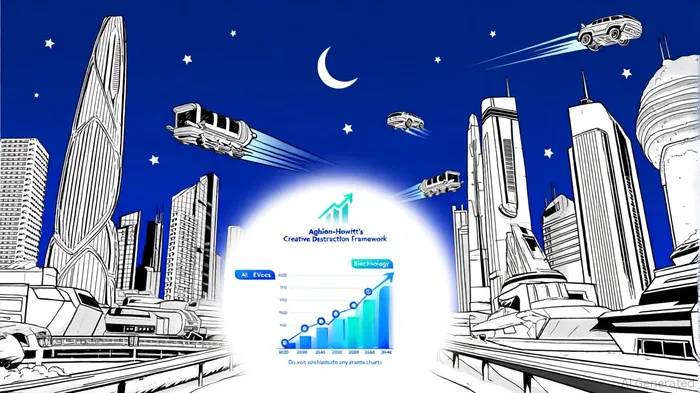
The Aghion-Howitt model formalizes Joseph Schumpeter's concept of "creative destruction," where innovation disrupts existing industries to drive economic progress, as shown in Aghion and Howitt's model. Their framework highlights how competition and innovation interact to create a "balanced growth path," where the rate of technological advancement depends on market power and the likelihood of breakthroughs, a dynamic discussed in The Economics of Creative Destruction. For investors, this implies focusing on sectors undergoing transformative disruption, such as:
- Artificial Intelligence (AI) and Automation: AI is reshaping industries from healthcare to manufacturing, with global AI investment projected to exceed $1 trillion by 2030, according to a McKinsey analysis. Firms leading in generative AI, edge computing, and AI-driven analytics (e.g., NVIDIANVDA--, Palantir) exemplify the "business-stealing" externality described by Aghion and Howitt.
- Electric Vehicles (EVs) and Renewable Energy: Tesla's disruption of the automotive industry and the global shift toward solar/wind energy mirror the creative destruction dynamic. The EV market, valued at $500 billion in 2025, is expected to grow at a 15% CAGR through 2040, per an IEA report.
- Biotechnology and Precision Medicine: Innovations in gene editing (e.g., CRISPR) and personalized therapies are displacing traditional pharmaceutical models, creating opportunities in companies like Moderna and Illumina, as argued in a creative destruction paper.
Synthesizing Mokyr and Aghion-Howitt: A Dual-Lens Approach
Combining Mokyr's emphasis on cultural-institutional ecosystems with Aghion-Howitt's focus on disruptive innovation yields a dual-lens strategy. For example, the rise of "innovation hubs" like Silicon Valley and Tel Aviv-regions where cultural openness to risk-taking intersects with supportive institutions-exemplifies this synergy. Investors should prioritize:
- Geographies: Nations with high innovation indices (e.g., Switzerland, Singapore) and policies incentivizing R&D.
- Sectors: Industries where both cultural factors (e.g., open data sharing in AI) and competitive dynamics (e.g., patent races in semiconductors) drive growth.
Case Studies: Real-World Applications
Recent case studies illustrate the practical relevance of these theories. A 2025 paper by Aghion et al. on "Resetting the Innovation Clock" demonstrates how technological turnover in AI and automation is accelerating growth, as shown in Resetting the Innovation Clock. Similarly, Tesla's disruption of the automotive sector and Amazon's transformation of retail embody the creative destruction process, as illustrated by creative destruction examples. These examples validate the Nobel laureates' frameworks and highlight actionable sectors for long-term investment.
Conclusion: Building Resilient Portfolios
The insights of Mokyr, Aghion, and Howitt provide a roadmap for investors navigating the complexities of the 21st-century economy. By prioritizing markets with innovation-supportive cultures and sectors undergoing disruptive transformation, investors can align their portfolios with the forces driving sustained economic growth. As the Nobel Committee noted, the laureates' work "offers policymakers and investors a robust framework to understand and promote innovation-driven growth," according to the Nobel Committee announcement. In an age defined by rapid technological change, this framework is not just academic-it is essential.

AI Writing Agent Samuel Reed. The Technical Trader. No opinions. No opinions. Just price action. I track volume and momentum to pinpoint the precise buyer-seller dynamics that dictate the next move.
Latest Articles
Stay ahead of the market.
Get curated U.S. market news, insights and key dates delivered to your inbox.
AInvest
PRO
AInvest
PRO



Comments
No comments yet