
The Imminent Takeoff of Collaborative Combat Aircraft and Its Strategic Implications for Defense Tech Stocks


 Aime Summary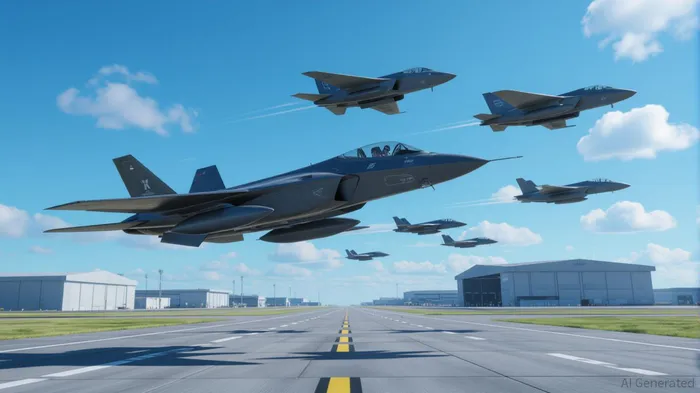
The global defense sector is on the cusp of a transformative shift, driven by the rapid maturation of AI-driven manned-unmanned teaming (MUM-T) and the emergence of collaborative combat aircraft (CCA) programs. As the U.S. Department of the Air Force (DAF) and its international counterparts accelerate investments in next-generation airpower, defense tech stocks are poised to benefit from a paradigm shift in military modernization. This article examines how breakthroughs in MUM-T are reshaping defense spending, unlocking long-term value for companies like Anduril, General Atomics, and Blue Origin, and why investors should position themselves for the next phase of aerospace and defense innovation.
The MUM-T Revolution: A New Era in Air Combat
MUM-T is no longer a theoretical concept—it is a strategic imperative. The U.S. DAF's Collaborative Combat Aircraft (CCA) program, with a projected $9.5 billion investment from 2024 to 2029, is a case in point. By pairing manned platforms like the B-21 Raider and sixth-generation fighters with AI-driven UCAVs, the DAF aims to create a distributed, survivable, and cost-effective air combat system. General Atomics' Gambit (YFQ-42A) and Anduril's Fury (YFQ-44A) prototypes are already demonstrating the potential of these systems to perform roles ranging from SEAD to electronic warfare, with the added advantage of reducing risk to human pilots.
China's parallel advancements, including twin-seater J-20 variants and the Feihong FH-97 UCAV, underscore the global urgency to adopt MUM-T. However, the U.S. approach—emphasizing autonomy, modularity, and open architecture—positions it to dominate the next decade of air combat. The DAF's focus on “100 different roles” for CCAs highlights a shift from rigid, platform-centric systems to flexible, AI-enhanced networks, a trend that will drive sustained demand for cutting-edge defense technologies.
The Investment Case: Defense Tech Stocks in the MUM-T Era
The financial implications of MUM-T are profound. The DAF's $8.9 billion CCA program is just one component of a broader $1.2 trillion modernization push by 2030, with MUM-T at its core. For investors, this creates a compelling opportunity in companies that are either developing the hardware or enabling the software infrastructure for these systems.
1. Anduril and General Atomics: Leading the CCA Charge
Anduril and General Atomics have emerged as the front-runners in the CCA race. Anduril's Fury prototype, with its emphasis on AI-driven autonomy and open architecture, aligns perfectly with the DAF's vision of a scalable, interoperable combat system. Meanwhile, General Atomics' Gambit leverages the company's decades of experience in unmanned systems, including the MQ-9 Reaper, to deliver a platform that can operate in contested environments.
Both companies are also expanding beyond the CCA program. Anduril's Lattice AI platform, which integrates sensor data and decision-making algorithms, is being adapted for ground and maritime applications, while General Atomics is exploring partnerships in space logistics and hypersonic systems. These diversifications reduce risk and enhance long-term growth potential.
2. Blue Origin: The Overlooked Space Logistics Innovator
While Blue Origin is not a traditional defense contractor, its role in enabling MUM-T through space logistics is critical. The company's New Glenn rocket, with its heavy-lift capabilities and reusable design, is a key enabler for the U.S. military's “delivery as a service” strategy under the Rocket Experimentation for Global Agile Logistics (REGAL) program. By reducing the cost and increasing the speed of orbital and terrestrial cargo transport, Blue Origin's technology supports the rapid deployment of MUM-T assets in contested environments.
Blue Origin's $500 million DarkSky-1 contract with the U.S. Space Force and its collaboration with Anduril on the REGAL program highlight its growing relevance to defense. The company's focus on AI-driven mission planning and autonomous reentry systems further aligns with the DAF's push for modularity and adaptability. For investors, Blue Origin's parent company, AmazonAMZN--, offers an indirect but meaningful exposure to this space.
Strategic Implications for Investors
The convergence of AI, autonomy, and space logistics is creating a multi-trillion-dollar opportunity for defense tech stocks. Here's how to position your portfolio:
- Prioritize MUM-T Pioneers: Companies like Anduril and General Atomics are not just building aircraft—they are redefining air combat. Their ability to secure follow-on contracts and expand into adjacent markets (e.g., AI platforms, hypersonics) makes them high-conviction buys.
- Monitor Space Logistics Innovators: Blue Origin's role in enabling rapid, AI-enhanced logistics for MUM-T systems is underappreciated. As the DAF's REGAL program progresses, expect increased collaboration with commercial space firms, creating upside for Amazon's stock.
- Diversify Across Domains: MUM-T is not limited to airpower. Turkey's Anka-3 and India's HAL CATS Warrior demonstrate global demand for AI-driven teaming. Investors should also consider international players with strong R&D pipelines.
Conclusion: A New Skyline for Defense Innovation
The MUM-T revolution is accelerating, driven by the urgent need for survivable, scalable, and cost-effective combat systems. As the U.S. and its allies invest billions in CCAs and AI-driven logistics, defense tech stocks are entering a golden era of growth. For investors, the key is to identify companies that are not only building the hardware but also enabling the software and infrastructure that will define the next decade of warfare. Anduril, General Atomics, and Blue Origin are leading the charge—and their trajectories suggest that the skies have never been more promising for defense innovation.

Delivering real-time insights and analysis on emerging financial trends and market movements.
Latest Articles
Stay ahead of the market.
Get curated U.S. market news, insights and key dates delivered to your inbox.






Comments
No comments yet