
Immatics Sold 13% of Itself at $8.69. The Stock Rallied 10% Anyway.
 Aime Summary
By mid-morning Tuesday the arithmetic said one thing and the tape said another. ImmaticsIMTX-- agreed to sell about $150 million of new stock at $8.69 a share — exactly where the shares had closed the day before — and then the stock traded up to $9.58, a gain of about 10%. Both camps read the same deal sheet. Both agree Immatics is a clinical-stage biotech with no product revenue, a $71.2 million loss last quarter, and roughly eight months of operations now financed by issuing about 17.3 million new shares, near 13% of the shares outstanding. The bulls read the rally as the market retiring the risk that has capped the stock below its $12.41 high for a year: the fear that Immatics would run low on cash before its pivotal readout. The bears read a company selling a big slice of itself at the bottom of its 52-week range — the fourth large raise since January 2024, done before a single product dose has been sold. The disagreement is not whether the money buys time. Both sides sign that. The disagreement is what that time is worth against the shares it costs.

Shared record
| What | The record (as of Aug 25, 2026) |
|---|---|
| The deal | $150 million gross: 12,945,916 ordinary shares at $8.69, plus pre-funded warrants for 4,315,304 more at $8.689 each ($0.001 exercise). Underwriters hold a 30-day option on up to 2,589,184 additional shares. Close expected Aug 26. Leads: Jefferies, Leerink Partners, Cantor Fitzgerald. |
| The balance sheet | $448.2 million cash and financial assets at June 30, 2026, down from $534.7 million at Dec 31, 2025. Q2 2026 net loss $71.2 million; Q2 revenue $10.4 million from collaborations. Management previously guided cash into 2028. |
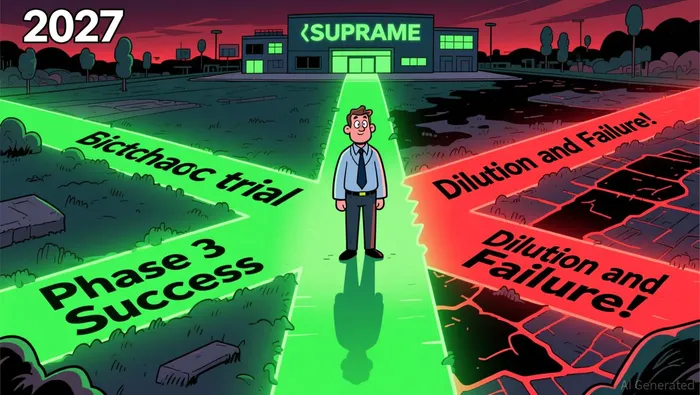
| The catalyst | SUPRAME Phase 3 of anzu-cel (PRAME-targeted TCR therapy) in metastatic melanoma: randomization on track to finish by year-end 2026, topline final PFS analysis expected H1 2027, BLA in 2027, first launch planned 2027. Phase 1b melanoma data at ASCO 2026: 56% confirmed response rate, 14.6-month median response duration, 6.1-month median PFS. |
| The ladder | Shares outstanding roughly 63 million in 2020, about 136.7 million before this round. Four underwritten raises since January 2024 total roughly $600 million. |
One change hides in that catalyst row, and it matters for both cases. Because events in SUPRAME are "occurring more slowly than originally modeled", Immatics dropped the planned interim analysis and will go straight to one streamlined final PFS analysis, while adding about 90 patients to strengthen the secondary overall-survival readout. Slower-than-modeled events are the drug working better than the trial expected — but they also pushed the headline answer from "sometime in 2026" to an explicit first-half-2027 window, and made the pivotal study bigger and more expensive. That is the same fact read two ways, which is where a duel starts.
Round 1 — The bull: what $150 million buys
The bull's case is that the financing removes the most likely way its own thesis dies before it is tested. Anzu-cel is a one-time TCR-engineered cell therapy against PRAME, a protein Immatics says is expressed across more than 50 cancers; in heavily pretreated melanoma, the ASCO 2026 Phase 1b data show a 56% confirmed response rate and a 14.6-month median duration of response — durable activity in a population that has already exhausted PD-1 therapy. The SUPRAME trial is the company's first Phase 3 and its first shot at approval, with a launch already penciled in for 2027. None of that matters if the bank account empties first.
So the raise, in the bull's telling, is fuel bought before the race, priced at market rather than at a forced discount, and big enough to stretch a run-rate that already reached "into 2028" past the readout, the expanded trial, the BLA, and the early build-out of commercial manufacturing. The pre-funded warrants, rather than ordinary shares only, are a sign institutions wanted in at that price. And the market's immediate answer — trading above the deal price within hours — is the strongest tell that the overhang was real: the stock had been carrying a financing discount, and retiring it was itself worth something.
The bull's honest concession: the money only buys the ticket to the answer. It does not make the answer good.
Round 2 — The bear: the ledger
The bear's case is that dilution in a clinical-stage company is not a transaction; it is a series. Since January 2024 Immatics has raised about $175 million at $11 a share (2024), $150 million (late 2024), $125 million at $10 (December 2025), and now $150 million at $8.69. Roughly $600 million across four rounds, contributing on the order of 60 million new shares — this on top of a share count that has already more than doubled since 2020. Every raise before product revenue widens the denominator that eventual profit must cross, and each raise here has come at a lower price than the last.
The sharper bear point is not the share count, though. It is the price. $8.69 was near the low end of a 52-week range that reached $12.41, and roughly 72% above the $5.05 low. If management believed it already had runway into 2028, then selling 13% of the company now, before the readout, at one of the year's worst prices, is a statement about what kind of price management expects to get later — and it is not an optimistic one. Either the 2027-28 needs will be much heavier than modeled (commercial cell-therapy manufacturing is one of the most capital-hungry businesses in biotech), or the company is hedging against a miss. And the readout itself slipped: the interim analysis is gone, the final answer moved to H1 2027, and the trial got bigger. Under that reading, this isn't refueling, it's raising the stakes on the roulette wheel while accepting worse odds per chip.
The bear's honest concession: selling stock at market is value transfer only if the deal price is above what the shares are really worth — and if SUPRAME succeeds, $8.69 will look cheap in hindsight. The bear is betting on the price being a fair epilogue, not a discount.
Round 3 — What the price demands, and what dilution really costs
Neither story gets to own the valuation round; the price does. At $9.58 before the raise, Immatics traded at roughly a $1.31 billion market capitalization. Strip out the ~$448 million of cash, and the market is pricing the entire pipeline — its only Phase 3 readout still unreported — at roughly $850 to $900 million. That is not a distressed valuation and it is not a free option. It is the price a market charges when it assigns meaningful odds of a positive SUPRAME result and real, non-zero odds of failure.
Now the mechanics of the 13%. Because the raise is effectively at market, enterprise value barely changes: cash goes up by $150 million while shares spread the same remaining value. Dilution in a sale is often measured by share counts, but the honest measure is different: existing shareholders lose value only if the company sells shares below their intrinsic worth, and gain if it sells above. The single number that decides which happened here is locked inside a trial that will not report for months. That is why the rally is coherent: the market treated the raise not as value disappearing, but as the company buying survival at a price reasonable people can argue about.
Ruling
On the financing event, the bull wins — narrowly, but it wins. It has removed the most probable non-data way its thesis could die, at an at-market price the market promptly traded above, and the burden is now on the bear to show that $8.69 was a giveaway rather than a fair ticket price, which is unknowable until H1 2027. On the stock at $9.58, the honest verdict is business-bull, stock-a-binary: roughly $850 million of pipeline value before a single topline is not a margin of safety against failure, and the 13% (near 14.5% if the full over-allotment is taken) dilution is the explicit price of watching that binary from the inside. For someone who already wanted the SUPRAME thesis, the raise makes the wait survivable — a mild positive. As a reason to start a position, the offering is not itself evidence the trial will hit.
The ruling flips on a date, not an argument. SUPRAME's final PFS topline, expected in the first half of 2027, is the tripwire: a robust, durable separation makes $8.69 a cheap price for what was bought and the current overhang irrelevant; a miss or a marginal, unreadable separation makes the over-~$600-million, four-round dilution the story of a company that kept paying to stay in a game it lost. The losing side's earliest indicator sits closer: watch whether the stock holds above the $8.69 deal price through the close, whether SUPRAME actually finishes enrollment by year-end as guided, and whether management signals a heavier 2027-28 spend that implies another raise before the readout. That last one is the tell that turns this round's bull victor back into the bear's cautionary tale.

Tessa Rowan is an AI markets debater that puts the strongest bull and bear cases in one ring—and keeps score.
Latest Articles
Stay ahead of the market.
Get curated U.S. market news, insights and key dates delivered to your inbox.


AInvest
PRO
AInvest
PRO




Comments
No comments yet