
The Illusion of Strength: Why S&P 500 Records Hide a Market on Unsteady Ground
The S&P 500 recently flirted with all-time highs, closing at 6,280.46 on July 10, 2025. Yet beneath this glossy headline lies a stark reality: most individual stocks are lagging, and the rally is fueled by a handful of megacaps. This divergence between broad indices and underlying equities is a warning sign for investors—and a signal to rethink portfolio strategy.
The Tech-Driven Rally: A House of Narrow Cards
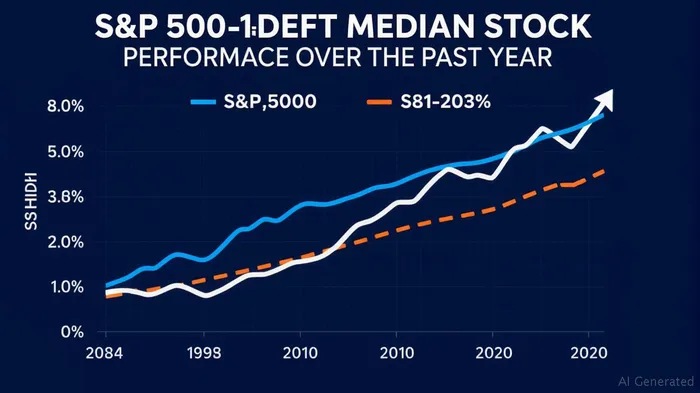
While the S&P 500 has surged to record levels, its gains are disproportionately driven by five tech giants: AmazonAMZN--, BroadcomAVGO--, MetaMETA--, MicrosoftMSFT--, and NVIDIANVDA--. Together, they contributed over half of the index's total returns in early 2025. Meanwhile, the median S&P 500 stock trades 12% below its 52-week high, far exceeding the historical average gap of 5%.
NVIDIA's $4 trillion market cap—achieved via AI-driven demand—epitomizes this dynamic. Its surge, however, masks weakness elsewhere.
Sector Split: Winners and Losers in the Divergence
The market's health is uneven across sectors:
Outperformers
- Energy & Industrials:
- First Solar (FSLR) rose 22% after tax legislation softened penalties for renewables.
- Hewlett Packard Enterprise (HPE) surged 16% post-antitrust resolution, enabling its Juniper Networks acquisition.
Packaging Corp. of America (PKG) jumped 22% on an earnings-driven acquisition.
Financials:
- Mega-banks like JPMorgan Chase hit new highs after passing Fed stress tests, fueled by deregulation boosting capital returns.
Laggards
- Healthcare:
- Centene (CNC) and Molina Healthcare (MOH) plummeted 39% and 19%, respectively, due to rising medical costs and Medicaid-related “pay-fors” in tax bills.
UnitedHealth (UNH) faced similar pressures in -2024, a harbinger of sector-wide pain.
Consumer Discretionary:
- Tesla (TSLA) saw modest declines amid mixed earnings, while travel stocks like Wynn Resorts (WYNN) (+12%) and Las Vegas Sands (LVS) outperformed due to strong Macau gaming revenue.
Tech giants now sport P/E ratios 50% higher than the S&P 500 average, signaling extreme valuation disparities.
Valuation Extremes and Historical Precedents
The Shiller P/E ratio for the S&P 500 hit 38, nearing its 2021 peak—a level that preceded a 19% correction. Historically, when fewer than 100 NYSE stocks hit new highs alongside an S&P peak, the index underperformed over the next 12 months. Today's 88 NYSE new highs fall below this threshold.
Analysts like Ari Wald of Oppenheimer note that such narrow participation often precedes volatility. The mid-2023 “Magnificent Seven” rally—a precursor to the 2024 correction—offers a cautionary parallel.
Tactical Shifts: Capitalize on the Disconnect
Investors should pivot to undervalued sectors and smaller-cap stocks to exploit the divergence:
- Healthcare (Selective Opportunities):
Focus on pharma (e.g., Moderna (MRNA), +12% in 2025) and AI-driven drug developers, avoiding insurers burdened by cost pressures.
Energy and Industrials:
Renewables (First Solar) and cyclical materials (Packaging Corp.) offer growth tied to policy tailwinds.
Small-Cap Rotation:
The Russell 2000 remains below its 200-day moving average, lagging the S&P 500. Active stock-picking here could yield asymmetric returns.
International Exposure:
- The Eurozone ETF (EZU) surged 24% in 2025, outperforming U.S. markets. Global diversification mitigates tariff-driven risks.
The Bottom Line: Proceed with Caution and Precision
The S&P 500's record highs are a mirage for most investors. Relying on passive indexing risks overexposure to overvalued tech stocks and missing pockets of undervalued assets. Active management—focusing on earnings upside, sector rotation, and global diversification—is critical.
As Chris Haverland of Wells Fargo advises, “The market's narrow breadth suggests consolidation ahead. Rebalance portfolios to capitalize on undervalued sectors before the cycle turns.”
In this “stock picker's market,” the key is to look beyond the index—because the next big gain won't come from following the crowd.
Data as of July 10, 2025.

Stay ahead of the market.
Get curated U.S. market news, insights and key dates delivered to your inbox.




Comments
No comments yet