
The Illusion of AI-Driven Economic Resilience in a 60% Recession-Prone U.S. Economy
 Aime Summary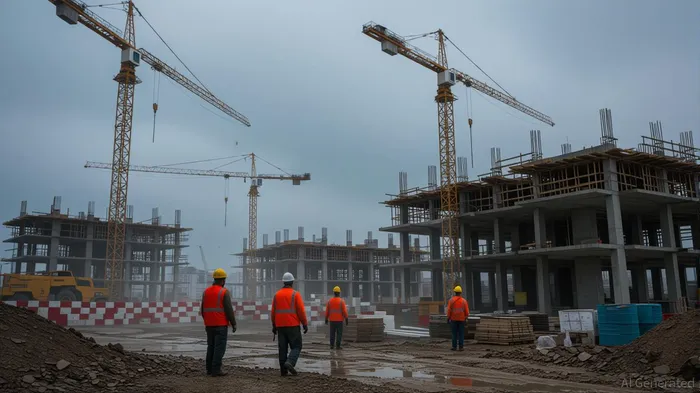
The U.S. economy, teetering on the edge of a 60% probability of recession by 2025, has become a battleground for competing narratives about resilience. On one side, the AI-driven economy is hailed as a savior—a force that automates, optimizes, and transcends traditional cycles. On the other, the industrial and construction sectors, long dismissed as relics of the 20th century, quietly outperform during downturns. The truth, as always, lies in the data.
The AI Mirage: Growth, Not Resilience
Artificial intelligence has undeniably reshaped industries, but its role during recessions is often overstated. Historical employment data from the 2008–2009 and 2020–2021 recessions reveals a critical nuance: AI-driven sectors did not protect jobs, but rather accelerated structural shifts. For example, during the 2008 crisis, AI adoption in software and finance sectors automated repetitive tasks, displacing roles in customer service and data entry. Yet, the broader labor market slump was driven by aggregate demand collapse, not AI. By 2020, the U.S. employment-population ratio for prime-age workers had hit a 20-year high, contradicting the narrative of AI-induced mass unemployment.
The 2020 pandemic further exposed AI's limitations. While tech stocks surged, AI-driven firms like NVIDIANVDA-- and Alphabet saw valuations soar on speculative bets, not proven resilience. The sector's growth was fueled by liquidity, not cyclical immunity. Meanwhile, AI's role in construction—such as optimizing supply chains or 3D printing—remains nascent, contributing less than 1% to the sector's output.
The Industrial and Construction Paradox: Suffering, Then Surpassing
Contrast this with the industrial and construction sectors, which have historically rebounded after recessions, often outperforming the S&P 500. During the Great Recession, manufacturing employment fell by 21.2% but recovered fully by 2017. The construction sector, though harder hit (27% job loss in 2009), rebounded by 2019, driven by pent-up demand for housing and infrastructure. The 2020 pandemic, a unique shock, saw construction employment drop by 2.2 million jobs but recover within a year—faster than the S&P 500's 18-month rebound.
Why? These sectors are structural, not cyclical. They are tied to long-term trends: urbanization, energy transition, and the need for physical infrastructure. For instance, renewable energy construction (solar, wind) is projected to grow by 275% by 2033, while EV charging infrastructure will require $120 billion in investment. These are not short-term bets—they are foundational to the economy's future.
The Contrarian Play: Positioning for the Inevitable
The 60% recession probability isn't a prediction—it's a probability. Investors must prepare for a scenario where AI-driven growth falters, and industrial/construction sectors lead the recovery.
- Industrial Giants with Infrastructure Exposure: Companies like CaterpillarCAT-- (CAT) and 3MMMM-- (MMM) are not just cyclical plays. Their exposure to infrastructure spending (e.g., Caterpillar's mining equipment, 3M's materials for EVs) positions them to benefit from both short-term stimulus and long-term trends.
- Construction Firms with ESG Alignment: LennarLEN-- (LEN) and McCarthy Building Companies (MBC) are capitalizing on green construction and retrofitting. With 53% of retail construction now focused on renovations, these firms are less exposed to new-project volatility.
- Materials and Logistics: Procter & Gamble (PG) and Union PacificUNP-- (UNP) are critical to supply chains that underpin industrial activity. Their stable cash flows and pricing power make them recession-resistant.
The Bottom Line: Resilience Over Hype
AI will continue to disrupt, but its economic resilience is a myth. The real winners in a 60% recession-prone economy are the sectors that build the world—literally. Industrial and construction firms, often overlooked in favor of shiny tech darlings, have a proven track record of surviving and thriving in downturns. For contrarian investors, the message is clear: dig beneath the hype and bet on the bedrock of the economy.
In the end, the next recession will not be a test of algorithms—it will be a test of grit. And grit, as history shows, is where the real money is made.

Stay ahead of the market.
Get curated U.S. market news, insights and key dates delivered to your inbox.
AInvest
PRO
AInvest
PRO



Comments
No comments yet